
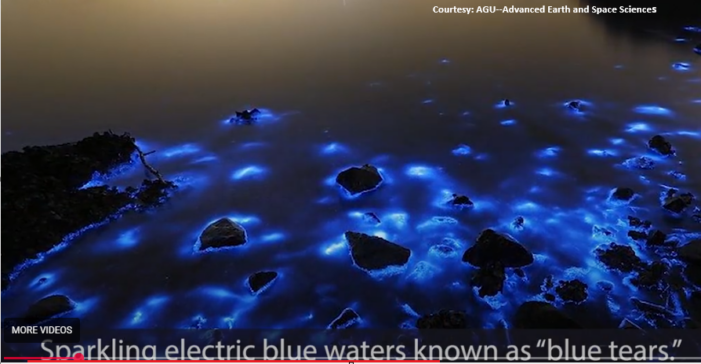
Blue tears is a stunning, natural bioluminescent phenomenon where coastal waters glow with an ethereal blue light, primarily caused by massive blooms of microscopic marine plankton, such as Noctiluca scintillans or ostracod crustaceans, disturbed by wave motion. Often seen in China, Taiwan, and the Maldives, this glowing,, sometimes toxic, “sea of stars” usually occurs in warmer months.
The chasing of blue tears has emerged as a common tourism activity in the recent years along the coastlines in order to experience the natural spectacular. Nonetheless, algal blooms occurrences and movements are unpredictable, and this affects the quality of tourist experiences as well as introducing safety risks and ecological pressures.
A group of researchers headed by the professor of the Shenzhen Institutes of Advanced Technology of the Chinese Academy of Sciences, Li Jianping, and the partners of the Ministry of Natural Resources came up with a novel algorithm to monitor videos in real-time called BT-YOLO in one of the studies published in the Ecological Informatics.
Bt-YOLO algorithm makes it possible to pixel-by-pixel segment the glowing parts of video footage and localize and analyze bloom strength and distribution in a quantitative manner. In contrast to the traditional approach of revealing the existence of the so-called blue tears, the given algorithm offers the scientific rationale to rate the blooms harshness and advance to the creation of a predicting algorithm.
(Courtesy: AGU–Advanced Earth and Space Sciences)
We have made scales and rulers to measure blue tears. It is after the implementation of the coastal surveillance camera network that this algorithm will enable us to carry out quick quantification and get closer to an operational forecasting system, as explained by Prof. LI. The algorithm can also be used to track other features in the seas like the red tide and marine debris, and there is a solution to smart coastal management.
The research forms a basis upon which the time, place, magnitude, and severity of the occurrence of blue tears can be predicted. The forecasting system will be further refined through the data of the coastal camera networks that will bring the system nearer to the real world which will allow balancing the ecological protection with the sustainable tourism.
Also Read:
End of the World champion Meade surfaces again, says April 23 the Doomsday
‘Aliens Real But Not in Form We Imagine’: Reiterates Alien Hunter Bill Diamond of SETI

Whar are “blue tears”? New AI algorithm allows scientific monitoring of this unique phenomenon added by Srinivas Chakravarty on
View all posts by Srinivas Chakravarty →