
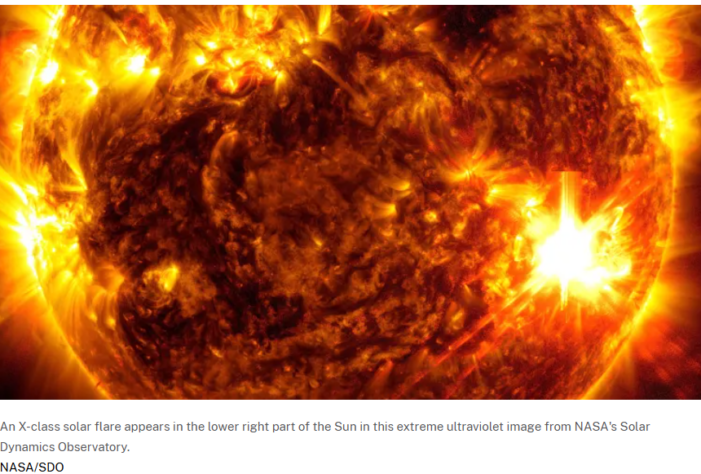
On January 1, 2024, something weird occurred. The most powerful solar flare ever recorded hit the Earth and just less than 24 hours after, the Noto Peninsula in Japan suffered a devastating earthquake, claiming the lives of more than 700 and destroying almost 205,000 homes. Scientists referred to it as a coincidence. But a startling new model has been proposed by scientists in Kyoto University indicating that solar flares, which are giant bursts of charged particles of the sun, could be able to trigger earthquakes on earth.
The paper introduces a theoretical process in which the changes in ionospheric charge due to intense solar activity like a solar flare may cause collision with already existing weak structures within the crust of the earth and therefore play a role in the fracture process.
In simple words: the Sun throws a burst of energy towards the earth, it destabilizes the upper atmosphere, and that instability can, in the right circumstances, cause an already stressed fault to slip over the edge into a disastrous failure.
The senior author of the study, Ken Umeno of Kyoto University was careful in his framing: “We are not saying that solar flares produce tectonic stress. We are talking of timing, not energy. With a fault that is already near failure, a minor perturbation can change upon rupture.”
Earth Is a Giant Leaky Battery, and Sun Has the Switch
The process suggested by the Kyoto team is as beautiful as it is terrifying. The researchers developed a model that considered the crust of the earth and the ionosphere; a charged layer 250 miles above the earth as two poles of a battery. Upon entering the Earth when the electrically charged particles of a solar flare collide, the particles move the electrons downwards in the ionosphere resulting in an accumulation of electrons at lower altitudes forming a negative charge layer. The charge, in its turn, adds electrostatic force acting in the crust of the earth, namely, in the microscopic openings filled with water in the fracture areas of the rocks.
The resulting electrostatic pressure within those voids can rise to a number of megapascals – magnitudes that are equal to and in certain cases surpass the levels of pressure known to affect brittle failure in rock.
‘Hiding data’ pitch surfaces again
As can be expected, the research has sparked a firestorm on X, the Reddit, and Telegram earthquake-watching groups. The fact that the anomalies in the ionosphere can be repeatedly observed before significant earthquakes, and that this anomaly was noticed during the 2011 disaster in Tohoku, the 2016 earthquake in Kumamoto, and the 2024 Noto Peninsula earthquake, is being pointed out by conspiracy theorists who believe that governments and space agencies have long known about this phenomenon but suppressed it so as to prevent panic around the world.
There is another one that an earthquake of December 2025 that Umeno mentioned which came after an X-class solar flare by hours. Seismology chat rooms are already recording all the big solar events with a view to cross-checking them with future quakes, they are known as solar seismic watchers.
Not Everyone Is Convinced
The establishment is scratching its way back. According to a geophysicist, Nicholas Schmerr of the University of Maryland, the study was highly speculative and the paper lacks an in-depth analysis or well-founded evidence that the activity under discussion does in fact connect solar flares and earthquakes. The research itself admits that it is not intended to forecast earthquakes, just to trace a physical way that may potentially be used in further research. A causal relationship may not be established until several years of statistical work through the records of seismic activities across the world are undertaken.
This is where it becomes very disturbing. It was observed by scientists that the visible disk of the Sun has never been fully devoid of sunspots before June 2022, which marks the second indication that the ongoing solar cycle might be approaching a quieter period. But solar cycles do not decline evenly they tend to result in strong, bursting out bursts of activity during the wind-down. And in case even the Kyoto model is partially true, the question is: what stressed fault zone of the world is currently sitting at its breaking point, and which is the solar storm that will be the one to get it to break?
The scientists indicate that the future work will involve a combination of the high-resolution atmospheric monitoring and underground sensors. Until now, the next time a solar flare warning lights up, it will seem to you as though you are staring at the ground under your feet.

The Sun is Just a Secret Earthquake Machine with switch: Reveals Japan Study added by Sridhar P on
View all posts by Sridhar P →