
Syria transition gains ground with Kurdish deal, but violence and humanitarian strain persist

A new agreement between the Syrian government and Kurdish-led forces in the country’s northeast is being viewed by the United Nations as a potentially significant step toward stabilising a region long shaped by conflict and competing authorities.

Briefing members of the UN Security Council for the first time in his role as Deputy Special Envoy for Syria, Claudio Cordone highlighted the ceasefire and integration agreement signed on January 30 between Damascus and the Syrian Democratic Forces (SDF). The arrangement, he said, could mark an important turning point if implemented effectively.

Agreement Aims To Integrate Northeast Syria

The deal outlines a gradual process to integrate the military and administrative structures of northeast Syria with the Syrian state. It also contains provisions aimed at facilitating the return of displaced residents and safeguarding Kurdish cultural and educational rights.

Officials say the framework builds upon earlier government measures, including Presidential Decree 13, which recognised certain linguistic, cultural and citizenship rights for Kurdish communities.

Cordone told the Council that hostilities in the region had largely subsided and that work on implementing the agreement had begun.

Security deployments by Syria’s Ministry of Interior have already taken place in key cities such as Al-Hasakeh and Qamishli, while talks are underway regarding local governance arrangements and political appointments.

The United Nations Secretary-General welcomed the agreement soon after it was announced, urging all sides to move quickly to ensure its full implementation. He emphasised that the deal should guarantee the peaceful integration of the northeast, protect Kurdish rights and enable displaced Syrians to return home voluntarily and safely.

Security Council members echoed that message in a presidential statement this week, describing the deal as a comprehensive step that could help prevent further civilian suffering and reduce risks surrounding detention facilities holding suspected fighters from the Islamic State group, also known as ISIL or Da’esh.

UN Continues Political And Humanitarian Engagement

Alongside political mediation, the United Nations remains heavily involved in humanitarian operations across Syria.

The office of the UN Special Envoy continues to engage with the Syrian government and other political actors in an effort to advance the broader political transition. These discussions include implementing the northeast agreement, encouraging inclusive governance and promoting respect for human rights.

At the same time, UN agencies and partner organisations are delivering food, water, healthcare and shelter to millions of Syrians affected by years of war. Aid teams are also supporting mine clearance operations, restoring damaged infrastructure and helping communities rebuild basic services.

These efforts aim to create conditions that would allow displaced families to return home in safety and dignity.

Security Concerns Persist In Several Regions

Despite the relative calm in parts of the northeast, the situation across Syria remains fragile.

Cordone said the United Nations is closely monitoring the transfer of suspected Islamic State fighters from Syria to Iraq. He stressed that legal proceedings must meet international fair-trial standards and urged countries to repatriate their citizens detained in Syria as quickly as possible.

Elsewhere in the country, tensions continue to flare. In the southern province of Sweida, clashes between government forces and local armed groups have caused damage to infrastructure and triggered electricity outages. Protests calling for greater local autonomy have also resurfaced.

In southern border areas, Israeli military operations and search activities have continued. Reports have also emerged of aerial herbicide spraying damaging farmland. UN officials have called for adherence to international law and urged Israel to withdraw from territories it occupies in violation of the 1974 Disengagement of Forces Agreement.

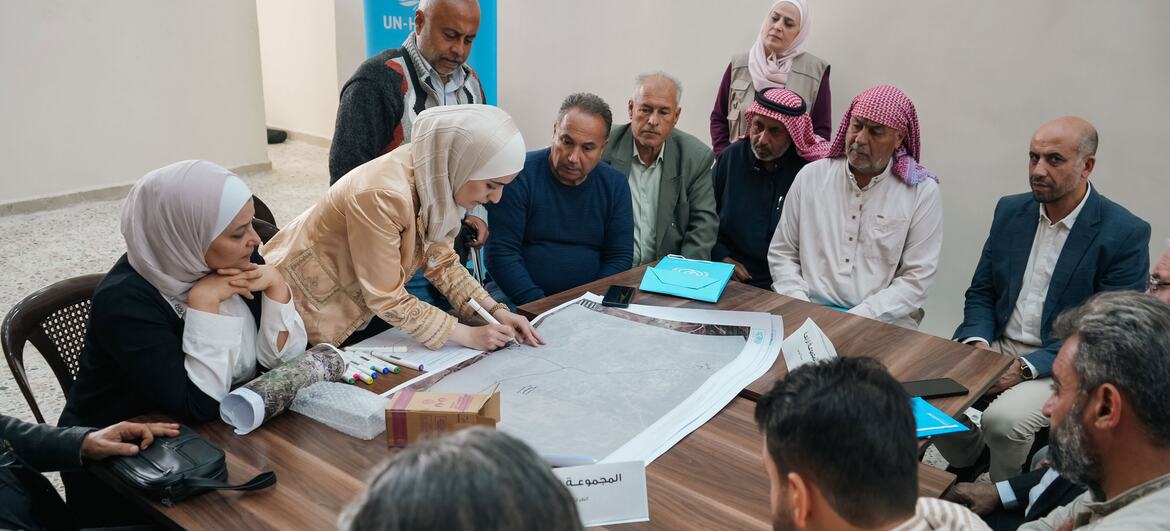
A group of people, including men and women wearing traditional attire and headscarves, are gathered around a table in a workshop setting, reviewing and discussing large architectural plans. A UN-Habitat banner is visible in the background. The workshop is part of a participatory effort to set recovery priorities for housing in Syria, funded by multiple UN agencies.Participants at a UN workshop on recovery priorities, challenges and response planning /UN

Displacement And Humanitarian Needs Remain High

Humanitarian conditions remain difficult for many Syrians despite some limited improvements.

According to the UN humanitarian coordination office, recent clashes in the northeast displaced tens of thousands of people. Although many have since returned, around 130,000 individuals remain displaced across the governorates of Al-Hasakeh, Ar-Raqqa and Aleppo.

More than 90 percent of those affected are women and girls, many of whom are living in overcrowded camps or staying with host families already facing economic hardship.

Heavy flooding this week in Idlib and northern Latakia further compounded the crisis, killing two children and destroying or damaging around 2,000 tents sheltering displaced families.

Still, aid groups say access to some areas is gradually improving. UN teams have reached around 200,000 people in recent weeks, delivering assistance through more than 170 aid convoys.

Electricity supply has also reportedly resumed in the town of Ain al-Arab, also known as Kobane, following repairs to damaged infrastructure.

Political Transition Moves Forward

Attention is now turning to the next stage in Syria’s political transition: the formation of a new People’s Assembly.

Elections for most seats were held in October 2025, though additional seats, including those representing Raqqa, remain to be filled. Confirmation is still awaited regarding the appointment of 70 members by President Ahmed al-Sharaa and the date of the assembly’s opening session.

Cordone stressed that the success of the transition would depend on meaningful representation from Syria’s diverse communities and regions.

He also underscored the need to address long-standing issues such as the fate of missing persons and mechanisms for transitional justice.

Highlighting the contributions of Syrian women throughout years of conflict, the UN envoy said their participation in politics and civil society would be essential for building a more inclusive and stable future.

He concluded his remarks by praising the resilience of the Syrian people and expressing hope that continued cooperation between Syria and the United Nations would help lay the foundations for lasting peace and recovery.

Leave a Reply

Your email address will not be published.

This site uses Akismet to reduce spam. Learn how your comment data is processed.