
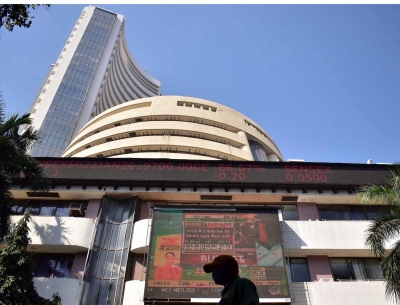
Indian equity markets staged a powerful rally on Tuesday morning, surging nearly 3 per cent in early trade, as investors reacted enthusiastically to the announcement of the India–US trade deal that promises immediate tariff relief for Indian exports.
By 9.25 a.m., the Sensex had jumped 2,421 points, or 2.97 per cent, to 84,088, while the Nifty climbed 741 points, or 2.96 per cent, to 25,829, marking one of the strongest single-session opening rallies in recent months.
The sharp upmove followed confirmation that India and the United States have agreed to a trade arrangement under which reciprocal tariffs on Indian goods will be cut to 18 per cent from 25 per cent. In addition, the extra 25 per cent duty imposed on India over its purchases of Russian crude oil will be scrapped. U.S. President Donald Trump said the agreement would be “effective immediately” after a phone call with Prime Minister Narendra Modi late on Monday, delivering instant relief to exporters and markets.
The rally was broad-based, extending well beyond frontline stocks. The Nifty Midcap 100 index surged 3.10 per cent, while the Nifty Smallcap 100 rose 3.25 per cent, signalling renewed risk appetite across market segments that had remained under pressure amid trade uncertainty.
All sectoral indices traded firmly in the green, led by realty, auto, consumer durables and information technology. The realty index jumped 4.47 per cent, auto rose 3.78 per cent, consumer durables gained 3.69 per cent, and IT stocks advanced 3.04 per cent, reflecting expectations of stronger demand, improved export competitiveness and higher earnings visibility.
At 18 per cent, India’s new U.S. tariff rate now undercuts that of several key export-oriented Asian economies. Bangladesh, Sri Lanka, Taiwan and Vietnam face tariffs of 20 per cent, while Indonesia, Malaysia, Thailand, the Philippines and Pakistan are subject to tariffs of 19 per cent. Market participants said this relative advantage could help Indian exporters gain market share in labour-intensive and manufacturing segments.
Technically, analysts said immediate support for the Nifty lies in the 25,600–25,800 zone, while resistance is seen at 26,200–26,350. A sustained move above these levels could open the door to further upside, they added.
“The dramatic announcement of the long-awaited US–India trade deal and the US decision to cut tariffs on India from 50 per cent to 18 per cent is a game changer for the Indian economy and stock markets as its delay was the single important factor weighing on the markets,” an analyst said, underscoring how prolonged uncertainty had capped valuations.
Market watchers said the deal could lift India’s growth trajectory, with GDP growth seen rising to around 7.5 per cent in FY27, supported by stronger exports to the U.S. Corporate earnings, which are already showing signs of revival, could accelerate to 16–18 per cent growth in FY27, aided by improved demand conditions and operating leverage.
Rupee Rebounds
Analysts also expect the rupee to rebound sharply in the near term. They said the combined impact of the US–India trade deal, the recently concluded EU–India trade agreement, and the growth-focused Union Budget has materially improved India’s macro outlook. The positive sentiment could trigger renewed foreign capital inflows, potentially strengthening India’s Balance of Payments position.
Large-cap stocks in banking, non-banking financials, telecom, capital goods and IT — sectors traditionally favoured by foreign institutional investors — are expected to attract significant inflows if risk-on sentiment sustains, market participants said.
Global cues were largely supportive. In Asia, China’s Shanghai Composite rose 0.38 per cent and Shenzhen gained 0.93 per cent. Japan’s Nikkei jumped 3.23 per cent, South Korea’s Kospi surged 5.04 per cent, while Hong Kong’s Hang Seng edged up 0.11 per cent.
U.S. markets had ended the previous session mostly higher, with the Nasdaq gaining 0.56 per cent, the S&P 500 advancing 0.54 per cent, and the Dow Jones Industrial Average adding 1.05 per cent.
Despite the sharp rally, data showed that foreign institutional investors remained net sellers on February 2, offloading equities worth ₹1,832 crore. Domestic institutional investors, however, continued to provide strong support, with net purchases of ₹2,446 crore, cushioning the market ahead of the trade deal announcement.
The scale and breadth of Tuesday’s rally suggest that investors are now repositioning for a post-tariff-reset environment, with expectations of stronger growth, improved earnings visibility and renewed foreign interest shaping near-term market sentiment.
cheer, market, Nifty, sensex, sentiment, Stocks, US-India trade deal

Sensex Soars Over 2,400 Points as Markets Cheer India–US Trade Deal added by Sridhar P on
View all posts by Sridhar P →