
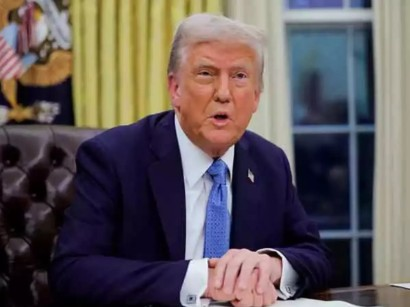
The US military is preparing contingency plans for the possibility of sustained, weeks-long operations against Iran if President Donald Trump authorises military action, according to two US officials cited by Reuters in its report. Such preparations point to a scenario that would go far beyond the limited, one-off strikes seen previously between the two countries.
The officials, who spoke on condition of anonymity due to the sensitivity of the planning, said the scope of military options under consideration underscores the high stakes surrounding ongoing diplomatic efforts between Washington and Tehran.
US envoys Steve Witkoff and Jared Kushner are scheduled to hold talks with Iranian representatives in Geneva on Tuesday, with Oman acting as a mediator. US Secretary of State Marco Rubio said over the weekend that President Trump still prefers a diplomatic solution, but acknowledged that negotiations with Tehran remain challenging.
Even as diplomacy continues, Washington has significantly bolstered its military presence in the region. US officials confirmed that the Pentagon is deploying an additional aircraft carrier to the Middle East, along with fighter aircraft, guided-missile destroyers and thousands of troops. The buildup has heightened concerns about a possible escalation into open conflict.
Trump for Regime Change
Speaking after a military event at Fort Bragg in North Carolina, Trump openly raised the prospect of political change in Iran, suggesting that a change in government “seems like that would be the best thing that could happen.” He declined to name potential successors, saying only that “there are people.”
Trump has previously expressed reluctance to deploy large numbers of ground troops to Iran, remarking last year that “the last thing you want to do is ground forces.” The assets now being positioned in the region point primarily to air and naval strike options, although Trump has shown a willingness in other theatres, including Venezuela, to rely on special operations forces.
Asked about preparations for a potentially prolonged military campaign, White House spokesperson Anna Kelly said the president has “all options on the table” when it comes to Iran. She added that Trump consults widely but ultimately decides based on US national security interests. The Pentagon declined to comment.
The United States has carried out strikes on Iranian targets before, including last year’s “Midnight Hammer” operation, in which stealth bombers flew directly from the US to hit Iranian nuclear facilities. That operation was limited in scope, and Iran’s response was confined to a restrained retaliatory strike on a US base in Qatar.
This time, officials said, the planning is more complex. In a sustained campaign, US forces could target Iranian state and security institutions in addition to nuclear infrastructure. While specific targets were not disclosed, analysts warn that such operations would significantly increase risks to US personnel.
Iran’s Missile Arsenal
Iran possesses a substantial missile arsenal, and US officials expect Tehran to respond forcefully to any sustained attack. One of the officials said Washington fully anticipates Iranian retaliation, potentially triggering cycles of strikes and counter-strikes over an extended period.
Iran’s Revolutionary Guard has warned that any attack on Iranian territory could prompt strikes on US military bases across the Middle East. The US maintains installations in several countries in the region, including Qatar, Bahrain, Kuwait, Saudi Arabia, the United Arab Emirates, Jordan and Turkey.
Israeli Prime Minister Benjamin Netanyahu discussed Iran with Trump during talks in Washington last week, stressing that any agreement with Tehran must address Israel’s security concerns. Iran has indicated it is willing to discuss limits on its nuclear programme in exchange for sanctions relief, but has ruled out negotiations on its missile capabilities.
Meanwhile, Iranian opposition figure Reza Pahlavi argued that US military intervention could hasten political change in Iran. In an interview with Reuters, the US-based son of Iran’s last shah said there were signs the current leadership was weakening and that an attack could accelerate its collapse.
As diplomatic efforts continue, US military preparations suggest Washington is keeping open the option of a prolonged confrontation, one that could reshape regional security dynamics and carry far-reaching consequences for the Middle East.

Is US Military Preparing For Weeks-Long Iran Operations? added by Sridhar P on
View all posts by Sridhar P →