
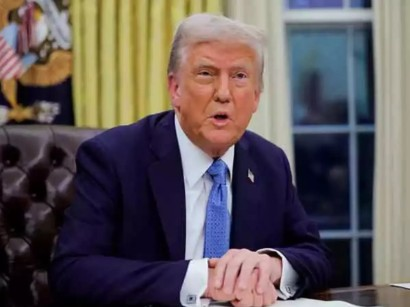
The announcement by U.S. President Donald Trump and Prime Minister Narendra Modi that Washington will cut its “reciprocal” tariffs on Indian goods from 25% to 18% has brought immediate relief to Indian exporters and signalled a thaw after nearly a year of strained ties. The rollback also includes the removal of a punitive 25% penalty tariff imposed last August, which had pushed total U.S. tariffs on Indian exports to 50%, among the highest in the world, on par with Brazil.
Yet, beyond the headline tariff cut, the statements from Washington and New Delhi diverge sharply. While Mr. Trump has framed the move as part of a sweeping trade deal involving oil, investments and zero tariffs, Mr. Modi has confined himself to welcoming the tariff relief alone. This gap leaves several fundamental questions unanswered.
Is There Actually a US-India Trade Deal?
Mr. Trump’s repeated references to a “Trade Deal” have created ambiguity over whether the two sides have concluded a comprehensive agreement or merely agreed on a tariff rollback. One possibility is that he is referring to the long-discussed “first tranche” of an India–U.S. Free Trade Agreement (FTA), negotiations for which gathered pace after Mr. Modi’s visit to Washington in February 2025.
If so, the absence of detail is striking. Unlike the EU–India FTA concluded last week, where the negotiated text and scope were clearly outlined, neither Washington nor New Delhi has released any documentation, timelines or sectoral commitments for an India–U.S. FTA. Tariffs, non-tariff barriers, market access and investment rules were all meant to be part of this package, yet none of these elements has been formally disclosed.
Compounding the uncertainty is Mr. Trump’s claim that India has agreed to reduce “Tariffs and Non-Tariff Barriers against the United States, to ZERO”. New Delhi has not confirmed this, nor clarified which tariff lines would be reduced to zero. Sensitive sectors such as agriculture, particularly soyabean and dairy, which India has consistently opposed, remain conspicuously unaddressed.
The confusion is not new. In January, U.S. Commerce Secretary Howard Lutnick said a deal had been ready for months but stalled because, according to him, Mr. Modi did not make a phone call to clinch it, a claim the Ministry of External Affairs (MEA) firmly denied.
Does 18% Figure Indicate Level Playing Field for India?
The reduction to 18% is unquestionably an improvement from the earlier 25% rate imposed in April 2025. That earlier hike had left Indian exporters worse off than many regional competitors: Bangladesh and Vietnam faced tariffs of around 20%, Pakistan 19%, while China’s 34% rate was largely deferred until November 2026.
For labour-intensive sectors such as apparel, and for gems and jewellery exporters who were among the hardest hit, the new rate restores some competitiveness. However, Indian exporters are still not on equal footing. Many neighbouring and Asian economies continue to enjoy a Generalised System of Preferences (GSP) concession of about 5%, a benefit the U.S. withdrew from India in June 2019 during Mr. Trump’s first term.
As a result, Indian industry had hoped that any revised reciprocal tariff would land closer to 15%, not 18%. The current rate narrows the gap, but does not eliminate it.
What Is Actually Happening With Russian Oil?
Perhaps the most contentious claim from Washington is Mr. Trump’s assertion that Mr. Modi has “agreed to stop buying Russian Oil, and to buy much more from the United States and, potentially, Venezuela”, a move he linked to ending the war in Ukraine. The MEA has so far declined to comment on this assertion.
This silence matters because it cuts against India’s long-stated position. When the U.S. imposed a 25% penalty tariff last August over India’s Russian oil purchases, the MEA called the move “unfair, unjustified and unreasonable”, stressing that energy imports are driven by “market factors” and the need to ensure energy security.
In practice, however, India’s Russian oil imports have already been declining. After peaking in 2024, refiners began scaling back purchases. In October, imports of Russian Ural crude fell about 38% year-on-year. By December, the trend had deepened.
According to the European Centre for Research on Energy and Clean Air (CREA), “India’s Russian crude imports recorded a sharp 29% month-on-month reduction to the lowest volumes since the implementation of the price cap policy.” On January 6, 2026, Reliance Industries said it would not receive any Russian oil in January and had not taken Russian crude for the previous three weeks.
The key question is whether these reductions reflect commercial recalibration, or a political commitment now being formalised under U.S. pressure.
India Under US Sanctions Pressure?
There is historical precedent for concern. In 2019, India “zeroed out” imports of Iranian and Venezuelan oil after U.S. sanctions threats, with then U.S. Ambassador Nikki Haley publicly pressing New Delhi. Following the U.S. operation against Venezuelan President Nicolás Maduro in January this year, Mr. Trump has suggested that Washington would now “allow” imports of Venezuelan oil, a position that offers India flexibility, but also underscores how contingent its energy choices appear on U.S. approval.
The pressure extends beyond oil. The U.S. has warned of 25% tariffs on countries doing business with Iran and has withdrawn the sanctions waiver for Indian investment in Iran’s Chabahar port. Government sources indicate India is prepared to give up its “minimal levels” of trade with Iran to avoid further tariffs.
Significantly, the Union Budget presented on February 1 makes no allocation for Chabahar in the coming year. After 23 years of strategic investment, this omission suggests New Delhi may be preparing to pause or retreat from the project until the sanctions environment eases.
What’s $500 Billion Commitment?
Mr. Trump’s claim that Mr. Modi committed to “BUY AMERICAN” at a much higher level, including purchases of over $500 billion in U.S. energy, technology, agricultural products, coal and more, is one of the boldest assertions yet the least substantiated.
The MEA has declined to confirm any such commitment. Context matters here. India–U.S. bilateral trade in goods currently stands at about $131 billion. India’s cumulative investment in the U.S. has hovered around $40 billion.
A $500 billion figure, therefore, can only be meaningful if spread over many years and across multiple sectors, much like similar claims Mr. Trump has made about the European Union, Japan and others following their trade deals. Without timelines, sectoral break-ups or binding mechanisms, the number functions more as a political headline than a verifiable obligation.
The tariff cut to 18% is real, immediate and economically significant. Beyond that, much remains unresolved. The gulf between Washington’s expansive claims and New Delhi’s carefully limited confirmations raises fundamental questions about the scope of the agreement, India’s energy autonomy, and the true balance of concessions.
Until the fine print is released, the India–U.S. deal remains less a finished treaty and more a framework shaped as much by geopolitics and pressure as by trade economics.

India–U.S. Deal: What We Know, What We Don’t added by Sridhar P on
View all posts by Sridhar P →