
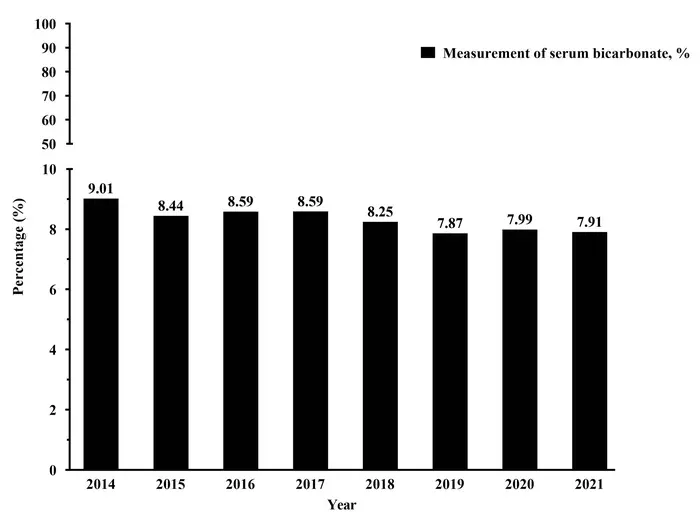
A massive national survey in Japan has found a massive gap in the routine care of chronic kidney disease (CKD), and one of the major metabolic complications used to remain undiagnosed by lack of testing.
The researchers under the leadership of Mai Tanaka have conducted the study using the data of the Japan Chronic Kidney Disease Database Extension and analyzed the clinical records of over 21 university hospitals in the period between 2014 and 2021. It targeted individuals with moderate CKD (stages 3a to 4) that already have high susceptibility to disease progression and complications.
The results indicate a glaring omission: a simple and cheap test such as serum bicarbonate, which is used to diagnose metabolic acidosis, was ordered less than 10% per year. Consequently, the condition, which, as known, deteriorates kidney outcomes and general health, seems to be considerably under-measured in the everyday care.
Metabolic acidosis is a condition that develops when the body retains too much acid in it because of a deteriorated renal strength. It has also been associated with muscle atrophy, bone mineral loss, insulin resistance with accelerated kidney disease, and an increased risk of dying. The clinical practice is to intervene in cases where the bicarbonate of the body is lower than 22 mEq/L.
Nevertheless, the Japanese statistics indicate that the burden of the condition is being hidden by the low level of testing. Although the general prevalence seemed to be low in the general population of CKD, a more detailed look at patients that indeed underwent a test showed a significantly different pattern. Almost half of them fit the criteria of metabolic acidosis, and the rates were getting higher as the kidney function declined.
Follow up care was limited even among the patients who depicted definite biochemical signs of the condition. It was determined by the study that a gap between detection and clinical response was significant, with only 8.6% actually diagnosed and only 7.5% actually treated.
Metabolic Acidosis Undetected
The results are similar to those reported in North America where individual studies of the U.S. and Canadian cohorts have also indicated that metabolic acidosis is commonly undiagnosed in CKD patients. In such researches, less than every five patients was given sodium bicarbonate treatment in spite of the facts that acid retention was associated with persistent damage to the kidney by inflammation and fibrosis.
According to experts, the problem is not about access or price, since bicarbonate testing is readily available, but it is more about the failure to integrate it into a normal monitoring practice. Current guidelines, such as those of nephrology societies, suggest routine evaluation and correction of metabolic complications in CKD but this is not done so consistently.
The paper highlights a larger issue of concern of health systems where there has been a progressive growth in cases of CKD worldwide due to aging, increased incidences of diabetes and hypertension. Researchers indicate that regular bicarbonate testing may be an intervention that is scalable and practical as a part of the regular care panel.
Early identification of metabolic acidosis would enable clinicians to start treatment, either the use of alkali therapy or diet change at a time that might allow it to delay disease onset and minimize complications.
The authors have come to the conclusion that there is not as much a problem with the rarity of the condition but its invisibility in existing practice. In the absence of regular testing, there is a high-risk chance that a high and manageable element of kidney disease can be ignored, which has long-term patient consequences.
Also Read:
What are Zombie cells? Mayo Clinic researchers minimize cells in diabetic kidney disease
Polluted air may pose great threat to your kidneys, says study

Hidden acid imbalance in kidney disease raises red flags: Japan Study added by Arun Kumar N on
View all posts by Arun Kumar N →