
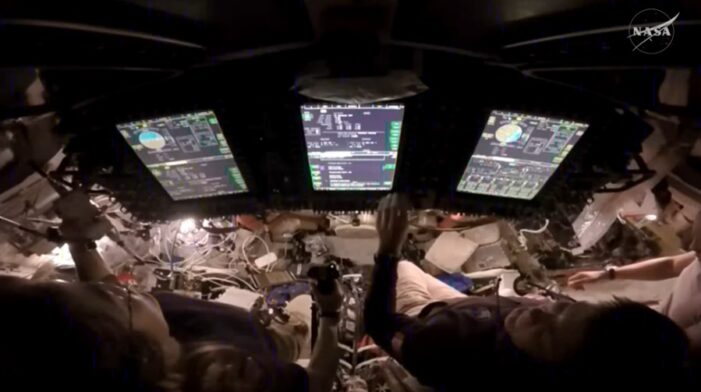
Astronauts aboard Artemis II completed a 41-minute manual piloting test of the Orion spacecraft on Flight Day 4, taking turns controlling the vehicle in deep space. The demonstration, carried out tested thruster modes and maneuvering capabilities as the crew also reviewed targets for an upcoming lunar flyby. The mission continues on a stable trajectory toward the Moon, with further piloting tests planned later in the flight.
The astronauts aboard Orion spent part of their fourth day in space doing something few humans have ever done: manually steering a spacecraft far beyond Earth orbit.
Late in the day, Christina Koch and Jeremy Hansen took control of the capsule, guiding it through a series of controlled maneuvers designed to test how the spacecraft responds to human input in deep space.
The exercise began at 9:09 p.m. Eastern Daylight Time and lasted 41 minutes, giving engineers a detailed look at Orion’s handling under different conditions.
Orion manual piloting test evaluates deep space handling
During the demonstration, the astronauts tested two distinct thruster configurations. One allowed full six degrees of freedom, enabling movement and rotation across all axes. The other restricted motion to three degrees of freedom, simplifying control inputs and simulating different operational scenarios.
The goal is data. NASA engineers are studying how Orion behaves when astronauts take direct control, measuring responsiveness, stability, and precision. These findings will inform how future crews operate spacecraft during longer missions, where autonomy becomes essential.
Commander Reid Wiseman and pilot Victor Glover are scheduled to repeat the test on Flight Day 8, allowing ground teams to compare performance across different crew members.
Manual control remains a backup capability in modern spacecraft, but NASA continues to treat it as a core skill. In deep space, where delays in communication can limit ground intervention, astronauts must be able to operate independently if needed.
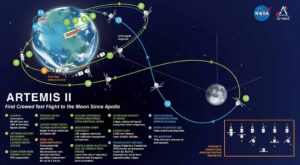
Lunar flyby imaging plan finalized ahead of observation window
While piloting tests drew focus late in the day, earlier hours were spent preparing for the mission’s next major milestone: the lunar flyby.
The crew reviewed a list of imaging targets prepared by NASA’s science team, outlining specific features on the Moon that astronauts will photograph and analyze during a six-hour observation period.
That window begins at approximately 2:45 p.m. on April 6, when Orion’s main cabin windows will be oriented toward the lunar surface.
The targets include impact craters, volcanic plains formed by ancient lava flows, and structural features such as ridges and fractures. By documenting variations in brightness, texture, and color, astronauts will contribute data that helps scientists interpret the Moon’s geological history.
Unlike earlier missions that passed close to the surface, Orion will observe the Moon from thousands of miles away. That distance allows the crew to capture a broader view, including polar regions that are difficult to study from low-altitude trajectories.
The planning session ensures that each crew member understands their role during the flyby. Timing, camera positioning, and observational priorities must align precisely during the limited window available.
Crew life aboard Orion blends routine with milestone moments
Even as the mission advances toward the Moon, daily life aboard Orion continues to follow a structured routine.
Earlier in the day, the astronauts used one of the spacecraft’s external solar array cameras to capture selfies, offering a glimpse of the crew inside the capsule as Earth recedes in the distance. The images are expected to be transmitted to mission control in the coming days.
Such moments, while informal, serve a broader purpose. NASA often shares these images to document the human experience of spaceflight, providing visual context for missions that otherwise unfold far from public view.
The crew is scheduled to begin their sleep period at 3:15 a.m., with mission control at the NASA Johnson Space Center set to wake them at noon Central Daylight Time to begin Flight Day 5.
Structured sleep cycles remain essential. Maintaining physical and cognitive performance is critical as the mission approaches its most observation-intensive phase.
Precision trajectory allows focus on operations
Artemis II continues along a stable trajectory toward the Moon, allowing astronauts to dedicate more time to operational tasks rather than propulsion adjustments.
NASA flight controllers have already canceled multiple planned trajectory correction burns, citing the spacecraft’s accurate path. That precision reduces workload on both the crew and ground teams while conserving fuel for later mission phases.
Inside Orion, that translates into a shift in focus. The early days of the mission emphasized propulsion and navigation. Now, attention has turned to piloting validation, scientific preparation, and system monitoring.
The manual piloting demonstration is part of that transition. It marks a point where the spacecraft is no longer just being guided by automated systems but is also being tested as a vehicle that astronauts can control directly in deep space.
As the Moon draws closer, the crew’s preparations inside the capsule are becoming more deliberate. Every maneuver, checklist review, and system test feeds into the upcoming flyby.
For now, the spacecraft continues forward on a steady path, with astronauts alternating between routine tasks and moments that underscore the scale of the mission.
Also Read:
Artemis II Update-11, Day 4: Crew Enters Deep Space, Lunar Flyby Prep
Artemis II Update-10, Day 3: Crew Prepares Orion Cabin As Lunar Flyby Nears Milestone
artemis 2 crew, Artemis II mission, Artemis II mission update, Artemis II update, Earth, Moon, Moon Mission, NASA, nasa crew, NASA News, Space, space news, Sun

Artemis II Update-12, Day 4: Astronauts Hand-Fly Orion, Sharpen Lunar Flyby Plan in Deep Space added by Arun Kumar N on
View all posts by Arun Kumar N →