
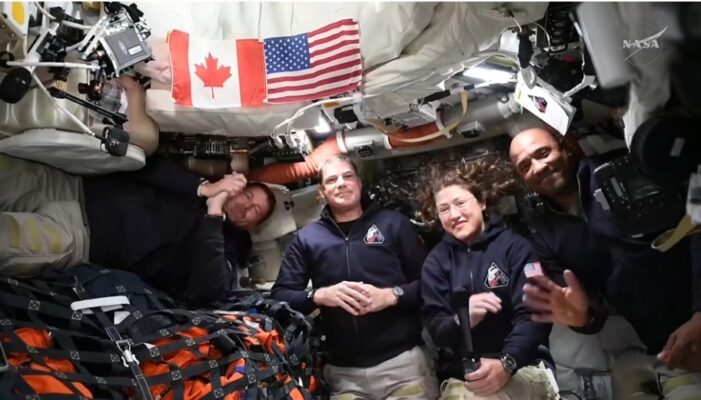
As the Orion spacecraft continues its path toward the Moon, the Artemis II crew will spend their fourth flight day preparing for their lunar flyby on Monday, April 6. Traveling more than 169,000 miles from Earth aboard the Orion spacecraft, astronauts are set to manually pilot the vehicle and study the Moon from a distant vantage point. The mission will also include a planned communications blackout and record-breaking distance milestone as Orion moves deeper into space.
Inside the Orion capsule, the day began with music and routine. The four astronauts, already days into deep space travel, woke to Chappell Roan’s “Pink Pony Club” before shifting into a tightly scheduled slate of mission tasks.
By the time they started work, the spacecraft had already crossed roughly 169,000 miles from Earth and was closing in on the Moon, which lay about 110,700 miles ahead. The numbers mark a point where Earth is no longer the dominant visual reference, and operational focus shifts toward lunar proximity.
Manual control test of Orion in deep space
Later in the day, pilot Victor Glover is scheduled to take manual control of Orion, a rare exercise designed to evaluate how the spacecraft responds to human input far beyond Earth orbit.
NASA officials have framed the test as critical for future missions, where astronauts may need to intervene directly in spacecraft navigation. The maneuver will provide engineers with data on handling characteristics, including responsiveness and stability under manual control.
The crew is also running a 24-hour acoustics test inside the cabin. Engineers are using the data to map the spacecraft’s sound environment, which affects both crew comfort and communication clarity during extended missions.
These activities reflect a broader goal of Artemis II. Beyond reaching the Moon, the mission is designed to validate systems that astronauts will rely on during longer journeys, including eventual missions to Mars.
(This artist’s concept depicts the nominal trajectory for NASA’s Artemis II test flight, an approximately 10-day mission that will send four astronauts around the Moon and back. The agency’s SLS (Space Launch System) rocket and Orion spacecraft will launch from Kennedy Space Center in Florida. Orion will fly two orbits of Earth and then venture around the Moon in a figure-eight pattern before returning to Earth.NASA/JSC/Goddard)
Lunar flyby observations and scientific targets
Preparation for the lunar flyby dominates the schedule. The six-hour observation window begins at approximately 2:45 p.m., when Orion’s main windows will face the Moon, allowing astronauts to begin detailed visual and photographic analysis.
Unlike the Apollo missions, which passed about 70 miles above the lunar surface, Orion will remain roughly 4,066 miles away at its closest point. From that distance, the crew will see the Moon as a full disk, including polar regions rarely observed in a single view.
Astronauts Reid Wiseman, Christina Koch, and Jeremy Hansen will work through a checklist of surface features identified by NASA’s science team.
They are expected to document impact craters, ancient lava plains, and fractures in the Moon’s crust. Variations in brightness and color will also be recorded, offering clues about the composition and geological history of the lunar surface.
The flyby will also create a rare viewing condition. As Orion, the Moon, and the Sun align, astronauts will witness a solar eclipse from space lasting about an hour. During that period, they will study the Sun’s outer atmosphere, known as the corona, as it becomes visible around the Moon’s edge.
NASA has also tasked the crew with watching for flashes of light caused by meteoroid impacts on the lunar surface. These observations could help scientists better understand surface hazards for future missions.
(This visualization follows the trajectory of the Orion spacecraft during the Artemis II flyby of the Moon, showing what astronauts will see out the window as they approach the Moon and fly around its far side. The flyby will last from 2:45 – 9:40 PM EDT on April 6, 2026, and marks the window of time that the Artemis II crew will be close enough to the Moon to make scientific observations and Orion’s windows will be pointed toward the Moon. The angle of the Sun’s illumination of the Moon will change throughout the period based on the shifting positions of the Sun, Moon, and spacecraft — revealing both familiar nearside terrain and portions of the far side not visible from Earth. This visualization, compressed from seven hours to one minute, includes Earthrise and Earthset, and a solar eclipse, which will be visible to the crew at the end of the flyby window, when the Sun will glide behind the Moon for nearly an hour from the perspective of Orion.NASA/Ernie Wright)
Communications blackout and record distance milestone
A planned communications blackout is expected when Orion passes behind the Moon. The interruption will begin around 5:47 p.m. and last approximately 40 minutes, as the Moon blocks signals between the spacecraft and NASA’s Deep Space Network.
Such blackouts are standard in lunar missions and were also experienced during earlier programs. Once Orion emerges from behind the Moon, ground stations are expected to quickly reestablish contact.
During this phase, Artemis II is also set to surpass a long-standing distance record. Orion will travel about 252,757 miles from Earth at its farthest point, exceeding the distance reached by the Apollo 13 crew.
The milestone reflects both trajectory design and the mission’s broader objective of pushing human spaceflight deeper into space than previous crewed missions.
Life sciences research and onboard system challenges
Beyond navigation and observation, Artemis II is carrying a suite of experiments aimed at understanding how humans and biological systems respond to deep space.
One payload, known as AVATAR, includes bone marrow cells derived from crew blood samples to study immune system behavior in space. The astronauts are also collecting saliva samples as part of ongoing biomedical research.
Radiation exposure remains a key concern. Sensors provided by the German Aerospace Center, along with NASA instruments, are measuring radiation levels throughout the spacecraft.
Crew members are also wearing actigraphy devices that track sleep patterns, movement, and overall health. These data sets will inform planning for longer missions, where maintaining crew performance becomes increasingly complex.
Not all systems have operated without issue. Engineers are working to clear a wastewater vent line after a partial blockage. The crew has been instructed to use backup collection methods if necessary, although the main system remains functional.
Mission controllers at the NASA Johnson Space Center have again canceled a planned trajectory correction burn, confirming that Orion remains on its intended path. Instead, the spacecraft will be oriented toward the Sun to help resolve the vent issue.
Expanding communications capabilities in deep space
In parallel with crew operations, Orion’s optical communications system has surpassed 100 gigabytes of data transmitted back to Earth.
The system uses laser-based transmission, allowing higher data rates than traditional radio signals. NASA officials see the technology as essential for future missions that will require rapid transmission of high-resolution imagery and scientific data.
As Artemis II approaches its lunar flyby, the mission has shifted into a phase where precision operations, scientific observation, and human endurance intersect. The spacecraft continues on a trajectory that requires no correction, while inside, astronauts prepare to document the Moon from a distance no crew has experienced in decades.
Also Read:
Artemis II Update-10, Day 3: Crew Prepares Orion Cabin As Lunar Flyby Nears Milestone
Artemis II Update-9, Day 3: NASA cancels first trajectory correction burn
artemis 2 crew, artemis 2 update, Artemis II astronauts, Artemis II mission, Artemis II update, NASA, nasa new, NASA News, Space, space news

Artemis II Update-11, Day 4: Crew Enters Deep Space, Lunar Flyby Prep added by Arun Kumar N on
View all posts by Arun Kumar N →