
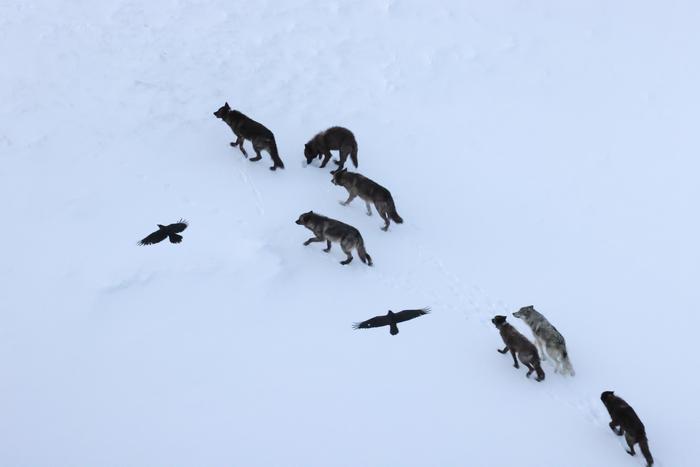
The legend went that wolves were followed by ravens to fresh kills. Another scavenging strategy is of much interest, as demonstrated by a tracking study.
The raven is usually the first to be on the scene when the wolf pack is running down its prey. The ravens are already waiting in queue to grab hold of the scrap of meat that is an oddity and may arise even before the predators have time to dig. The scavengers are so fast in getting to wolf kills that it is uncanny to people how they got there and the answer is that wolves must have ravens trailing on them.
However, a recent study that followed ravens and wolves in the Yellowstone National Park during two-and-a-half years reveals that the predators adopt a much more advanced approach. Ravens know the locations that wolves will most likely kill and they will fly far back to the location. According to the first author of the study, Matthias Loretto, “they are capable of flying six hours without making a landing, directly to a kill site.”
The findings were published in the journal of science, with suggestions that ravens attempt to locate food scattered in the landscape by the use of spatial memory and navigation. According to Loretto, ravens can travel long distances by flying, and apparently they have a good memory so they do not have to always keep up with wolves in order to make out of the predators.
The research was conducted by the Research Institute of Wildlife Ecology of the University of Veterinary Medicine Vienna and the Max Planck Institute of Animal Behavior (Germany) along with several other institutes across the world including the Yellowstone National Park (USA).
Putting a legend to the test
The research was conducted regarding the Yellowstone National Park where wolves were introduced in the mid 90s after 70 years. The wolves of the park are monitored using tracking collars which are implanted on a quarter of the wolf population in any given year, according to Dan Stahler, a Yellowstone biologist, who has been tracking the wolves of the park since its reintroduction, the ravens seem to prefer the company of the wolves: you find them flying directly overhead or even leaping behind them when they take down prey.
To the ravens, it is a lucrative foraging measure, because the wolves always generate food which the birds can deal with. “The rule of the birds, which we all had supposed, was,” says Stahler, “simply to keep near the wolves.” However, the assumption was not checked. He says he did not know what ravens could do because nobody had ever put them in the middle; nobody had ever put the scavenger into the perspective.
To get a full view of the behavior of the raven, the group fitted the birds with small GPS positioning devices, 69 ravens in all, which is, according to Loretto, simply insane. “The reason is that ravens are so watchful of the scene that they do not easily fall into traps,” he says. Researchers were keen to adjust the traps to the environment in order to trap the birds to tag them. To illustrate, traps placed near the campsites had to be covered with rubbish and fast-food lure, otherwise, the ravens would know that something was not right and would not approach it, according to Loretto who is now a scientist at the University of Veterinary Medicine Vienna.
Besides the tracking ravens, the researchers added the movement data of 20 Yellowstone collared wolves. They followed the animals through the winter when ravens most frequently occur with wolves and recorded GPS positions with intervals up to 30 minutes in the case of ravens and up to one hour in the case of wolves. They also added information as where and when wolves killed their prey which consisted mainly of elk, bison and deer.
The memory of lucrative sceneries
In more than two-and-a-half years of observation, scientists discovered only one unambiguous incidence of a raven trailing a wolf at a distance of over one kilometer or over an hour. “In the beginning we were confused,” says Loretto. “After we discovered that wolves were not being followed by ravens from a great distance, we could not understand why the birds came so fast to wolf killings.”
The pattern was obvious after the thorough analysis of the movement data. Instead of following predators at long distances, the ravens returned to certain locations where they could find wolf kills. Others covered as little as 155 kilometers per day, but in a highly directional way, towards locations where a carcass was likely to be found–although the time a kill will occur is indeterminate.
In regard to location, wolves kills are clumped into specific terrain features, which the wolves hunt more effectively, flat valley bottoms. Ravens were also much more likely to visit frequently wolfridden locations as compared to infrequently wolfrided locations, indicating that they learn and retain the long-term resource landscape that wolves cause.
Loretto says that ravens have already been known to recollect consistent food sources, such as landfills. “What did we find surprising is that they also appear to learn where the wolf killings are more frequent. One kill is random, and with time certain areas of the terrain prove more fruitful than others, but ravens seem to take advantage of this pattern.”
Greater understanding of the intellect of animals
The authors do not eliminate the possibility that wolves continue to be followed by ravens on a short distance. To locate wolf kills in their area, ravens must be able to determine this by short-range signals, probably by watching the movements of the wolves or hearing them howl. However, on a bigger level, the order is quite obvious: memory then, cues then. Spatial memory and navigation enables ravens to make decisions regarding where to start searching, in the first place, sometimes tens or even hundreds of kilometers.
Senior author Prof John M. Marzluff of the University of Washington adds: “What is evident in our work is the fact that ravens are able to be quite flexible in the locations they choose to feed. They do not remain attached to a certain wolf pack. They have the opportunity to select between numerous foraging opportunities since they have a good sense and recollection of the previous feeding places far and wide. This alters our way of thinking about scavenger finding food, and the notion may be that we have long underestimated certain ones.”
Read More:
‘Plenty of fish in the sea’? Not anymore, say UN experts in Nice
Sound reveals ‘Ocean giants’ dance with wind to find food

Wolves kill, and ravens recall where: What is the scavenging strategy? added by Arun Kumar N on
View all posts by Arun Kumar N →