
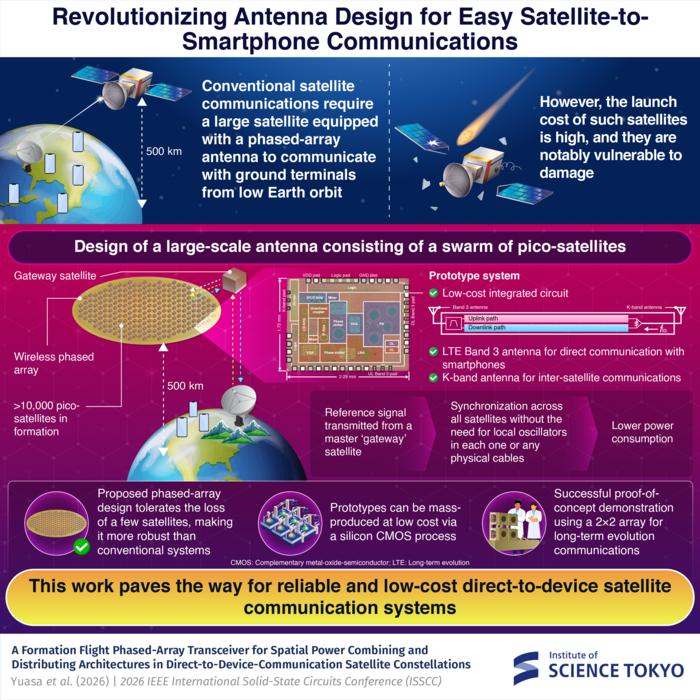
A new approach to satellite communications could significantly reshape how smartphones connect to space, with researchers proposing the use of thousands of tiny satellites working in unison rather than relying on a single, complex spacecraft.
Scientists in Japan have demonstrated that swarms of pico-satellites—each carrying a small हिस्सा of a larger antenna system—can collectively function as a single, powerful phased-array antenna. The early-stage experiment showed that such a distributed system can deliver stable, high-quality data transmission, offering a potential pathway to cheaper and more resilient global connectivity.
The concept builds on the growing interest in direct-to-device (D2D) satellite communications, which aim to allow ordinary smartphones to connect directly to satellites without the need for ground infrastructure. The technology is particularly attractive for extending coverage to remote regions such as oceans, deserts, and disaster-hit areas where terrestrial networks are either weak or nonexistent.
Traditionally, achieving this requires large satellites equipped with sophisticated phased-array antennas. These systems rely on tightly coordinated antenna elements that can steer signals electronically. However, they are expensive to build and launch, and their centralized design creates a single point of failure—any major malfunction can render the entire satellite ineffective.
The Japanese research team, led by Associate Professor Atsushi Shirane, has proposed a fundamentally different architecture. Instead of concentrating antenna elements on one satellite, the system distributes them across thousands of pico-satellites flying in formation. These miniature units are synchronized wirelessly, eliminating the need for physical connections.
At the heart of the innovation is what the researchers describe as “spatial wireless combining and distributing technology.” In this setup, a central gateway satellite broadcasts a reference signal that allows all participating pico-satellites to remain precisely synchronized. This removes the need for energy-intensive components such as local oscillators on each unit, enabling further miniaturization and reducing power consumption.
The team developed a compact transceiver chip using standard silicon CMOS technology, making it suitable for large-scale, low-cost manufacturing. In laboratory simulations replicating satellite formations, the system demonstrated accurate beam steering and reliable data transmission using communication protocols similar to those found in modern smartphones.
Beyond lowering costs, the distributed nature of the system offers a major reliability advantage. Because the network is made up of numerous independent satellites, the failure of individual units does not compromise the entire system—unlike traditional monolithic satellites.
The findings suggest that formation-flying pico-satellites could become a viable foundation for next-generation satellite networks. If scaled successfully, the approach could expand global connectivity while reducing both financial and operational risks, bringing direct satellite communication closer to everyday mobile users.
Also Read:
direct smartphone connection, pico satellites, satellites, smart phones, Space

Thousands Of Pico-Satellites Could Redefine Direct Smartphone Connectivity From Space added by Arun Kumar N on
View all posts by Arun Kumar N →