
Researchers at the University of Oxford have identified a semiconductor that could help address a longstanding challenge in solar energy technology. The study, published in Nature on October 28, 2026, reveals that bismuth sulfide can absorb light efficiently while slowing the loss of electrical charges, a combination that could support the development of more efficient solar cells.
Solar cells use semiconductor materials to capture sunlight and convert its energy into electricity. When sunlight strikes a semiconductor, it releases negatively charged particles called electrons, leaving behind positively charged gaps known as holes. To generate electricity, these charges must be collected before they recombine and release the energy they carry.
However, materials that absorb light strongly often allow electrical charges to disappear more quickly. This trade-off limits the amount of energy solar cells can extract from sunlight.
The newly identified properties of bismuth sulfide suggest that this limitation may not be unavoidable.
“One of the longstanding challenges in developing efficient solar-energy materials is that the properties which make a semiconductor very good at absorbing sunlight also tend to make the resulting electrical charges disappear quickly,” said corresponding author Professor Laura Herz of the Department of Physics at the University of Oxford. “Our work shows that this trade-off is not inevitable. By uncovering how an unusual electronic structure can combine strong light absorption with much slower recombination, we have identified a new principle for designing semiconductors that could help us harvest solar energy more efficiently.”
Unusual Energy Levels Help Charges Survive Longer
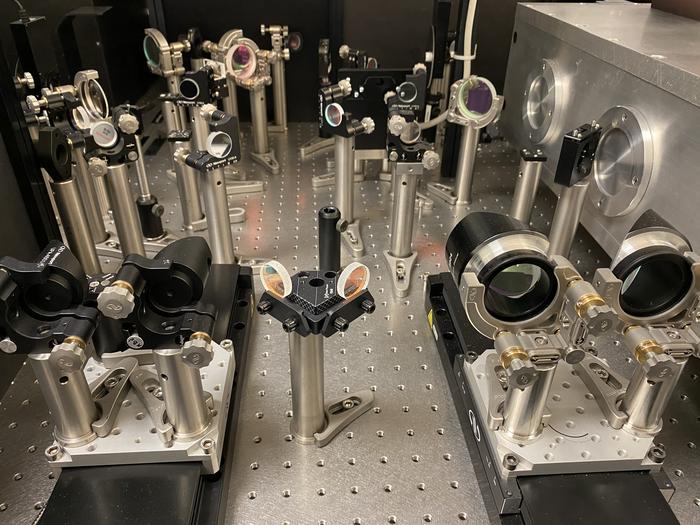
To investigate the material, the researchers exposed thin films of bismuth sulfide to extremely short laser pulses. They then measured how quickly the resulting electrical charges disappeared using ultrafast terahertz spectroscopy. Measurements were conducted across a temperature range extending from room temperature to just above absolute zero.
Electronic structure calculations conducted by Professor Marina Filip’s group in the Department of Physics helped explain the material’s unusual behaviour.
Bismuth sulfide absorbs light primarily through a strong transition between energy levels. However, another transition requiring slightly less energy provides a much weaker route. Charges occupying these lower-energy states disappear more slowly, allowing the states to function as a temporary reservoir for electrical charges.
Because the two energy levels are close together, charges can spend considerable time in this reservoir, reducing the rate at which they are lost.
The experimental results supported this explanation. In most semiconductors, cooling causes electrical charges to disappear more quickly. In bismuth sulfide, however, charge loss slowed as the temperature decreased, consistent with more charges settling into the reservoir states.
The researchers describe this behaviour using the term pseudo-direct semiconductor. Their model estimates that, at room temperature, the arrangement reduces charge loss by approximately 75% compared with conventional materials that absorb light with similar strength.
Findings Could Guide the Development of Better Solar Cells
The discovery identifies a different way to combine strong light absorption with longer-lived electrical charges, potentially offering researchers a new direction for semiconductor design.
“What makes this discovery particularly exciting is that we are not simply improving an existing semiconductor property but identifying a different way in which semiconductors can behave,” said Professor Herz. “Understanding this mechanism gives us a roadmap for discovering and potentially engineering other materials with similarly advantageous properties.”
Longer-lasting electrical charges could improve solar energy conversion by giving electrons and holes more time to reach the parts of a solar cell where they can be collected. This could reduce energy losses without compromising the material’s ability to absorb sunlight.
The findings may also have implications for solar fuels. Longer-lived charges could provide additional time for the chemical reactions required to convert solar energy into fuels.
The research team believes that other materials exhibiting similar properties could be identified by screening existing materials databases or developed through further engineering.
However, the researchers caution that the study demonstrates a physical mechanism rather than a commercially ready solar cell. Additional research will be required to translate the findings into practical solar technologies.
Read More :
 Sridhar P