
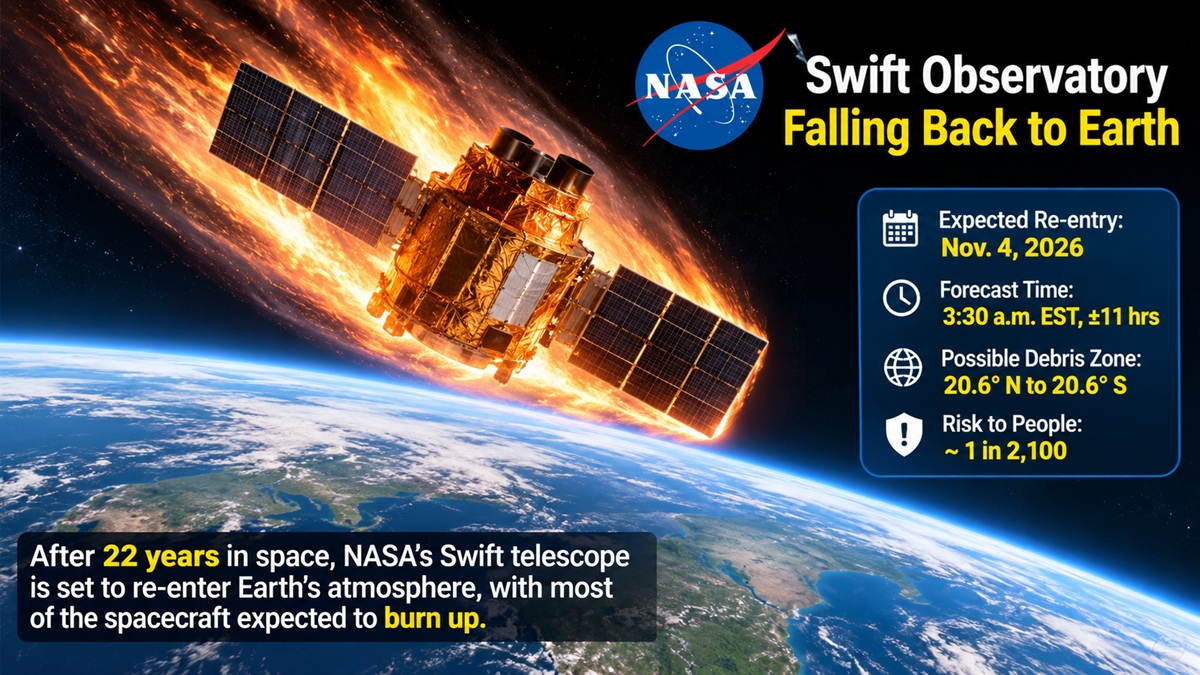
NASA’s Neil Gehrels Swift Observatory, a space telescope that spent nearly 22 years studying cosmic explosions, is expected to re-enter Earth’s atmosphere on November 4, with the possibility of surviving debris reaching the surface.
The 3,200-pound (approximately 1,450-kg) observatory is making an uncontrolled descent after a $30 million rescue mission failed to raise it into a higher orbit. NASA says most of the spacecraft is expected to burn up during re-entry, while the risk of harm to people on Earth remains very low.
The impending re-entry marks the end of a mission that far exceeded its original two-year operating target and helped astronomers investigate some of the universe’s most powerful events.
When and where could Swift re-enter?
How solar activity accelerated the descent
Swift’s orbit gradually deteriorated because of atmospheric drag. Increased solar activity in 2024 heated and expanded Earth’s upper atmosphere, increasing the drag acting on the spacecraft and accelerating its descent.
NASA and Katalyst Space Technologies attempted to save the observatory through a $30 million servicing mission. The robotic spacecraft LINK was intended to capture Swift and raise it into a higher orbit, potentially extending its scientific life by years.
The rescue effort was abandoned after LINK encountered problems with its orientation and stability. Swift’s final scientific observation took place on October 20, 2026, when it had descended to approximately 275 kilometres above Earth.
What Swift leaves behind
Swift was launched on November 20, 2004, to detect gamma-ray bursts, some of the most energetic explosions in the universe. Its three telescopes allowed it to observe cosmic events across multiple wavelengths and rapidly alert other observatories.
During its mission, Swift:
-
Observed more than 2,000 gamma-ray bursts.
-
Studied more than 1,400 supernova explosions.
-
Investigated stars being destroyed by black holes.
-
Contributed data to approximately 7,000 scientific papers.
-
Built a publicly accessible archive of nearly 22 years of observations.
NASA said the observatory’s scientific archive could support discoveries for decades after the spacecraft’s re-entry.
What happens next?
NASA and the US Space Force are continuing to track Swift’s descent and refine the re-entry forecast. The exact time and location of atmospheric entry will become clearer as the spacecraft approaches Earth.
The observatory’s re-entry also highlights the growing challenge of managing ageing spacecraft in low Earth orbit, where atmospheric drag can eventually bring satellites back to Earth without a controlled landing.
 Shelton Rozario