
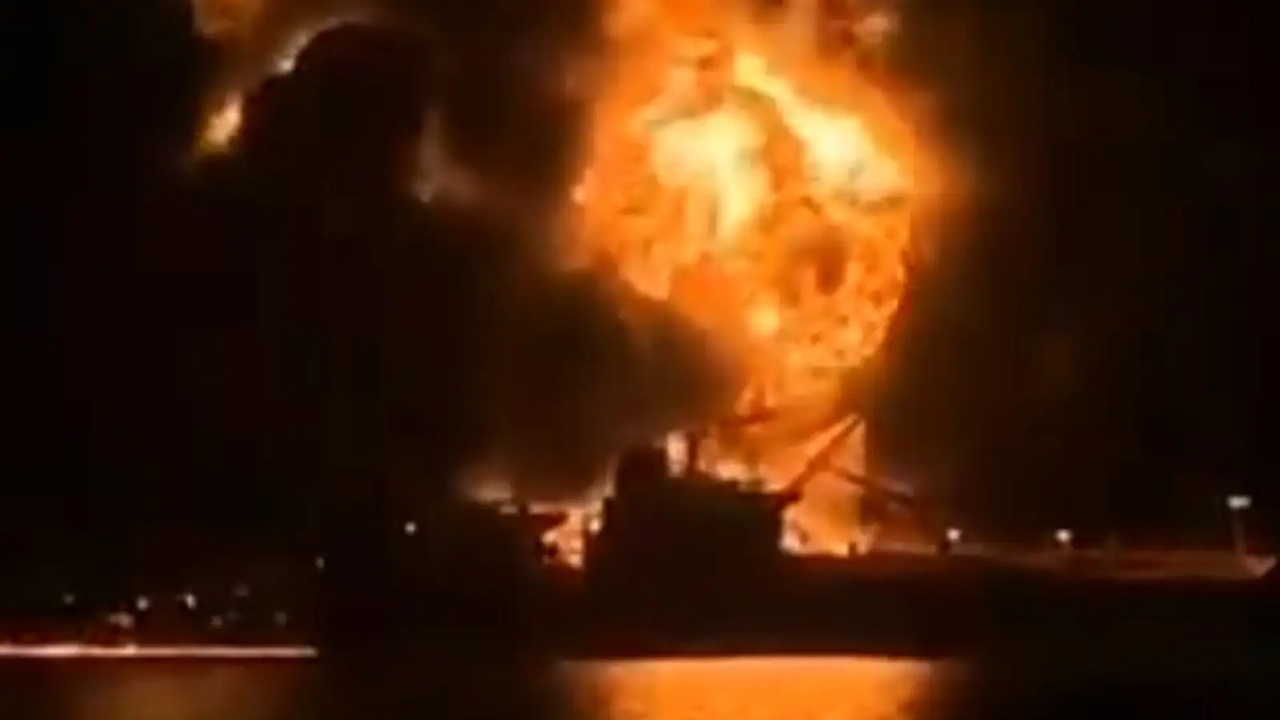
The eight-minute educational video, published by Iran’s state news agency IRNA on October 29, outlines precautions against a nuclear blast, extreme heat, shock waves and radioactive fallout. The instructions were prepared by emergency services in Isfahan province, which houses the Natanz nuclear facility.
The advisory has gained attention as the United States carried out limited strikes on Iran’s Qeshm Island near the Strait of Hormuz on November 2. Washington described the operation as defensive, targeting Iranian forces and missile systems considered a threat to US assets. The strikes did not signal a return to major combat operations, according to US officials.
The timing has also renewed scrutiny of President Donald Trump’s repeated threats to target Pickaxe Mountain, a deeply buried nuclear-related facility near Natanz.
Trump said in an October 16 interview that the US might have to strike Pickaxe Mountain to prevent Iran from developing nuclear weapons. However, he explicitly ruled out using a nuclear weapon, saying: “I wouldn’t use nuclear. We don’t have to.”
The latest Iranian advisory does not establish that a nuclear attack is imminent. It was issued as part of the country’s annual Passive Defence Week, an initiative focused on preparing civilians for emergencies. But the detailed instructions have drawn attention because of the continuing military confrontation and uncertainty over Washington’s next move.
Shelter, switch off ACs and avoid radioactive fallout
The video identifies four major dangers from a nuclear explosion: intense light, blast waves, extreme heat and radioactive materials.
Ebrahim Adelzadeh, deputy director of education and research at the Isfahan Red Crescent Society, advised people to seek shelter in sturdy buildings, preferably in basements or central rooms away from windows.
“A basement or a room in the central part of a building, away from windows, can be a suitable shelter if it can be accessed safely,” Adelzadeh told IRNA.
Residents have been advised to close doors and windows and switch off air conditioners and ventilation systems that draw air from outside. Additional instructions recommend staying inside for at least 24 hours, using bottled water and packaged food, and avoiding vehicles as shelters.
People caught outdoors during an explosion have been told not to look directly at the flash. They should take cover behind a solid barrier, lie close to the ground and protect their heads and faces. Once the initial blast wave passes, they should enter the nearest sturdy building.
The advisory also warns against remaining outdoors to watch or photograph an explosion. If a shelter catches fire or faces the risk of collapse, people should move to another safe building.
Iran warns against self-medication with iodine tablets
Radioactive fallout is a central concern in the guidance. Airborne particles could travel beyond the immediate blast zone, exposing people who are not close to the explosion.
Adelzadeh urged residents far from a potential attack site to take official warnings seriously and follow instructions from emergency authorities.
People who may have been exposed to radioactive dust have been advised to remove outer clothing carefully, seal it in a bag and wash exposed skin and hair with soap and water. The guidance also recommends using packaged food and bottled water to reduce the risk of consuming contaminated supplies.
Abbas Abedi, spokesperson for Isfahan’s pre-hospital emergency services, cautioned against taking iodine tablets without medical advice.
“Stable iodine can, under certain conditions, reduce the absorption of radioactive iodine by the thyroid gland, but it does not provide protection against other radioactive materials or radiation resulting from an explosion,” he told IRNA.
The video also refers to Prussian Blue, a medicine used in certain cases of internal contamination involving radioactive caesium-137. Officials recommend keeping battery-powered radios because electromagnetic pulses could disrupt electronic equipment and communication systems.
Pickaxe Mountain remains a potential flashpoint
Pickaxe Mountain, located near Natanz in Isfahan province, has become a focus of US and Israeli concern because of its heavily fortified underground facilities. The complex is buried beneath a granite mountain, making it a difficult target for conventional weapons.
The precise activities inside the facility remain unclear. International inspectors have not been given access to the site, while allegations that Iran has moved centrifuges there have not been independently established.
The latest US strikes on Qeshm Island came amid continuing diplomatic efforts to prevent a wider conflict. Iranian Deputy Foreign Minister Kazem Gharibabadi said Tehran remained open to negotiations through Qatari mediation while retaining the right to defend itself.
Iran’s survival guide therefore comes at a moment of heightened military uncertainty. Its publication signals a public preparedness effort, but does not by itself confirm that either Washington or Tehran expects a nuclear strike.