
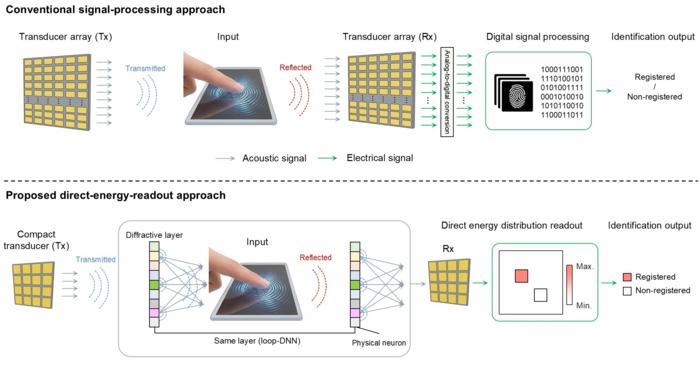
Researchers at South Korea’s POSTECH have developed a fingerprint authentication system that identifies users without digitally storing fingerprint information. The technology uses ultrasound and specially designed metasurfaces to make authentication decisions through physical computation.
Fingerprint recognition is widely used to unlock smartphones, authorise financial transactions and control access to secure facilities. However, fingerprints cannot easily be changed if compromised, making the protection of biometric data a significant security concern.
Conventional systems typically convert fingerprints into digital data and compare them with previously stored information. Even when this information is encrypted, the authentication process still requires access to biometric data, potentially creating security vulnerabilities.
Rather than improving how fingerprints are stored, the research team sought to eliminate the need for digital storage and comparison altogether. Led by Professor Junsuk Rho, alongside Dr. Seokho Lee and integrated M.S.–Ph.D. student Beomseok Oh, the team developed the technology at the Pohang University of Science and Technology (POSTECH). The study was published in the journal Nature Sensors.
How Ultrasound-Based Authentication Works
The researchers developed a system called a metasurface-driven loop-diffractive neural network, or loop-DNN. A metasurface is an artificial structure that can precisely control the direction, intensity and phase of waves. In this system, it manipulates ultrasound to process fingerprint information without sending it to a computer for conventional digital analysis.
When ultrasound passes through the metasurface, its energy is directed towards different locations depending on the fingerprint presented. A registered fingerprint concentrates acoustic energy in a designated region, while an unregistered fingerprint directs it towards a different region.
The system determines authentication by comparing signal intensities in these two regions. It does not need to reconstruct a fingerprint image or separately extract fingerprint features through digital computation.
The team also controlled the ultrasound’s phase, amplitude and transmission states, allowing the metasurface to manipulate the waves with greater flexibility than conventional diffractive neural networks, which primarily modulate phase.
Experimental Results Show Promising Accuracy
In experiments involving fingerprints from four individuals, the system achieved 97.92% accuracy across 192 validation samples. Additional numerical analysis using an international fingerprint recognition database demonstrated accuracy of up to 99.75% for a single registered user.
The researchers also found that recognition performance generally improved as the number of design parameters available for controlling the metasurface increased.
By shifting authentication from a store-and-compare model to physical computation and direct decision-making, the approach could reduce the risk of biometric data exposure. Potential applications include smartphones, automobiles, wearable devices and security-sensitive sectors such as finance, healthcare and defence.
Further Development Needed Before Practical Use
Despite the promising results, the technology requires further development before widespread implementation. The current experimental system operates at approximately 40 kHz, while industrial sensors commonly use frequencies in the megahertz range. The researchers also need to expand the system to support multiple registered users.
The team plans to advance the platform by combining multilayer metasurfaces with digital technologies.
Professor Junsuk Rho said, “Rather than developing a faster algorithm or stronger encryption technology, this study changes the starting point of biometric authentication itself. By eliminating the need to separately store biometric information, we expect this approach to develop into a new authentication method that can reduce the risk of fingerprint information being exposed through hacking.”
Read More :