
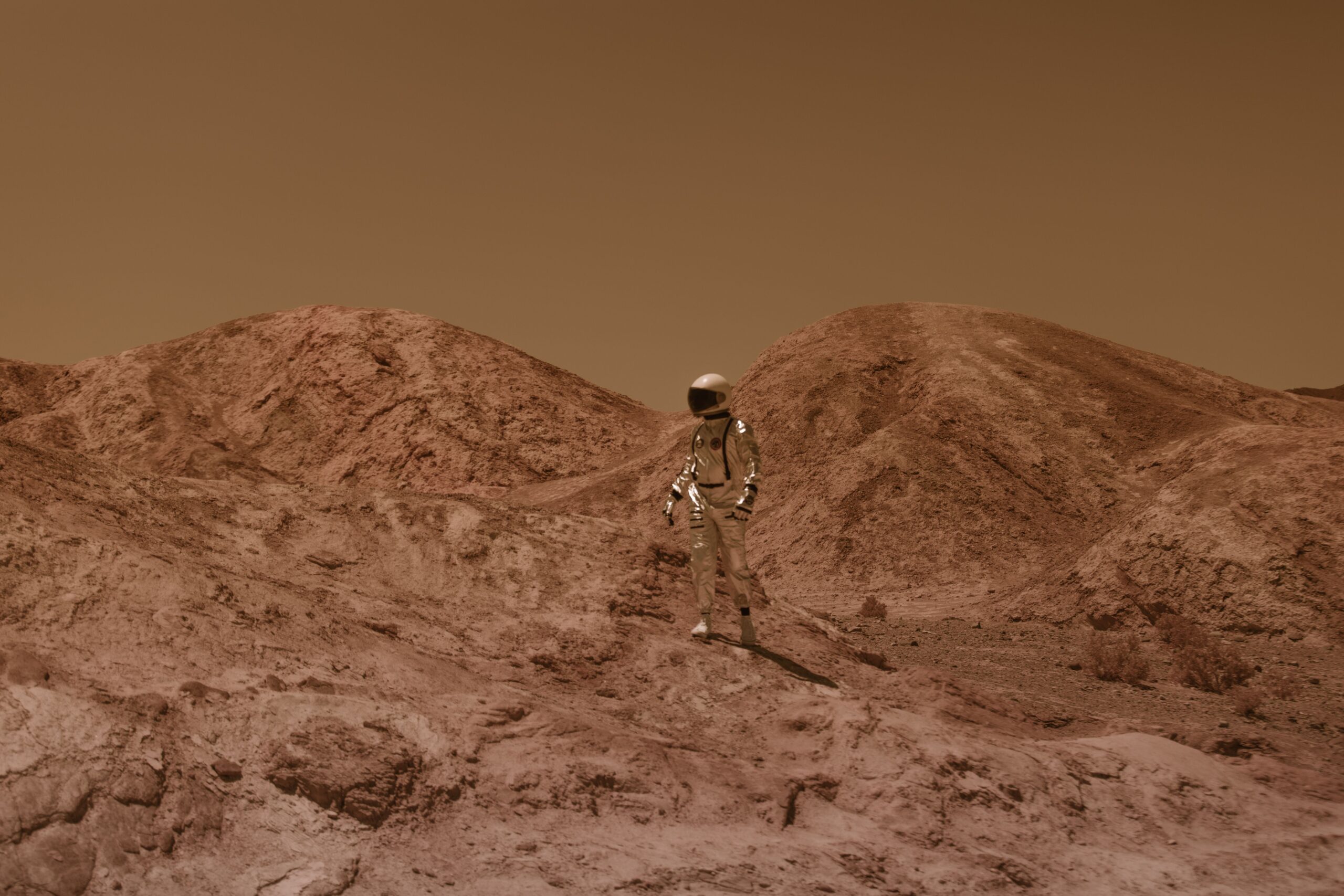
Future astronauts travelling to Mars will have to contend with one persistent environmental challenge: dust. A new study led by Washington University in St. Louis examines how Martian dust interacts with spacesuit materials and other surfaces, providing insights that could help engineers prepare for human missions to the Red Planet.
Scientists used small swatches of spacesuit material attached to NASA’s Perseverance rover, alongside other materials such as Teflon, to examine the effects of prolonged exposure to Martian dust. Each swatch measures less than a square inch and is positioned among the rover’s scientific instruments and navigation equipment. Although the rover does not require a spacesuit, these samples allow researchers to assess how dust could damage equipment and materials used by future astronauts.
“Mars is a very dusty place,” said VanBommel. “Astronauts to Mars will have to be prepared.”
Martian Dust May Be Less Abrasive Than Lunar Dust
The Apollo missions demonstrated how dangerous dust can be during space exploration. Despite their relatively short duration, lunar missions exposed astronauts and equipment to abrasive particles that scratched visors and degraded spacesuits. Dust particles also clung to astronauts’ clothing, entered the lunar module and eventually reached their lungs, causing hay fever-like symptoms in some cases.
The new findings suggest that Martian dust may be less abrasive and irritating than lunar dust. After 1,645 Martian days of exposure, the spacesuit material samples showed little visible wear.
Researchers also found that Martian dust particles were considerably smoother than the jagged grains found on the Moon. VanBommel explained that prolonged exposure to wind may have gradually rounded the particles, giving them shapes similar to pebbles found in rivers.
“The particles in the Martian atmosphere have been blowing in the wind for potentially billions of years, so they tend to be well rounded, like pebbles in a river,” VanBommel said.
However, smoother particles do not eliminate the risks associated with Martian dust.
Ultrafine Particles Could Pose Health Risks
One of the study’s major findings concerns the extremely small size of some Martian dust particles. VanBommel developed a method to estimate individual particle sizes and identified ultrafine particles measuring as little as 100 nanometers across, equivalent to one ten-thousandth of a millimeter.
On Earth, ultrafine particles released by smoke and air pollution are considered a significant health concern because they can penetrate deep into the lungs and enter the bloodstream.
Although astronauts will not breathe the Martian atmosphere directly, these microscopic particles could still create problems if they enter habitats or attach to spacesuits and equipment. Engineers will therefore need to consider their potential effects when designing protective clothing, habitat systems and air filters.
The researchers also found that Martian dust has electrostatic properties that influence how it interacts with different surfaces.
“The electrostatic properties of Martian dust are likely causing it to preferentially adhere to some surfaces,” said study co-author Abigail Knight, a staff scientist who helped develop and conduct the analysis.
Potentially Toxic Compounds Add to Mission Challenges
Using data from Perseverance’s PIXL (Planetary Instrument for X-ray Lithochemistry) instrument, the researchers also examined the chemical composition of Martian dust.
Unlike lunar dust, the material on Mars contains perchlorates and other potentially toxic compounds. The samples were also enriched in sulfur, iron and silica.
The health risks associated with these substances will depend on the level and duration of exposure. Brief contact may not necessarily pose a serious threat, but their presence introduces additional considerations for the design of future human missions.
Perseverance Provides Insights for Future Human Exploration
NASA’s Perseverance rover and earlier Mars missions have helped scientists understand the planet’s geological history and present-day conditions. Their work also provides opportunities to test technologies and study environmental challenges that could affect future human exploration.
Researchers have now been operating rovers on Mars continuously for more than two decades, building a better understanding of how equipment performs in the planet’s dusty environment.
“We’ve been operating rovers on the surface of Mars continuously for more than 20 years at this point,” VanBommel said. “We know that dust will be a challenge, but it’s something we can prepare for and overcome.”
Read More :
 Sridhar P