
Five years after Myanmar’s military seized power, the country remains trapped in a worsening humanitarian and political crisis marked by widespread violence, economic collapse and mass displacement, according to the United Nations.
Marking the anniversary of the February 2021 coup, UN Secretary-General António Guterres expressed deep concern over the continuing suffering of the people of Myanmar. UN officials say violations of international human rights and humanitarian law remain widespread as the military government tightens its grip on power.
“The suffering of the people of Myanmar has deepened,” said Farhan Haq, Deputy Spokesperson for the Secretary-General, in a statement issued on Friday.
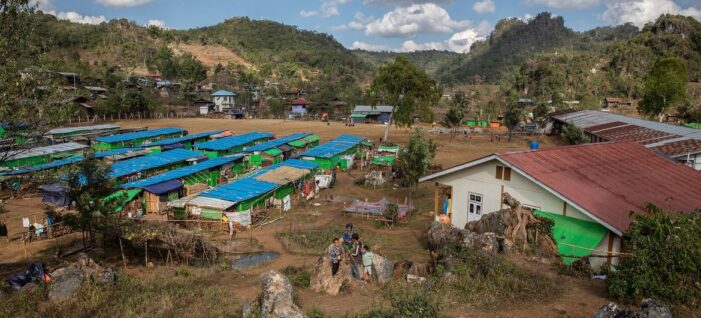
He pointed to escalating military airstrikes targeting civilians, severe food shortages and a growing displacement crisis that has forced nearly 5.2 million people from their homes, both within the country and across borders.
Military Elections Add To Political Tensions
The anniversary coincided with the conclusion of elections organised by the military government, a process that UN officials say has further intensified divisions in the country.
The vote was conducted in three phases between December 2025 and January 2026 but took place in only 263 of Myanmar’s 330 townships. Voting was largely limited to areas under military control, excluding large conflict-affected regions and many displaced communities.
Minority groups, including the Rohingya, were also excluded from participating.
Volker Türk, the UN High Commissioner for Human Rights, said the election process failed to meet international standards and instead deepened the country’s political crisis.
“The process failed to respect the fundamental human rights of Myanmar’s citizens and served only to exacerbate violence and societal polarisation,” he said.
The main opposition National League for Democracy (NLD), which won a landslide victory in the 2020 elections before the coup, was barred from participating in the vote. Several other political parties opposing military rule were also banned, and many of their leaders remain in detention.
Violence And Arrests During Voting Period
The election period itself was marked by escalating violence, according to UN human rights monitors.
Open-source reports documented at least 408 military airstrikes between December 2025 and January 2026, resulting in the deaths of at least 170 civilians.
One of the deadliest incidents occurred on January 22, when a military airstrike on a populated area in Bhamo Township in Kachin State reportedly killed up to 50 civilians. There were no indications of armed combatants in the area at the time of the attack.
Authorities also used new election security laws to suppress dissent. According to UN officials, the military arrested more than 400 people during the voting period, including 324 men and 80 women.
In one case, a citizen was reportedly sentenced to 49 years in prison for sharing anti-election content online.
Humanitarian And Economic Crisis Intensifies
Myanmar’s political repression is unfolding alongside a severe humanitarian emergency.
Nearly one quarter of the country’s population now faces acute food insecurity, while more than one-third require urgent humanitarian assistance.
Aid agencies have struggled to reach vulnerable communities due to restrictions imposed by authorities. In some areas, including Rakhine State, humanitarian assistance has been blocked despite reports of severe hunger among local populations.
The country’s economy has also deteriorated sharply since the coup. UN estimates suggest Myanmar has lost nearly $100 billion in economic output during the past five years, and the economy is not expected to return to pre-pandemic levels for some time.
“The military’s usurpation of power has also been accompanied by disastrous mismanagement of the country’s economy,” Türk said.
Evidence Of War Crimes And Crimes Against Humanity
Investigators are also examining allegations of serious international crimes committed during the conflict.
Nicholas Koumjian, head of the Independent Investigative Mechanism for Myanmar, said there is growing evidence that civilians have been subjected to atrocities amounting to war crimes and crimes against humanity.
According to the investigative body, the military has repeatedly carried out airstrikes that struck civilian areas including homes, hospitals and schools.
Reports have also documented widespread torture of detainees held by security forces.
The mechanism is also investigating allegations that some opposition armed groups may have committed abuses during the conflict.
Rohingya Survivors Seek Justice At World Court
Amid the bleak outlook, a rare moment of progress has emerged in the international legal effort to hold Myanmar accountable for atrocities committed against the Rohingya minority.
Survivors recently testified before the International Court of Justice (ICJ) in The Hague in a genocide case brought against Myanmar by the West African nation of Gambia.
UN Special Rapporteur Tom Andrews praised the courage of those who came forward to testify.
“Their testimony allows the light of truth to shine through the darkness of the most horrific of crimes,” he said.
Andrews emphasised that accountability for atrocities depends on individuals who are willing to speak out against injustice.
UN Calls For Political Dialogue
The United Nations says a sustainable path toward peace in Myanmar must begin with an immediate end to violence and the restoration of civilian governance.
The Secretary-General reiterated his call for the release of all arbitrarily detained political leaders, including President Win Myint and former State Counsellor Aung San Suu Kyi.
UN officials also stressed the need for inclusive political dialogue that brings together all stakeholders in Myanmar’s deeply divided society.
Julie Bishop, the Secretary-General’s Special Envoy for Myanmar, continues to engage with regional partners and political actors in an effort to support negotiations aimed at ending the conflict and restoring stability in the country.
ballot, coup, crisis, deepens, entrenches, military, myanmar, repression, years

Myanmar Crisis Deepens Five Years After Military Coup, UN Warns added by Arun Kumar N on
View all posts by Arun Kumar N →