
World Health Organization Director-General Tedros Adhanom Ghebreyesus issued a rare direct public message to residents of Tenerife on Friday, urging calm and solidarity as Spanish authorities prepare to receive a cruise ship linked to a hantavirus outbreak.
In a statement addressed specifically to “the people of Tenerife,” Tedros acknowledged public anxiety surrounding the arrival of the expedition vessel MV Hondius, but stressed that the situation was fundamentally different from the COVID-19 pandemic.
“This is not another COVID,” Tedros wrote, adding that the current public health risk from hantavirus to the local population “remains low.”
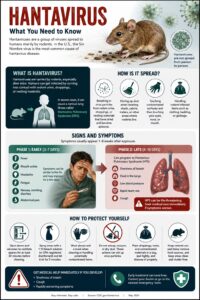
The ship has been at the centre of an outbreak involving the Andes strain of hantavirus, a rare but potentially severe viral disease. According to the WHO chief, three people have died in connection with the outbreak.
‘No Symptomatic passengers onboard’ now
Tedros said there were currently no symptomatic passengers aboard the vessel and confirmed that a WHO expert had been deployed on the ship. Medical supplies were also in place as part of the ongoing response effort.
Spanish authorities, he said, had developed a “careful, step-by-step plan” to receive passengers through Tenerife’s industrial port of Granadilla under strict containment measures.
Under the arrangement, passengers will reportedly be transported ashore in sealed and guarded vehicles through a restricted corridor before being repatriated directly to their home countries.
“You will not encounter them. Your families will not encounter them,” Tedros assured residents.
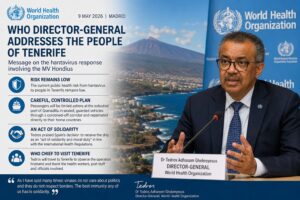
The WHO chief also defended Spain’s decision to accept the vessel, describing it as “an act of solidarity and moral duty.”
He said the WHO request to Spain had been made in accordance with the International Health Regulations, the legally binding framework governing global responses to international public health emergencies.
“Under those rules, the nearest port with sufficient medical capacity must be identified to ensure the safety and dignity of those on board,” he wrote.
Post-Outbreak trauma affecting passengers
Tedros noted that nearly 150 people from 23 countries had remained at sea for weeks following the outbreak, with many passengers grieving and seeking to return home. “Tenerife has been chosen because it has the medical capacity, the infrastructure, and the humanity to help them reach safety,” he said.
In a notable move, Tedros announced that he personally intends to travel to Tenerife to observe the operation firsthand and meet health workers, port personnel and officials involved in the response.
“I intend to travel to Tenerife to observe this operation firsthand, to stand alongside the health workers, port staff, and officials who are making it happen,” he wrote.
The WHO chief also praised the ship’s captain, Jan Dobrogowski, the crew and the operating company for their cooperation during the crisis. “As I have said many times: viruses do not care about politics, and they do not respect borders. The best immunity any of us has is solidarity,” Tedros said.
The statement comes amid heightened public concern in Tenerife over the planned arrival of the vessel and fears of possible disease transmission linked to the hantavirus outbreak.
The WHO has repeatedly maintained that the public risk associated with the current outbreak remains low and that containment measures are being strictly implemented.
 Shelton Rozario