
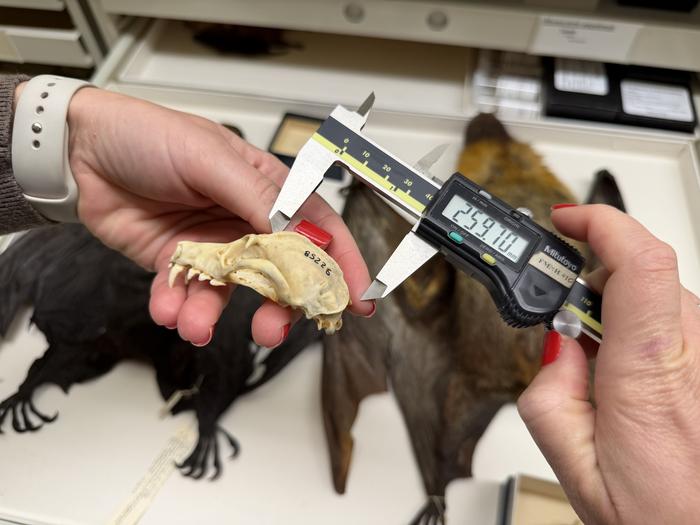
Flying foxes are the world’s largest bats, with wingspans reaching approximately five feet. However, Madagascar’s giant fruit bats appear to have become smaller over recent decades. Scientists at Chicago’s Field Museum identified the trend after noticing that older bat skulls and skins in the museum’s collections appeared larger than specimens they encountered during recent fieldwork in Madagascar. The observation prompted researchers to investigate whether the difference reflected a broader change in the animals’ physical characteristics.
Emily Cornelius Ruhs, a postdoctoral researcher at the Field Museum’s Negaunee Integrative Research Center and the study’s lead author, initially considered several possible explanations.
“I was thinking about a million different angles to explain why the bats were getting smaller. I wondered if it was related to changes in temperature or habitat,” Ruhs said.
Her colleague Steve Goodman, the Field Museum’s only full-time field biologist, proposed that hunting pressure might be responsible. Having worked in Madagascar for nearly 40 years, Goodman had observed that historical museum specimens were considerably larger than the bats encountered today.
“many of these animals were of monster size compared to animals we handle today. Hence, the idea was formed that they have diminished in body size as a result of recent heavy hunting pressure and they are not living as long as they did in decades past. This underlines the importance of historical museum material in helping scientists to understand change through time,” Goodman said.
Bat Size Decline Coincides With Commercialised Hunting
To investigate the trend, Goodman examined 121 Madagascar flying fox specimens held in nine natural history museums across the United States and Europe. The specimens had been collected over approximately 150 years.
He measured their skulls and teeth, while Ruhs conducted statistical analyses to identify changes in size over time. The results revealed a clear decline beginning around 1980, coinciding with the period when researchers believe bat hunting became more commercialised.
“We took all those measurements and put them together, and we looked at how they changed over time. We saw a clear drop in size starting around 1980, when we believe bat hunting became more commercialized,” Ruhs said.
The results surprised her because the difference was so pronounced that she initially suspected an analytical error.
“I thought that there must be something wrong with the analysis, there was no way that the rough estimate we had was correct, but it was,” she said.
Although the study establishes a correlation between shrinking body size and the expansion of commercial hunting, it does not conclusively demonstrate that hunting caused the change. Nevertheless, researchers suspect that hunters’ preference for larger animals could be contributing to the trend.
“If you’re the biggest bat in the sky, you might be the easiest target. You’re also going to provide a hunter with the most meat,” Ruhs said.
Why Losing Larger Bats Could Threaten Populations
Hunting may have consequences beyond reducing the number of bats. Many of the largest specimens examined in the study were also older individuals. If hunters disproportionately target larger, sexually mature bats capable of breeding, the practice could affect population reproduction and long-term survival.
Madagascar’s legislation classifies flying foxes as vermin because they consume commercially important fruits. The bats are also hunted for food on a large scale in certain parts of the country, making them an important resource for some communities.
However, researchers caution that hunting may not fully explain the decline in body size.
“Things like deforestation, climate change, inadequate or shifting timing of the fruit season could all be playing a role in making flying foxes smaller than they were 40, 50 years ago,” Ruhs said. “I don’t think there’s any one cause that explains it all.”
The findings therefore point to several possible human-driven pressures that may be affecting Madagascar’s flying fox populations.
Researchers Call for Stronger Conservation Measures
Flying foxes provide an important food source for some Malagasy communities and appear on the menus of certain roadside restaurants. Protecting their populations will require conservation measures that account for both their ecological needs and their importance to local livelihoods.
“These bats are an important food source in certain portions of the island for people to feed their families or on the menu in some roadside restaurants, so it is critical to figure out ways to protect the bat populations,” Ruhs said. “This needs to involve higher levels of protection following new national laws, particularly at breeding sites, so that the populations don’t collapse.”
The study also demonstrates how historical museum collections can help scientists investigate changes in wildlife across generations.
“We can still get a lot of information from these bat specimens that were collected in the 1800s,” Ruhs said.
Read More :
New ecology tools predict disease transmission among wildlife, humans
Lumpy Skin Disease looms large to become next Covid-19; Milk dairies to be affected more