
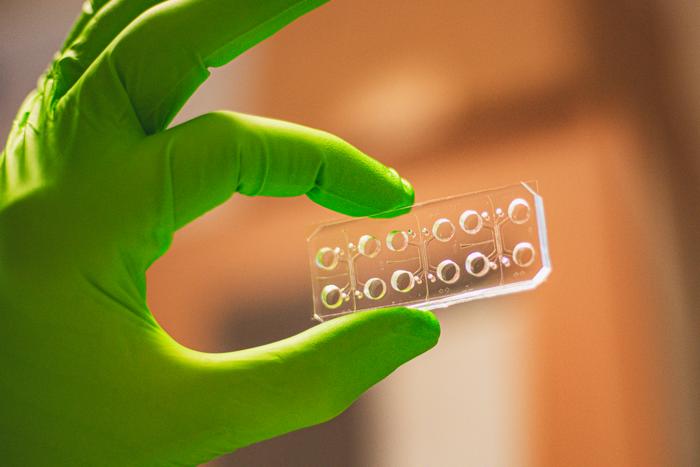
Researchers at Linköping University in Sweden, in collaboration with scientists from Politecnico di Milano in Italy, have developed an organ-on-a-chip model that recreates how head and neck cancer interacts with surrounding blood vessels, nerves and tissue.
The system, which fits on a plate roughly the size of a postage stamp, allows researchers to examine tumour growth, invasion and responses to chemotherapy under controlled laboratory conditions. The findings have been published in the Proceedings of the National Academy of Sciences (PNAS).
Three-dimensional model recreates the tumour environment
Solid tumours do not consist solely of cancer cells. They interact with surrounding tissues, blood vessels and nerves, all of which can influence how cancer develops, spreads and responds to treatment.
To recreate these interactions, the research team built the model in three stages. The first involved developing a material that imitates the extracellular matrix (ECM), the network of proteins and carbohydrates surrounding cells in the human body.
The researchers used hyaluronic acid, collagen and laminins, which are important components of the natural ECM. They found that changes in the matrix composition significantly affected cancer cell behaviour and their response to chemotherapy.
This suggests that the material surrounding cancer cells is an important factor when designing laboratory models intended to replicate human disease.
Blood vessels reveal how cancer cells spread
In the second stage, the researchers introduced blood vessel-like structures into the chip. Blood vessels supply tumours with oxygen and nutrients, provide a route for cancer cells to spread to other parts of the body and transport anticancer medicines to tumour sites.
The team observed that cancer cells responded to nearby blood vessels by moving towards them and eventually invading them, representing an early step in tumour spread. However, their behaviour varied depending on the composition of the surrounding extracellular matrix.
The researchers also used the blood vessel structures to administer cisplatin, a chemotherapy drug commonly used to treat head and neck cancer. The effectiveness of the treatment varied with the type of ECM material surrounding the cancer cells.
Pierfrancesco Pagella, Senior Associate Professor at Linköping University and lead researcher, said, “We saw that the cancer cells responded to the nearby blood vessel, moved rapidly towards it and invaded it, which is the first step in tumour spread. However, the cells behaved very differently depending on the material surrounding them.”
Nerve interactions influence tumour growth
To complete the model, the researchers used stem cells to recreate trigeminal ganglia, structures associated with nerves responsible for sensation and pain in the mouth and face.
Within a few days, the nerves had grown around the tumours, allowing the team to examine how nerve interactions affected cancer behaviour.
The researchers found that tumours in contact with nerves were less likely to invade blood vessels but grew larger. This suggests that nerves can influence tumour development in more complex ways than simply providing pathways for cancer spread.
Pagella said, “In our three-dimensional system, we saw that tumours in contact with nerves were less likely to invade blood vessels, but at the same time grew larger. Our model enables us to study nerves as an active component of the tumour microenvironment. This is particularly interesting in head and neck cancer, where nerves are involved both in regulating tumour behaviour and aggressiveness, and in cancer-related pain.”
Potential applications in drug screening and treatment research
The researchers believe the organ-on-a-chip approach could be adapted to other solid tumour types where interactions with surrounding tissues and structures play an important role.
By allowing scientists to study cancer cells, blood vessels, nerves and the extracellular matrix within one controlled system, the model could help improve understanding of tumour behaviour and treatment resistance.
Read More :