
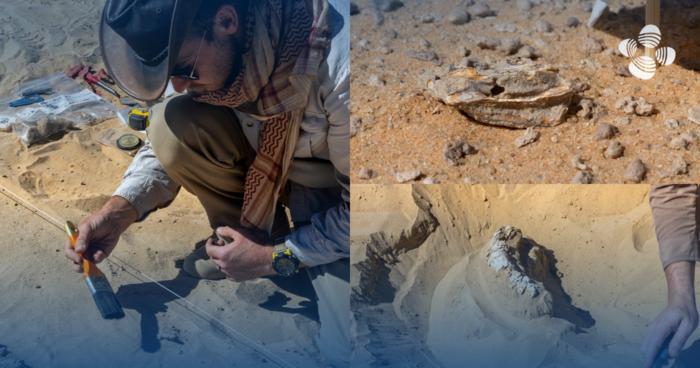
Archaeological discoveries at an ancient lakeside settlement in southern Saudi Arabia are offering new insights into how early humans hunted, processed plants and adapted to their surroundings around 125,000 years ago. Fossils, stone tools and preserved plant residues recovered from Uruq al-Julaybah near the ancient Mundafan lake provide an unusually detailed picture of human activity during a period known as Green Arabia.
The research was jointly conducted by the Saudi Heritage Commission, King Abdullah University of Science and Technology (KAUST) and Griffith University. Published in Science, the study brings together archaeological and environmental evidence to reconstruct life in the Arabian Peninsula during the last Interglacial period, when the region experienced warmer and wetter conditions.
Ancient Lake Mundafan supported a diverse ecosystem
Researchers used satellite-based terrain modelling to map the ancient lake, which covered approximately 340 square kilometres and reached a maximum depth of 29 metres. Analysis of sediments, landforms and aquatic remains indicated that it was a relatively stable freshwater body surrounded by vegetation and open grasslands.
The team documented more than 500 fossil specimens of plants and animals across over 130 locations. The animal remains included hippopotamuses, extinct long-horned buffaloes, camels, Arabian oryx, gazelles and ostriches.
These discoveries suggest that the lake supported a diverse ecosystem, providing early human populations with access to freshwater, vegetation, animals and raw materials.
Thousands of stone tools reveal hunting and plant-processing techniques
The archaeological survey recovered 5,511 stone tools measuring more than two centimetres from the main study area. Over 98% were made from flint, and researchers identified the use of Levallois techniques, a method of stone tool production involving carefully prepared cores.
Microscopic and chemical residue analyses revealed traces of various plants on the tools, including species containing toxic compounds. Residues of resin and woody tissue also suggested that some tools were used as hafted weapon tips, potentially attached to wooden shafts.
Other plant traces indicated that early humans processed tubers, bushes and palm leaves. These findings point to a range of activities involving food preparation, hunting equipment and everyday materials.
One particularly significant discovery was the potential use of toxic plant compounds in hunting technology. According to the researchers, this represents some of the earliest evidence of such practices recorded in Saudi Arabia. The site also contains some of the earliest evidence of palm-related vegetation in the region.
Evidence offers a detailed picture of daily life in Green Arabia
The researchers combined systematic archaeological surveys with two dating techniques applied to sand and fossil teeth. They also used three-dimensional stone tool refitting, alongside microscopic and chemical examinations of tool surfaces.
What makes Uruq al-Julaybah particularly important is that animal remains, stone tools and plant material were recovered together within a single dated archaeological context. This allowed researchers to connect environmental conditions with specific human activities.
The evidence indicates that people living near Lake Mundafan engaged in stone tool production, hunting equipment preparation, animal and plant resource processing, and fibre working. The availability of freshwater, vegetation and animal resources appears to have supported a variety of activities during the humid period.
Professor Frans van Buchem, KAUST Professor of Geology and co-lead scientist, said, “It is very exciting to see how the collaboration of so many different specialists allows to reconstruct this uniquely complete picture of life, behavior and the environment in the distant past.”
Dr Faisal Al-Jibreen, a Saudi Heritage Commission researcher and professor of Paleolithic archaeology, described the discovery in the sands of Lake Mundafan in the Empty Quarter as an important archaeological find that sheds light on the ancient environment and its relationship with humans and animals in southern Saudi Arabia’s early prehistory.
Discovery adds to understanding of early human movement across Arabia
Professor Chris Clarkson, co-lead scientist and Professor of Archaeology at Griffith University’s Australian Research Centre for Human Evolution, highlighted the significance of finding different forms of archaeological evidence together.
“This site gives us a rare and richly detailed view of how people lived in a landscape that looks nothing like Arabia today,” he said. “The combination of animal remains, stone tools and plant material in a single, dated context is what makes this discovery so significant.”
The research also contributes to wider efforts to understand how early human populations occupied and moved through the Arabian Peninsula as environmental conditions changed.
Professor Laurence Hapiot, co-author and Head of Heritage Research at KAUST, said, “Saudi Arabia has an exceptional archaeological heritage. Building Heritage Science capabilities in the Kingdom will enable us to turn the smallest traces into the biggest stories.”
Read More :