
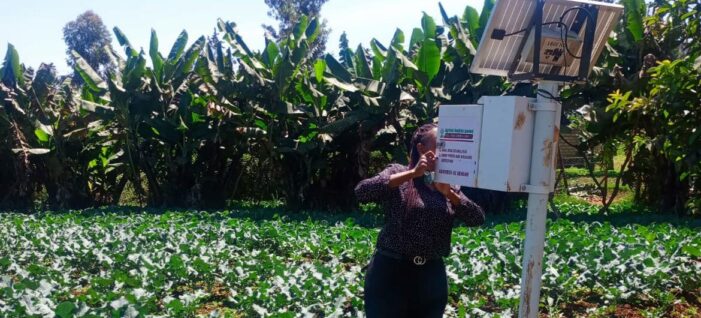
Climate change is increasingly threatening agriculture in Kenya, where farming remains the backbone of the economy and the primary source of income for millions of families. With up to 75 percent of the population relying on agriculture for their livelihoods, unpredictable weather patterns and declining soil productivity are putting growing pressure on rural communities.
Against this backdrop, Kenyan entrepreneur Maryanne Gichanga is using technology to help smallholder farmers adapt to a changing climate and improve crop productivity.
Speaking ahead of the International Day of Clean Energy, observed annually on January 26, she described how innovations such as solar-powered sensors and artificial intelligence-driven satellite data are helping farmers better understand their soil conditions, crop health and local weather patterns.
Personal Experience Inspires Innovation
Gichanga’s interest in agricultural innovation is rooted in her own childhood experiences.
She grew up in a farming family and witnessed firsthand how climate change began affecting harvests and livelihoods.
“I grew up in a farming set-up. My parents are farmers. I witnessed a lot of harvests, but when climate change started happening, we could not understand what was happening,” she said.
When crop yields declined, the impact was felt across the entire household. Farming was the family’s main source of income, and poor harvests meant fewer opportunities, including difficulties paying for education.
Those experiences motivated her to search for solutions that could help farming families cope with climate uncertainty.
“I always wanted to offer solutions to my parents and other people from farming families,” she explained. “That is what inspired me to start my company and work with people who are like-minded to build technology that supports smallholder farmers.”
Technology Helping Farmers Make Better Decisions
Through her work, Gichanga provides farmers with access to data that was previously unavailable to many small-scale agricultural communities.
Solar-powered sensors placed in farmland monitor soil moisture and other environmental conditions. These devices are combined with satellite imagery and artificial intelligence tools that analyse crop growth and changing weather patterns.
The information helps farmers make better decisions about irrigation, planting schedules and soil management, improving both productivity and resilience to climate shocks.
Her work has been supported by Greenovations Africa, a programme backed by the United Nations that supports women entrepreneurs working on climate and sustainability solutions.
The initiative provides training, mentorship and seed funding to help early-stage businesses expand their impact.
Breaking Barriers In A Male-Dominated Field
Despite the success of her work, Gichanga says building a technology-focused agricultural company has not been easy.
Agriculture and technology sectors across many parts of Africa remain largely male dominated, and women often face skepticism about their leadership and technical expertise.
“In Africa, communities are quite patriarchal,” she said. “Trying to get into this male-dominated field is hard because people would rather work with a man.”
She noted that some people initially doubted that women could lead technological innovations in agriculture.
Over time, however, demonstrations of the technology and visible results helped build trust with farmers and communities.
Persistence, collaboration and a clear sense of purpose, she said, were essential in overcoming those obstacles.
“You cannot give up. Collaborate with the people you meet and eventually it will work out,” she added.
Transforming Lives Through Agricultural Innovation
For Gichanga, the most rewarding part of her work is seeing how improved farming practices directly change people’s lives.
Access to better data can increase crop yields, strengthen farmers’ bargaining power and help families achieve greater financial stability.
“When you empower farmers, their lives change,” she said.
She recalled moments when farmers who once struggled to buy seeds were eventually able to sell their harvest at better prices and regain control over their livelihoods.
Such progress, she said, reinforces the importance of continuing to develop solutions that strengthen rural economies.
Encouraging The Next Generation Of Women Innovators
Gichanga also hopes her journey will encourage more women and young people to pursue innovation in agriculture and climate action.
Her advice to aspiring entrepreneurs is simple: start, even if the path ahead seems uncertain.
“You will learn along the way, and there are many people who will support you financially or offer advice and training,” she said.
“There is no perfect time to start. You will never feel fully prepared. Just do it and don’t be scared.”
As climate change continues to reshape agricultural systems across Africa, innovators like Gichanga are demonstrating how technology and determination can help farmers adapt and build more resilient futures.
climate, drought, family, farm, farmers, helping, Kenyan, outsmart, tech, woman

Kenyan Innovator Uses Solar And AI Tools To Help Farmers Tackle Climate Challenges added by Arun Kumar N on
View all posts by Arun Kumar N →