
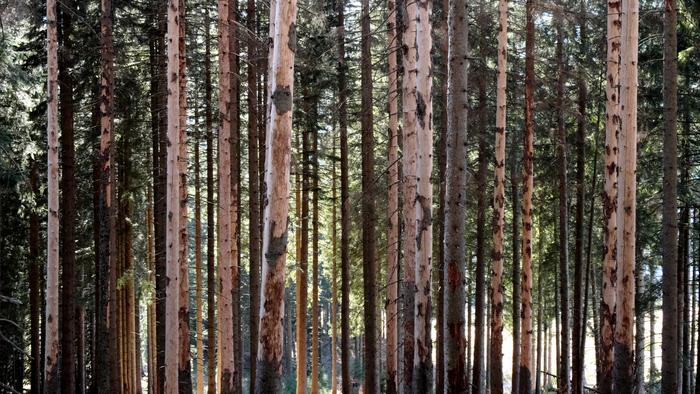
A new study estimated the extent to which the area covered by Europe in forest could be disturbed by fire, storms, and bark beetles by the year 2100 in varying climate conditions. With satellite data and forest simulations, an artificial intelligence model predicted the disturbances on a continental scale using 13,000 points in Europe.
In every case, disturbances of the forests in the future were greater than it is today, with great impact on forests and services to the society.
There is a significant effect of wildfires, storms, and even bark beetles on forests and the benefits that they bring to people and environment.
This is the first time when a big international team of researchers at the Technical University of Munich (TUM) has computed how disrupts would alter the forests in Europe in the year 2100. In even the most optimistic of scenarios, the team does project a significant expansion of the damaged forest area, in the worst case, the disturbance might even be doubled.
It is not novel that trees die, and in fact, it is a normal process in the forest that is in the process of natural dynamics whereby old trees die, young trees regenerate and become the next generation of canopy trees.
The new thing is the magnitude of how wildfires, storms, and bark beetles are transforming forests due to the change of climate. The amount of forest destruction in Central Europe demonstrated dramatic figures in recent years, however until this time it was unknown how much the area covered by forests could be deterred by future disturbances. The disturbances define the carbon storage capacity of the forests, the timber they are capable of offering, and the habitats of which species they are able to offer, thus making the results very significant to the policymakers and society.
A great number of researchers headed by Professor of Ecosystem Dynamics and Forest Management, Rupert Seidl, TUM, has now filled this gap in knowledge. The researchers have approximated that, the space disrupted by fires, storms, and bark beetles might increase threefold by 2100 with a global warming of slightly above 4 degrees Celsius.
The researchers used remote sensed data as a reference point between 1986 and 2020, a timeframe that experienced abnormally high disturbance in the forests. Although it is in the best scenario, the researchers are projecting increased destruction of forests in future compared to this reference period even with the warming of about 2 degrees Celsius.
Regional differences
In combination with 13,000 simulations of forests in Europe, the model was an AI-based simulation, which was trained on 135 million data points of forest simulations and multi-decadal satellite data of forest disturbances. This enabled them to model how the forests would develop in future and how disturbances would occur and penetrate to the scale of a single hectare providing very accurate information on regional variation in future forest disturbance patterns.
The study has indicated that forests in Southern and Western Europe will be affected especially and will experience the strongest forest disturbances.
The overall impact of the future on Northern Europe is less expected to be severe, though the hotspots of the future forest damage are predicted to appear as well. According to Rupert Seidl, disturbances are becoming a cross-regional problem, that is, they destroy timber markets in Europe and endanger the ecosystem services that forests bring to society.
The study authors hence regard the growing disturbance rates as being an urgent demand on forest policy and management to consider: “We should be ready to witness a lot of forest damage in the near future. On the one hand, this implies that we have to prepare and cushion against more severe changes in the services forests offer. Conversely, disruptions also provide a chance to create new and climate-resistant forests – they are agents of change,” said Seidl.
Forestry has to meet the threat and the opportunity of increasing the level of disturbance, with the help of new scientific techniques and knowledge, explained Seidl.

Europe Deforestation to Double, Predicts AI Study Citing Fires, Storms and Bark Beetles added by Arun Kumar N on
View all posts by Arun Kumar N →