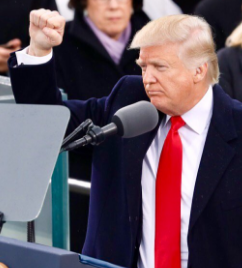
On the social media platform X, the rallying cry “Stop the Invasion” has exploded into a digital battleground, capturing the raw pulse of America’s polarized immigration debate. What began as a staple in Republican political rhetoric has evolved into a grassroots hashtag and slogan, amassing thousands of posts in recent months.
With U.S. President Donald Trump’s second term underway and promises of mass deportations in full swing, users from Texas suburbs to Minnesota diners are invoking the phrase to demand action, while critics label it a dehumanizing trope that stokes fear and division.The phrase’s resurgence coincides with heightened enforcement efforts by Immigration and Customs Enforcement (ICE), including raids in sanctuary cities and the conversion of warehouses into detention centers at a cost of $38.3 billion.
As border apprehensions dip under Trump’s executive actions, which he touted as fulfilling a 2024 campaign pledge to “stop the invasion of illegals into our country,” X serves as a real-time barometer of public sentiment.
A review of over 50 recent posts reveals a stark divide: fervent calls for walls, deportations, and cultural preservation on one side, and accusations of racism and moral panic on the other.The Slogan’s Political Pedigree“Stop the Invasion” isn’t new to U.S. discourse; it’s a thread woven through decades of conservative messaging on immigration.
Trump’s Amplification Throughout
Trump amplified it during his 2016 and 2024 campaigns, running thousands of Facebook ads in 2019 alone that warned of an “INVASION” at the southern border, often pairing it with images of migrant caravans. By 2024, Trump had invoked “invasion” over 500 times in speeches and posts, framing migrants as “killers” and “animals” to underscore the urgency, according to NYT.
His running mate, Florida Gov. Ron DeSantis, echoed the language in a 2023 campaign plan titled “Mission Stop the Invasion,” proposing military involvement in Mexico to curb drug flows and crossings. In Texas, Gov. Greg Abbott has operationalized the rhetoric through Operation Lone Star, a $11.1 billion initiative launched in 2021 to “stop the invasion.”
Abbott’s efforts, including razor wire and floating buoys in the Rio Grande, have drawn lawsuits from the Biden administration but praise from Trump allies.The slogan’s echoes reach beyond the border. In 1992, California Gov. Pete Wilson ran ads urging Congress to “stop the invasion” of Latino migrants, a tactic that boosted his re-election but deepened ethnic tensions.
Today, it’s a cornerstone of Trump’s “largest deportation operation in American history,” with early 2026 actions targeting criminal noncitizens and suspending asylum claims.
Viral Flashpoints: From Temples to Town Halls
On X, “Stop the Invasion” often pairs with visceral, local grievances, turning policy debates into cultural flashpoints. A February 16 post by Texas GOP operative @Carlos__Turcios went viral with 6,585 likes, decrying a 105-foot Hanuman statue in Sugar Land – the third-largest in the U.S. – as evidence of “Third World Aliens… slowly taking over Texas and America.”
The video, showing the Hindu deity’s installation, sparked a firestorm: supporters like @ma_double replied, “Houston, Texas too. Stop the invasion!” while others, including Indian-American users, fired back that it was “xenophobic fearmongering.” The post, viewed over 530,000 times, exemplifies how the phrase extends to non-border issues, blending immigration with anxieties over religious and ethnic shifts.
Similar outrage erupted over a Minneapolis restaurant meeting where Somali officials allegedly claimed parts of Minnesota for Somalia.
@DerrickEvans4WV, a former West Virginia lawmaker, shared footage calling it a “sovereignty” threat, prompting @GinoPatti88 to demand: “Stop the invasion. Revoke citizenship. Deport them all back to Somalia.”
The clip amassed 20,802 views, fueling calls for a nationwide immigration freeze.Even non-immigration contexts borrow the language. Rep. Nancy Mace (R-S.C.) used “Stop the Invasion of Women’s Spaces Act” in a February 7 post to ban transgender individuals from female facilities in federal buildings, garnering 2,007 likes. “Men in women’s private spaces is not normal,” she wrote, illustrating the phrase’s rhetorical elasticity.Grassroots users amplify these themes.
Another user @Oilfield_Rando, with 1,504 likes, argued the crisis could end “tomorrow if congress simply suspend[ed] asylum protections,” calling it a “two page bill.” @SitInMyTruck
echoed: “Halt ALL immigration and remove the invaders… There’s no ‘legal’ or ‘illegal’ – it’s just immigration and it’s an invasion that must be reversed.”
In Europe, @JoeyMannarino targeted Spain’s Pedro Sánchez: “The number one priority… must be to defeat Sánchez and close the border from Morocco.”
Dehumanization or Desperate Plea?
Not all reactions are supportive. Critics on X and beyond argue the rhetoric veers into racism, reducing humans to “vermin” or “swarms.” Rev. Dr. Jacqui Lewis posted in 2023 that terms like “infestation” enable violence: “Then you can kill them, and people will cheer.”
Also, @JRubinBlogger, a Washington Post columnist, called Trump’s “infest” language a “full-throttle toward dehumanization,” stripping immigrants of personhood.
Recent posts highlight the human toll. @AlBuffalo2nite criticized a viral narrative using a migrant’s death to shield against enforcement: “Turning personal grief into a political shield… is manipulation.”
@equalityAlec, a civil rights lawyer, decried the “nativist, xenophobic” framing: “The core… is the notion that human beings are worth more or less depending on where they are born.”
@LOPE_64warned: “The first step in dehumanization is language… one day, when this madness is over, everyone will claim they were against it.”
Media analyses reinforce this. A 2025 HuffPost report linked Trump’s “invasion” trope to the 2019 El Paso shooting, where the gunman cited it in his manifesto. The New York Times traced its use in GOP ads, noting parallels to Pete Wilson’s 1992 campaign, which “deepened ethnic tensions.”
The Anti-Defamation League (ADL) flagged it in 2025 white supremacist propaganda, often tied to “white genocide” conspiracies. Defenders push back. @AssociationOfF2F argued: “There’s nothing dehumanizing about enforcing immigration law… It’s about the social and political victimization of the native population.”
@dystopiangf framed opposition as “genocidal,” insisting borders protect a people’s “voice, will, mind, and soul.”
A Nation at the Crossroads
As Trump’s administration ramps up deportations, targeting over 1 million in the first year, “Stop the Invasion” encapsulates a broader reckoning. Polls show 60% of Americans favor stricter enforcement, but 55% also support pathways to citizenship for Dreamers.
On X, the phrase trends weekly, with spikes around ICE operations and viral videos.For users like @theworldofmomus, it’s a “consensus building” moment: “End to… illegal immigration while reducing the flow of legal migration.”
Yet as @MorgothsReview noted, such narratives often “humanize the illegal migrants” at the expense of native stories: “We do not get the story of the last white kid in class.”
The debate rages on X, where algorithms amplify outrage. Whether it’s a clarion call for security or a dog whistle for division, “Stop the Invasion” underscores America’s unresolved soul-searching: Who belongs, and at what cost? As one user put it, “A nation is equivalent to a people’s voice.” In 2026, that voice is louder than ever.
europe, Indian immigrants, norway reaction, Stop the Invasion, target, Trump call, US immigrants, X debate