
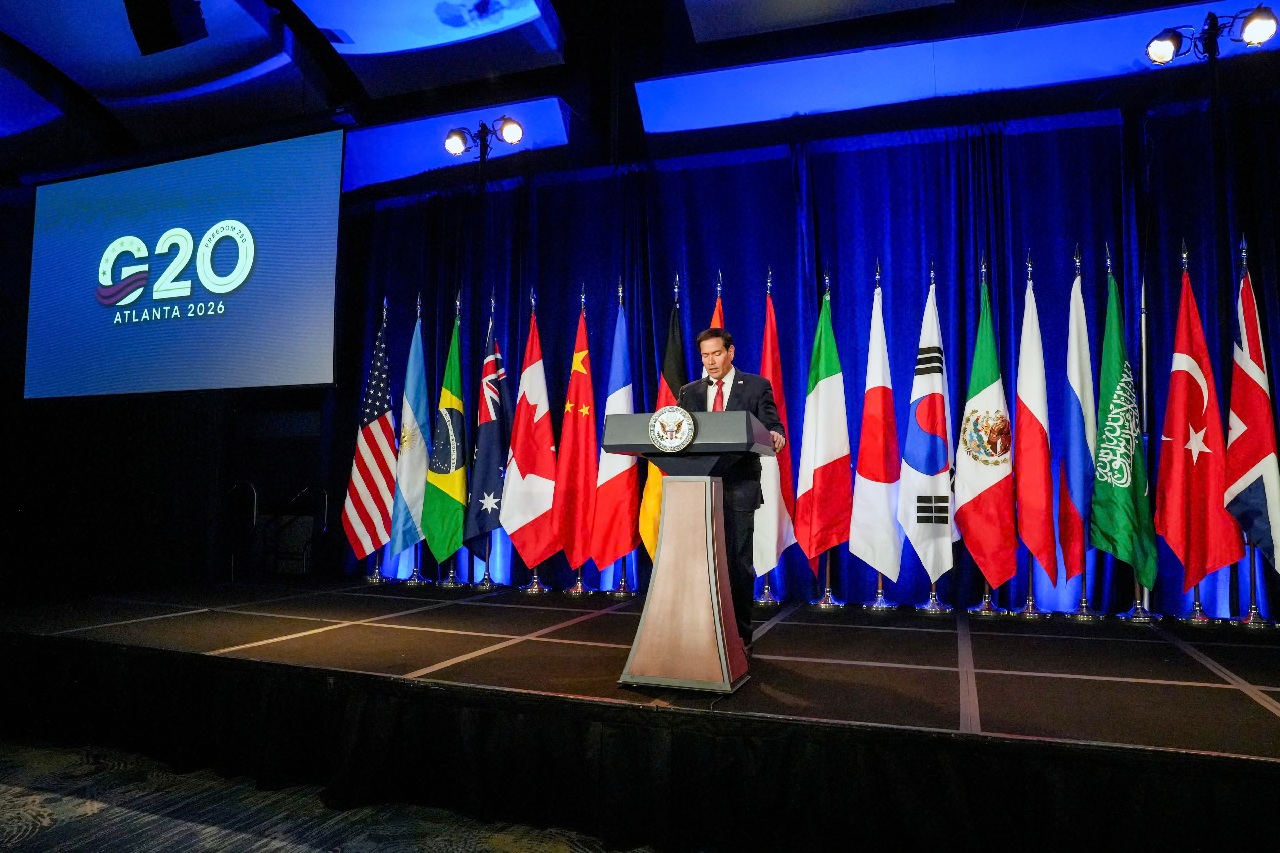
A diplomatic confrontation over Russia has forced the United States to abandon the traditional G20 foreign ministers’ family photograph after Australia, Britain, Canada and several European countries refused to appear alongside Russian Foreign Minister Sergei Lavrov at the gathering in Atlanta.
US Secretary of State Marco Rubio cancelled the planned photograph after objections from approximately a third of the participating delegations, turning what is usually a ceremonial opening to an international meeting into a public demonstration of the divisions over Russia’s continuing war against Ukraine.
The controversy reflects a wider diplomatic challenge for President Donald Trump, whose administration has sought to bring Moscow back into international engagement even as European governments maintain that Russia should remain politically isolated over its invasion of Ukraine.
The meeting also exposed disagreements over Washington’s handling of the Ukraine conflict, its decision to exclude South Africa from the gathering and the future direction of the G20, which brings together the world’s major economies.
Australia’s Foreign Minister Penny Wong backed the decision to cancel the photograph, making clear that Canberra did not want its participation to be interpreted as acceptance of Russia’s actions.
“Australia has been clear and consistent: we will not normalise Russia’s brutal and illegal invasion of Ukraine,” a spokesperson for Wong said.
“Our focus at the G20 remains on the important work before us and addressing the challenges facing the global economy.”
Lavrov’s presence triggers diplomatic protest
The British delegation also opposed participating in an official photograph with Lavrov.
UK Foreign Secretary Ed Miliband criticised Russia’s conduct in Ukraine, arguing that the conflict was not simply a bilateral dispute but an assault on international law and national sovereignty.
“An assault not only on Ukraine but on us all — trampling international law, sovereignty and self determination — core principles on which we all depend,” Miliband said.
A UK government source said Britain had no intention of changing its longstanding policy of avoiding direct bilateral engagement with Russian ministers following the invasion of Ukraine.
Germany also objected to the proposed photograph. Foreign Minister Johann Wadephul said there would be no family photograph with European partners and Lavrov because, in his words, “there is no normalcy with Russia”.
Poland’s Deputy Prime Minister and Foreign Minister Radosław Sikorski also made his position clear.
“I am not the only one who does not want to be photographed with Lavrov,” he told reporters in Atlanta.
The United States ultimately removed the photograph from the official programme, with officials concerned that the controversy would overshadow the discussions.
Russia, meanwhile, defended its participation. Lavrov attended the meeting as Moscow’s representative, while the Russian Foreign Ministry had earlier complained about visa-related difficulties faced by its delegation.
The gathering was particularly significant because Lavrov’s attendance represented another opportunity for the Trump administration to engage directly with Moscow despite continuing disagreements over Ukraine.
G20 divisions extend beyond Russia and Ukraine
The diplomatic confrontation was not limited to the question of Russia’s participation.
South Africa, a founding member of the G20 and its only African member, was not invited to the Atlanta meeting. The decision drew objections from other participating countries.
South African officials said the country’s absence was not voluntary.
“We have consistently maintained that our nonparticipation is not voluntary,” said Phindile Kunene, spokesperson for South African Foreign Minister Ronald Lamola.
Pretoria welcomed the objections raised by other G20 members and said it was prepared to participate on an equal footing when Britain assumes the group’s presidency next year.
Ukraine was also excluded from the Atlanta gathering. US officials said Washington had decided to limit invitations to formal G20 members, although Ukraine had been invited to previous meetings.
The disagreements come as the G20 faces a difficult agenda involving the Russia-Ukraine war, the US-Israeli conflict with Iran, trade tariffs, energy security, maritime navigation and China’s activities in the South China Sea.
Opening the meeting, Rubio urged participating countries to work together despite their differences.
“We are in a critical moment,” he said, warning that the world was facing “a series of interconnected economic and geopolitical crises”.
He pointed to disruptions affecting global energy and food supplies, international trade and freedom of navigation, arguing that these developments threatened the foundations of the global economic order.
The United States has identified maritime security, particularly freedom of navigation through the Strait of Hormuz, the Red Sea, the Black Sea and the South China Sea, as important subjects for discussion.
The prospect of renewed US military action against Iran has also added to concerns about energy supplies and global oil prices.
Diplomats described the opening discussions as cordial but acknowledged that major differences remained, particularly over Ukraine and Russia’s opposition to Poland joining the G20.
A joint communiqué from the foreign ministers appeared unlikely, although participants said they would continue efforts to bridge their differences ahead of the G20 leaders’ summit in Florida in December.
The cancellation of the family photograph has therefore become a visible symbol of a deeper problem: the G20 is attempting to coordinate global economic and security responses at a time when its members remain sharply divided over the wars, alliances and political relationships shaping the international order.