
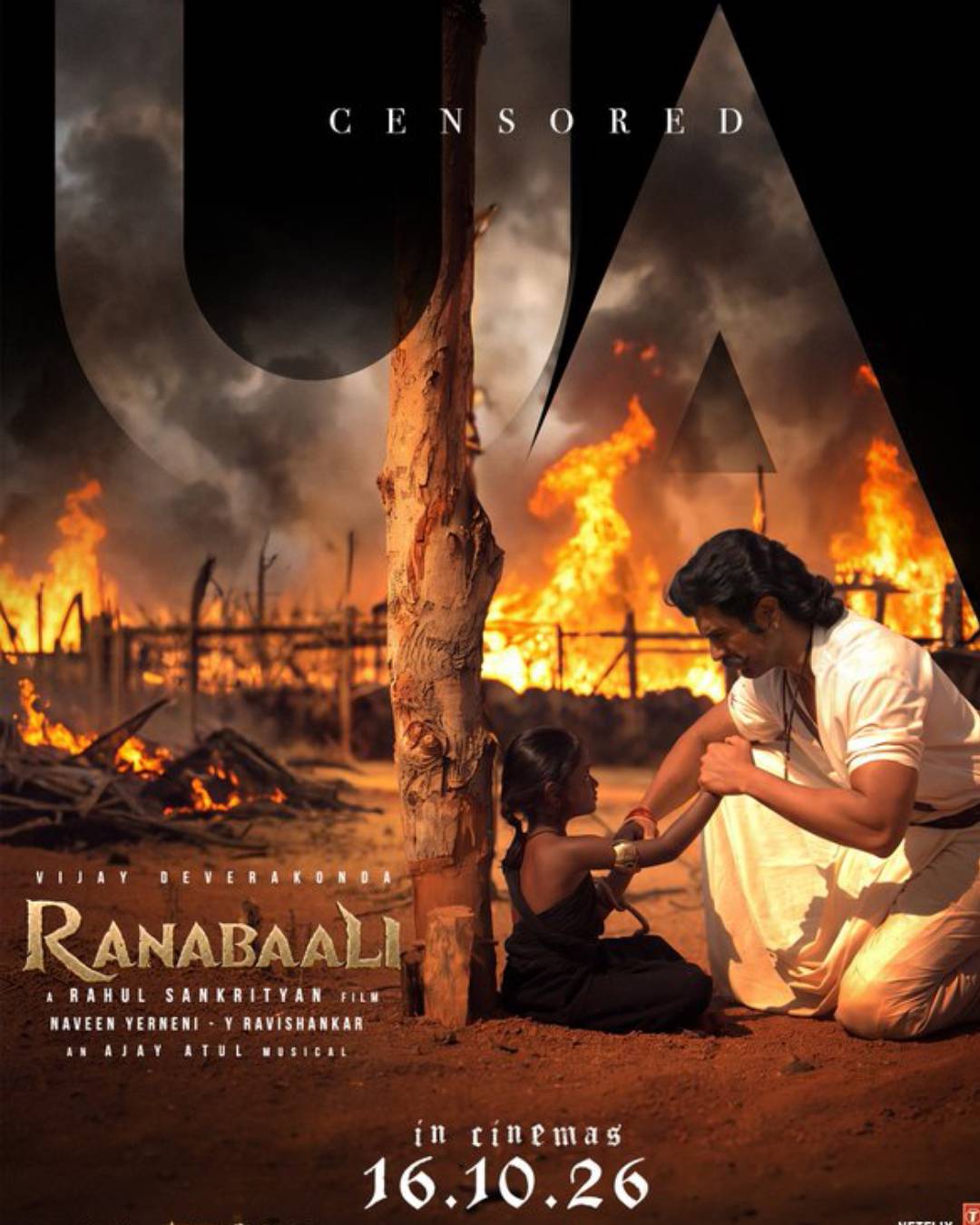
Vijay Deverakonda and Rashmika Mandanna’s much-anticipated period action drama Ranabaali has cleared the Central Board of Film Certification (CBFC) with a U/A certificate, clearing a key hurdle ahead of its scheduled worldwide theatrical release on October 16. Produced by Mythri Movie Makers and presented by T-Series, the film is being positioned as a large-scale historical spectacle that seeks to revisit events from British-ruled India that, according to the filmmakers’ promotional claims, have received limited attention in mainstream historical narratives.
The certification announcement comes just two days before the film’s scheduled release, giving overseas audiences and the Indian diaspora a fresh reason to watch for international screenings and ticket availability. With Vijay playing the titular character Ranabaali and Rashmika portraying his wife, Jayamma, the film brings together a commercially popular pairing while placing them in a period drama built around colonial-era conflict, resistance and contested historical memory.
Mythri Movie Makers announced the certification on social media, describing the film as a story that had survived generations and a legend that deserved to be witnessed. The production house urged audiences to book tickets for the October 16 release, using the promotional hashtags #NeverForget and #RanabaaliOnOct16th.
The film had originally been scheduled to release on September 11, 2026. Its revised October 16 date puts it among the notable Indian theatrical releases to watch this month, particularly for Telugu cinema audiences overseas who follow major releases featuring established stars.
What the U/A Certificate Means for Indian and Overseas Audiences
The U/A certification means the film has been cleared for public exhibition, with parental guidance advised for younger viewers. The certificate is relevant for families deciding whether to watch the film together, although the exact suitability for children will depend on the film’s depiction of violence, conflict and other mature material.
For non-resident Indians (NRIs), the immediate practical question is where and when Ranabaali will be screened in their country of residence. The production house has announced a worldwide theatrical release for October 16, but actual showtimes, language versions and ticket availability may vary by territory and cinema chain.
Overseas audiences should check local cinema listings and authorised ticketing platforms rather than assume that every market will begin screenings on the same day. Release schedules can differ because of local distribution arrangements, theatre availability and regional programming.
The film’s pan-India positioning may also draw attention from viewers beyond the Telugu-speaking diaspora. Vijay Deverakonda and Rashmika Mandanna have established followings among audiences who watch Indian films in multiple languages, while the colonial-era setting could appeal to viewers interested in historical action dramas.
However, the U/A certificate itself does not establish the film’s historical accuracy or confirm the claims made in its promotional campaign. It is a certification decision for theatrical exhibition, not an endorsement of the historical interpretation presented on screen.
A Colonial-Era Story Built Around Historical Reconstruction
Ranabaali is set against the backdrop of British rule and is being mounted as a period action drama based on events associated with the nineteenth century. The film’s stated historical span is 1854 to 1878, while promotional accounts have also described its inspiration more broadly as incidents from between 1850 and 1900.
According to sources associated with the project, the story draws on real incidents that allegedly received limited representation in mainstream history books. The film is also being promoted as an attempt to examine how certain events were represented during British rule and how alternative accounts may have survived outside conventional historical narratives.
The makers have reportedly described Ranabaali as neither a conventional biopic nor a straightforward retelling of a textbook account. Instead, it is presented as a cinematic reconstruction of an era drawing on multiple real accounts, oral histories and records said to have been overlooked or suppressed.
That distinction is important for viewers, particularly those in the diaspora who may encounter the film as an introduction to unfamiliar episodes of Indian history. A period drama can stimulate interest in historical events, but dramatic reconstruction may combine documented incidents, interpretation and fictional elements. The film’s specific claims about colonial-era events will need to be assessed against historical records and independent scholarship.
The nineteenth century was a period of major political and social upheaval across the Indian subcontinent, including resistance to colonial authority and the expansion of British administrative control. Yet the available information about Ranabaali does not identify all the specific historical incidents on which the plot is based. It would therefore be premature to attribute the film to a particular rebellion, historical figure or documented episode without further confirmation from the filmmakers.
For NRIs seeking to understand the historical context, the film may provide a starting point for further reading and discussion. Its broader appeal will depend partly on how effectively it combines historical setting, character development and action with a coherent account of the period.
Vijay Deverakonda, Rashmika Mandanna and the International Cast
Vijay Deverakonda plays Ranabaali, the central character, while Rashmika Mandanna appears as Jayamma, his wife. Their on-screen reunion is a major part of the film’s commercial appeal: Ranabaali marks their third film together after Geetha Govindam and Dear Comrade.
Their previous collaborations have given the pairing recognition among Telugu cinema audiences and fans who follow their work across Indian-language releases. Their return in a period action drama represents a different setting from their earlier films, with the new project relying on historical conflict and large-scale production rather than a contemporary romantic or relationship-driven backdrop.
The film also features Arnold Vosloo, known internationally for his role in The Mummy, as the antagonist Sir Theodore Hector. His casting adds an internationally recognised face to a production aimed at audiences in India and overseas.
Ranabaali has been produced by Naveen Yerneni and Y. Ravi Shankar under the Mythri Movie Makers banner, with T-Series presenting the film. Its large-scale production and worldwide release strategy reflect the growing emphasis on taking Indian-language films to overseas markets alongside domestic theatrical launches.
For the Indian diaspora, such releases can provide an opportunity to watch major Indian productions in cinemas close to where they live, rather than waiting for a later streaming release. The actual overseas rollout, however, will depend on local distribution and confirmed theatre schedules.
With certification secured and October 16 set as the release date, attention now shifts to the film’s theatrical rollout and audience response. Its combination of a popular lead pair, an international supporting actor and a colonial-era narrative gives Ranabaali several potential points of appeal. Whether it succeeds as both an action spectacle and a compelling historical reconstruction will become clearer once audiences see the finished film.
For now, the confirmed developments are the U/A certification, the principal cast, the production credits and the announced worldwide theatrical release date. The broader claims about overlooked historical events remain part of the film’s positioning and should be distinguished from independently established historical findings.