
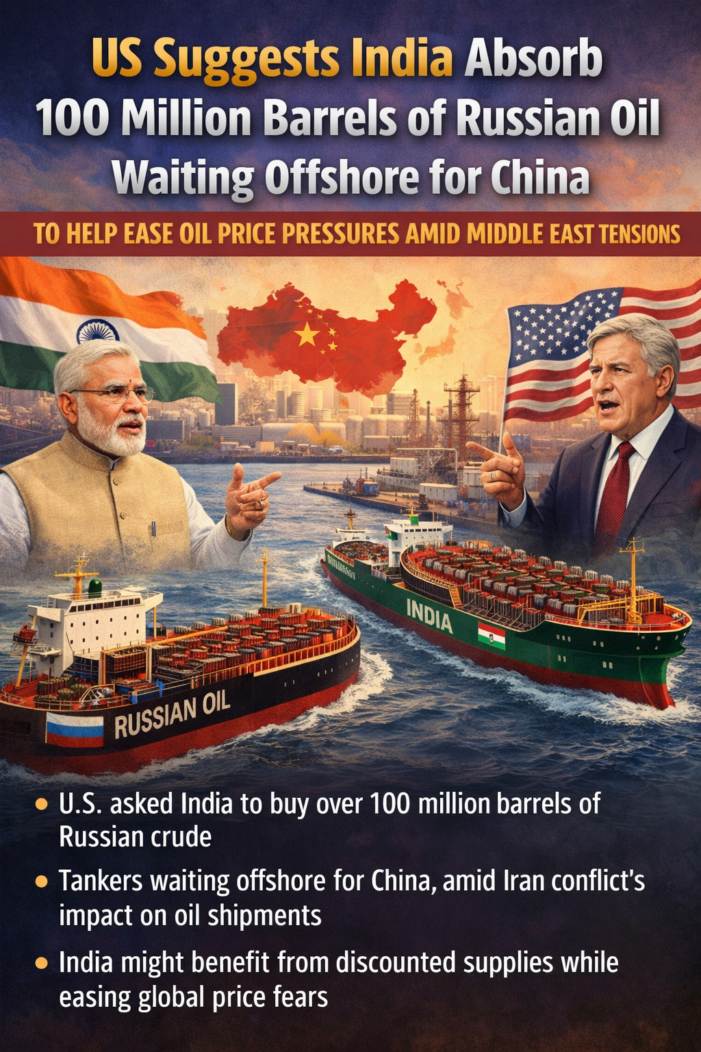
• US suggested India absorb Russian oil waiting for Chinese refineries
• Over 100 million barrels of crude currently floating offshore
• Extra cargoes could benefit Indian refiners through discounted supply
• Move aimed at cooling global oil prices amid Middle East tensions
The United States has proposed that India reflect on absorbing over 100 million barrels of Russian oil which is already offshore to be transported to refineries in China, which Washington reckons will assist in alleviating the soaring oil prices amidst the threats of violence in the Middle East.
US Energy Secretary Chris Wright said the suggestion was part of a short-term effort by the Trump administration to stabilise energy markets unsettled by disruptions in the Middle East. Speaking in television interviews on CNN and CBS News, Wright said senior US officials had directly raised the idea with New Delhi.
“I did call up the Indians, as did Treasury Secretary Scott Bessent,” Wright said, noting that a large volume of Russian oil is currently idling at sea while waiting to be processed by Chinese refineries. According to Wright, more than 100 million barrels of Russian crude are effectively stuck in a queue offshore because of limited unloading capacity in China.
The proposal, he said, was to divert those cargoes to Indian refineries instead of leaving them anchored for weeks.
“Instead of having it wait six weeks to unload there, let’s just pull that oil forward, have it land at Indian refineries and tamp this fear of shortage of oil, tamp the price spikes and the concerns we see in the marketplace,” Wright said.
“This is simply a pragmatic step with a short time horizon,” Wright said. The US official emphasised that the outreach to India does not signal any shift in Washington’s broader policy toward Moscow.
“The United States’ policy towards Russia has not changed,” Wright said when asked whether the move contradicts Western efforts to reduce reliance on Russian energy.
Wright added that the global oil market remains fundamentally well supplied and that recent price spikes are largely driven by uncertainty rather than an actual shortage.
“The world is very well supplied with oil right now,” he said.
Tanker movement through the Strait of Hormuz, a key artery for global oil shipments, has begun to resume following disruptions linked to the Iran conflict, although traffic remains below normal levels.
“We’re nowhere near normal traffic right now, and it will take some time,” Wright said, adding that any disruption is likely to last weeks rather than months.
What It Means For India?
India has become one of the biggest purchasers of discounted Russian crude since the war in Ukraine changed the global energy trade in 2022. The Russian oil is currently taking up approximately a 1/3rd of the crude imports into India and assists Indian refiners to obtain supplies at prices which are usually lower than those of the producers found in the Middle East.
Should the Indian refiners intervene and absorb some of the oil that is already awaiting China, this may contribute to alleviating congestion in global supply chains and avoid another round of crude prices soaring. Analysts opine that more discounted cargoes may also enhance the company refining margins of companies like Indian Oil Corp, Reliance Industries and Nayara Energy, which have increased their consumption of Russian crude in the last three years.
Nevertheless, the concept is not fully unproblematic.
The refining system already used in India has the capacity to process the blend of crude grades and the high volume would require a larger refinery capacity, logistics and contracts in place. The shipping routes and insurance arrangements may also come into play especially with the complicated system of sanctions on Russian energy exports.
New Delhi has always justified its energy buying decisions with Russia by saying that it is vital to buy low-cost gas to support its economy. Indian officials have reiterated on several occasions that the country would purchase oil anywhere it could at good prices.
In the case of international markets, the diversion of cargoes that is lying offshore may assist in abating the so-called fear premium which has increased the oil prices in the recent Middle East tensions.
In the case of India, however, the scenario may provide it with another opportunity to consolidate its as one of the most versatile and opportunistic purchasers in the rapidly divided energy market.
bring down oil prices, buy russian oi, diplomacy, iran war, reversal in US oil policy toward India, Russian oil, strait of hormuz, us asks India

Amid Iran Tensions, US Asks India To Absorb Russian Oil Meant For China; What The Proposal Means For India? added by Sridhar P on
View all posts by Sridhar P →