
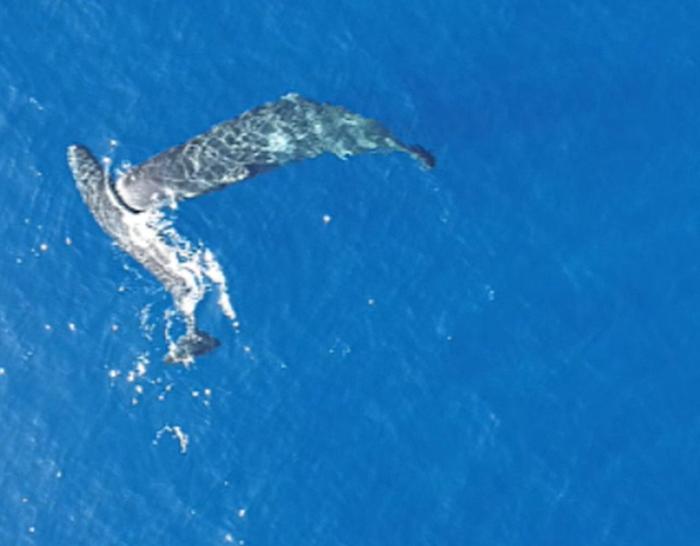
The first sign came as two massive bodies turned toward each other just below the surface. Moments later, their heads met in a controlled strike.
That interaction, recorded on drone footage between 2020 and 2022, now forms the basis of a study led by the University of St Andrews, a research university in Scotland. [1]
The findings, published March 23 in Marine Mammal Science, mark the first systematic scientific documentation of sperm whales headbutting one another.
Researchers say the behavior has long been suspected but never directly observed in a structured, repeatable way.
Sperm whale headbutting behavior documented using drone footage
The footage was captured during fieldwork in the Azores, an autonomous region of Portugal in the Atlantic Ocean, and the Balearic Islands, a Spanish archipelago in the Mediterranean Sea.
Scientists used aerial drones to observe whales from above, allowing them to track interactions that are difficult to detect from boats at sea level.
Lead author Dr. Alec Burlem said the observations confirmed a hypothesis that had persisted for decades without direct evidence.
“It was really exciting to observe this behaviour, which we knew had been hypothesised for such a long time, but not yet documented and described systematically,” Burlem said in a statement issued by the University of St Andrews.
The study found that sub adult whales, rather than large adult males, were most frequently involved in the headbutting interactions.
Earlier assumptions had linked such behavior to competition among dominant males. The new findings suggest a broader social function that may involve younger members of whale groups.
Researchers say the behavior appeared deliberate and repeated, often occurring alongside other forms of social interaction at the surface.
The function remains unclear. Scientists note that additional observations will be needed to determine whether the behavior relates to play, social bonding, or competitive practice.
(Courtesy: Popular Science Podcasts)
Moby Dick and Essex whale attack accounts gain scientific backing
Accounts of sperm whales using their heads as weapons date back to the 19th century, particularly during the era of open boat whaling.
One of the most widely cited incidents involves the Essex, a 27 meter sail powered whaleship that sank in 1820 after being struck by a sperm whale in the Pacific Ocean near the Galapagos Islands.
Owen Chase, the ship’s first mate, described the encounter in a contemporary account:
“I turned around and saw him about one hundred rods directly ahead of us, coming down with twice his ordinary speed of around 24 knots, and it appeared with tenfold fury and vengeance in his aspect. The surf flew in all directions about him with the continual violent thrashing of his tail. His head about half out of the water, and in that way he came upon us, and again struck the ship.”
The incident later inspired Herman Melville’s novel Moby Dick, which depicted a powerful whale attacking ships.
Other reports from the same period, including the sinkings of the Ann Alexander and Kathleen, describe similar head on strikes by whales.
Such accounts have often been treated cautiously in scientific contexts due to the lack of direct observational evidence.
The new study does not replicate ship attacks, but it provides evidence that sperm whales do engage in controlled head first contact with each other.
Evolutionary risks and questions about whale communication systems
The findings also raise questions about how such behavior fits within sperm whale biology.
Some researchers have suggested that headbutting may originate from physical contests, potentially linked to mating competition between males.
Others have argued that repeated use of the head as a weapon could pose risks. The sperm whale head contains structures critical for producing sound, including clicks used for echolocation and social communication.
Damage to these structures could affect navigation and group coordination, making the behavior potentially costly.
The study does not resolve these competing explanations. It documents the behavior and outlines possible interpretations based on observed patterns.
Burlem said drone technology is likely to expand what scientists can observe at the ocean surface.
“This unique overhead perspective for observing and documenting near surface behaviour is just one of the ways drone technology is transforming the study of wildlife biology,” he said.
He added that researchers are seeking additional footage from other observers to better understand how widespread the behavior may be.
For now, an observation once confined to maritime history and literature has entered the scientific record.
Also Read:
Aquatic plant reduces antibiotics in water and genetic damage in fish, but risks remain
‘Plenty of fish in the sea’? Not anymore, say UN experts in Nice
 Sridhar P