
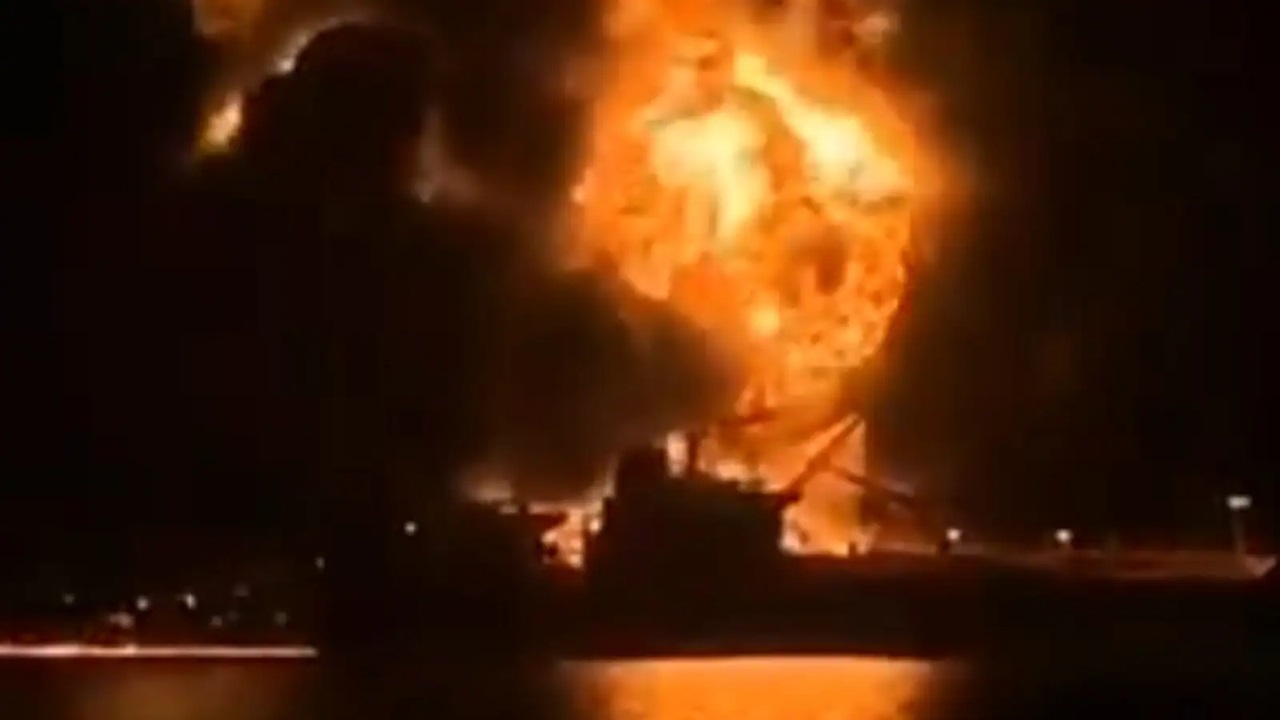
A single Israeli airstrike on the world’s largest gas field has ignited a chain of retaliatory attacks across the Middle East, crippling energy infrastructure from Tehran to Doha and sending shockwaves to petrol pumps from Mumbai to Minneapolis.
The flames that erupted over Iran’s Bushehr Province on the night of March 18 were visible from fishing boats miles out in the Gulf. On shore, they signalled something far more consequential than a military strike: the opening of a new and terrifying chapter in the Middle East’s long war over energy.
Israeli jets had struck the South Pars gas field (the world’s largest, shared between Iran and Qatar) and the sprawling Asaluyeh processing hub on Iran’s southern coast. Within hours, Tehran’s military commanders promised not merely retaliation but systemic destruction. They kept that promise.
In the days that followed, drones and missiles rained down on refineries, liquefied natural gas plants, and export terminals across Saudi Arabia, Kuwait, Qatar, the United Arab Emirates and Bahrain. The Gulf, the artery through which nearly a third of the world’s traded oil flows, was effectively at war with itself. “If strikes on Iran’s energy facilities happen again, further attacks on your energy infrastructure and that of your allies will not stop until it is completely destroyed,” said Ebrahim Zolfaqari, Iranian Military Spokesman.
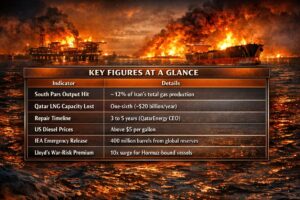
KEY FIGURES AT A GLANCE
The Strike That Started It All
South Pars is not merely a gas field. Shared with Qatar, which calls its half the North Field, the reservoir holds enough natural gas to power civilisations for generations. Disrupting it was not simply a military calculation. It was an economic declaration of war.
Israel’s stated rationale was to sever a critical revenue artery for the Islamic Revolutionary Guard Corps. According to Israeli officials, the strike was coordinated with Washington, a claim that put the White House in a diplomatically delicate position. President Donald Trump subsequently said the United States “knew nothing” about the strikes, even as an Israeli official told CNN the two governments had acted in concert. Trump later ruled out further American-sanctioned attacks on Iranian energy sites, though the damage was already done.
The Asaluyeh processing hub took offline approximately 100 million cubic metres per day of gas processing capacity, roughly 14 per cent of South Pars output and close to 12 per cent of Iran’s total national gas production. Eyewitness videos showed the field ablaze in the night sky, an orange glow reflected in the waters of the Persian Gulf.
Iran’s response was swift, coordinated, and designed to demonstrate that the Islamic Republic could exact a symmetrical price. The Iranian military announced it had entered “a new stage in the war,” one in which energy facilities linked to the United States were legitimate targets.
Drone and missile strikes hit refineries in Riyadh, LNG plants in Kuwait and Qatar, and export terminals along the UAE coast. Missile debris alone, intercepted by air defences, forced the shutdown of Abu Dhabi’s massive Habshan gas complex. The Fujairah export terminal, through which significant volumes of oil bypass the Strait of Hormuz entirely, was struck repeatedly.
Bahrain declared force majeure after its Sitra refinery was hit. Iraq sharply curtailed output from its southern oilfields as a precautionary measure, even though no direct strikes landed on Iraqi soil.
Perhaps most significantly for the global energy market, an Iranian strike hit Qatar’s Ras Laffan industrial city, the nerve centre of its LNG export operations.
“The attacks have knocked out a sixth of Qatar’s LNG export capacity, worth $20 billion a year. Repairs will take three to five years.” CEO, QatarEnergy, speaking to Reuters
Qatar accounts for roughly 20 per cent of global LNG supply. A sixth of that capacity gone overnight means dozens of energy-hungry nations, from Japan and South Korea to India and Germany, scrambling for alternative supply in a market with none readily available.
The violence did not spare Israel. Iranian forces struck oil facilities at the port of Haifa, Israel’s largest commercial harbour and a key energy terminal. Israeli media confirmed structural damage, though authorities reported no casualties. The symbolism was unmistakable: in this new phase of the conflict, no energy installation on either side is sacred.
Markets in Meltdown
Global energy markets reacted with a ferocity not seen since the early days of the Russia-Ukraine war. Middle East crude benchmarks hit record highs. In the United States, diesel crossed the $5-per-gallon mark, a politically charged threshold that sends inflationary pressure cascading through the entire economy. Gasoline reached its highest levels since late 2023.
In Asia, refiners from China to South Korea began cutting processing runs, unable to secure adequate feedstock at workable prices. Beijing and Seoul imposed export controls or price caps on refined products, prioritising domestic supply over export revenues. For India, which sources nearly 45 per cent of its crude from the Gulf, the disruption carries particular weight, both at the pump and at the policy table in New Delhi.
The insurance industry moved with unusual speed. Lloyd’s of London and major reinsurers imposed war-risk exclusions on Gulf energy infrastructure almost immediately. War-risk premiums for vessels transiting the Strait of Hormuz, the narrow chokepoint through which 21 million barrels of oil pass every day, multiplied tenfold within days.
The International Energy Agency took the extraordinary step of calling for the release of 400 million barrels from global strategic reserves, a scale of intervention that underscored just how severe the shock has been.
The strikes have laid bare two uncomfortable truths. First, that even the most sophisticated air defence systems, American, Israeli and Saudi alike, cannot fully protect the Gulf’s most critical and geographically exposed energy infrastructure. Second, that Iran retains a formidable capacity to impose costs on its adversaries and their regional allies, even as its own installations burn.
The world is watching a war fought not merely with missiles but with energy itself as both weapon and target. The question is no longer whether global supply chains will be disrupted. They already have been. The question is how long the disruption lasts, and whether diplomacy can find a foothold before another salvo makes that question moot.
(Disclaimer: The story has used AI assistance in images and online research but filed by reporter and vetted by human editor entirely.)
 Arun Kumar N