
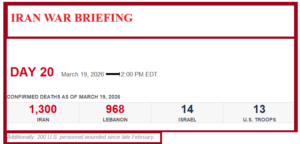
Iranian forces struck energy infrastructure across the Gulf on Thursday, triggering sharp movements in global oil and gas markets and widening a conflict that has now claimed more than 2,200 lives across four parties in 20 days. Brent crude, the international benchmark, surged past $116 a barrel while European gas prices rose more than 30 percent in a single session, as traders priced in the risk of prolonged supply disruption across the world’s most critical energy corridor.
The Trump administration responded on two fronts: a direct threat to destroy one of the world’s largest gas reserves if Iranian attacks on Qatari infrastructure continued, and a separate signal that Washington was prepared to release sanctioned Iranian oil to keep prices in check.
Energy and Market Impact
Brent crude closed above $116 a barrel on Thursday, a level not seen since the early months of Russia’s invasion of Ukraine in 2022, driven by Iranian attacks on Qatari LNG sites and widening threats to Gulf energy facilities. European gas prices climbed more than 30 percent in the same session.
The immediate trigger was “extensive” damage to Qatari LNG facilities, confirmed by state-owned QatarEnergy. Qatar supplies roughly one-fifth of the world’s LNG, making its export terminals among the most price-sensitive infrastructure in the global energy system. Any sustained outage there amplifies cost pressure across European importers still managing reduced Russian pipeline volumes.
Compounding market anxiety is Iran’s ongoing effective blockade of the Strait of Hormuz, through which passes a critical share of the world’s seaborne oil. The U.S. Navy has reported 20 commercial vessels targeted in or around the Strait since Iranian operations began, with seven fatalities and four crew members still unaccounted for.
Treasury Secretary Scott Bessent indicated the administration was weighing a partial sanctions waiver to release approximately 140 million barrels of Iranian oil, described as roughly two weeks of supply, currently immobilised in and around the Strait. “We will be using the Iranian barrels against the Iranians to keep the price down,” Bessent told Fox News.
Iran and the Gulf States
Iran’s Islamic Revolutionary Guard Corps (IRGC) issued advance evacuation warnings before launching strikes against what it described as “U.S.-linked” energy facilities across the Gulf. Saudi Arabia and Kuwait confirmed that drones struck three oil refineries. The UAE reported Iranian missiles directed at the Habshan gas facilities and the Bab oil field, both close to Abu Dhabi; Habshan was shut down after debris impacts, according to local officials.
Tehran framed the strikes as retaliation for Israeli attacks on Iranian coastal gas infrastructure connected to the South Pars field, carried out on Wednesday. South Pars is a joint Iranian-Qatari offshore reserve and Iran’s primary domestic gas source. President Trump warned publicly that the United States would “massively blow up” the South Pars Gas Field if Tehran continued targeting Qatari LNG sites, while distancing Washington from the preceding Israeli strikes.
Israel and Lebanon
Israel reported striking an Iranian military helicopter in Hamadan, in western Iran. In Lebanon, the Israel Defense Forces said operations in the south killed more than 20 Hezbollah fighters in the previous 24-hour period. Lebanese health authorities put the country’s total death toll at 968, as Israeli ground forces continued advancing north through southern Lebanon and conducting strikes on Hezbollah-linked districts of Beirut.
Air raid sirens sounded across Israel on multiple occasions Thursday. Iranian state media reported that nine medium-range ballistic missiles fitted with cluster warheads were fired at targets in central and northern Israel. Cluster munitions disperse dozens to hundreds of sub-munitions across a wide area, creating a broader pattern of damage than a single warhead but with less precision.
U.S. Policy Outline
Defense Secretary Pete Hegseth declined to specify a timeline for ending U.S. involvement when speaking to reporters Thursday, saying only that the military was “on plan” and “on target.” Hegseth addressed reports that the Pentagon had submitted a request to Congress for $200 billion in supplemental funding, saying: “It takes money to kill bad guys.”
Reuters, citing four unnamed U.S. officials, reported that the White House was actively considering deploying thousands of additional troops to the region. The U.S. has recorded 13 military fatalities since operations began in late February and a further 200 wounded.
On the diplomatic front, Treasury Secretary Bessent’s comments about sanctioned Iranian oil represented the clearest public signal yet that Washington is prepared to use economic tools, including partial sanctions relief, to manage energy market fallout, even as the military campaign continues.
Escalation Signals
Several indicators suggest the conflict is broadening rather than contracting. The expansion of Iranian strikes from the Strait of Hormuz to Gulf state energy facilities marks a geographic widening of Tehran’s targeting. The deployment of ballistic missiles with cluster warheads against Israeli population centres represents an escalation in weapons type. The Pentagon’s $200 billion supplemental funding request, if approved by Congress, would authorise sustained operations well beyond the current posture.
The sole de-escalatory signal on Thursday came from the economic track: Bessent’s sanctions-relief proposal, if implemented, would release Iranian oil into global markets without lifting pressure on Tehran politically. Whether that distinction holds under further military escalation remains uncertain.