
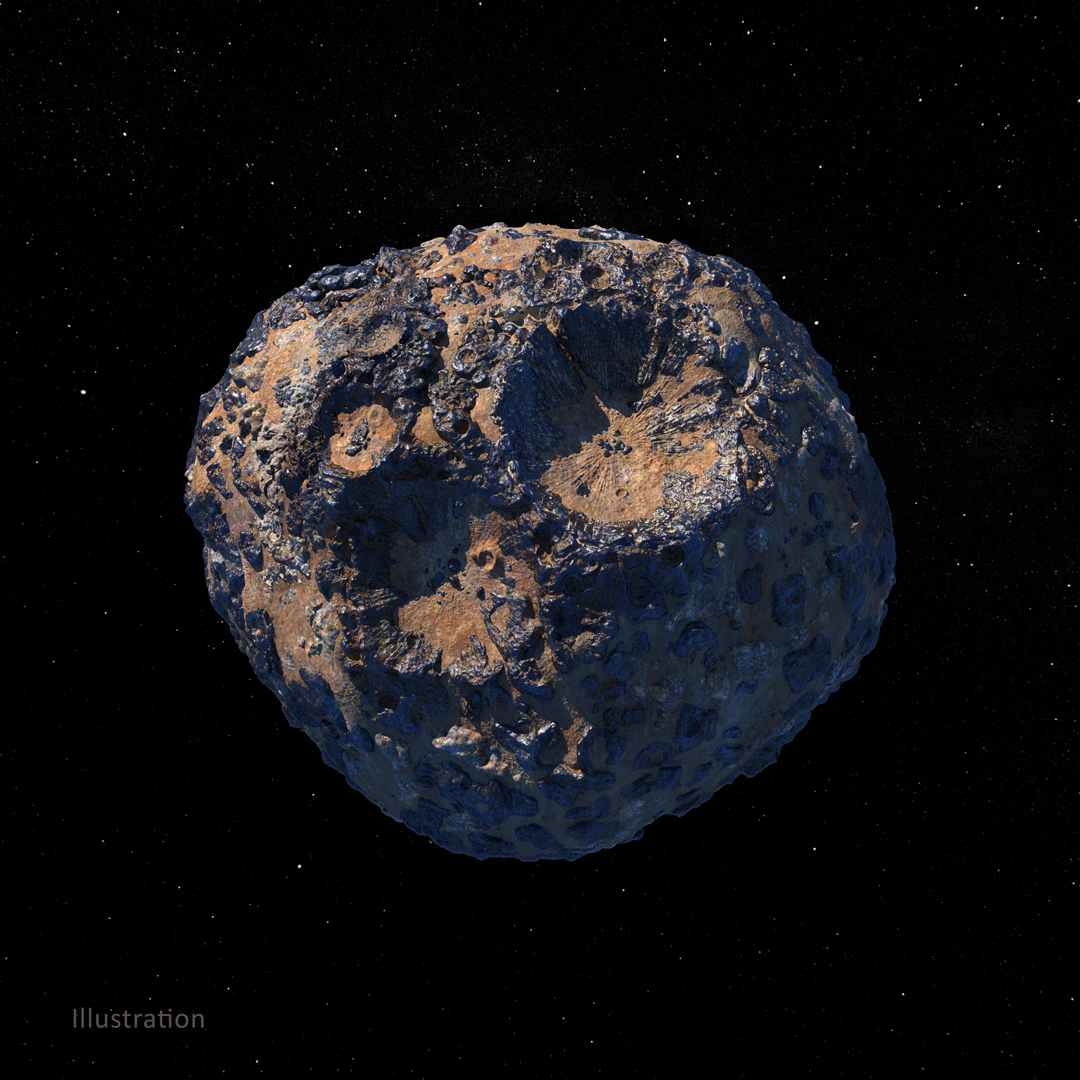
Another investigation that forms the structure of massive craters on asteroid 16 Psyche is providing new perspectives on one of the most persistent mysteries of the Solar System, whether the metallic object is the open core of an unsuccessful planet or a complex of debris formed during numerous collisions.
The scientists in the Lunar and Planetary Laboratory of the University of Arizona are the researchers who conducted the study, which was published in JGR Planets, and dedicated to the possibility of unlocking the inner composition of Psyche due to a large impact basin located near the north pole of the asteroid. The results will likely inform the interpretation of the data of the NASA Psyche space probe, which will visit the asteroid in the year 2029.
The largest known metal-rich asteroid is psyche, which is found in the prime asteroid belt separating mars and Jupiter and is one of the heaviest bodies found in the area. Its bizarre structure has been a long-standing puzzle to scientists, and rival theories have proposed that it might be the rocky and metallic inertia of an early planet, or of violent impact that caused the mixing of metals and rock over time.
To experiment with such situations, scientists ran high-speed crashes on a 3-D model of Psyche which was how a crater similar to 30 miles across and three miles deep was formed. The differing impact conditions and internal structures allowed the team to come up with predictions regarding the way various compositions would form the resulting crater and the surrounding debris.
According to the simulations, porosity, which is the empty space in the asteroid, is an important factor that affects the crater formation. This is different to solid planetary bodies, most asteroids are loose or fractured and thus can absorb impact energy in a different manner. Impacts in more porous structures will create deeper and steeper craters and less material ejected on the surface.
Asteroid layered metallic core
There were two main models of the interior of Psyche tested in the study: the asteroid is layered reaching a dense metallic core and thin rocky mantle, and the second one is that the metal and silicate materials are evenly intermingled. Although both scenarios could result in the measured crater sizes, each scenario created a different ejecta pattern and internal compression pattern.
These variations, according to researchers, may turn out to be important suggestions when there would be direct observations. Equipments in the Psyche spacecraft will capture the surface composition of the asteroid, gravity and magnetic field, an assessment of the difference in density that could have occurred due to impact in the past.
Scientists compare the research to the reconstruction of a process that has been abandoned long ago based on its remains. Through surface studies of craters and patterns of debris those studying them hope to be able to determine the internal composition of a body that might be able to tell us about the very earliest phases of planetary formation.
Origin of Psyche
The theory of the origin of Psyche has more far-reaching consequences in the field of planetary science. The discovery of the asteroid as an exposed core would give an opportunity to study processes that formed rocky planets such as Earth processes that are otherwise not reachable since planetary cores are buried deep within thick mantles.
Another theme addressed in the study is the increased importance of advanced simulations in space mission preparation. Predicting tests set in advance before the arrival of the spacecraft, researchers want to speed up the analysis of the information once the real-time stream of information arrives.
Psyche mission, which was initiated by Arizona State University and is supported by NASA Jet Propulsion Laboratory and other organizations belongs to NASA Discovery Program. By the time the spacecraft arrives at its destination towards the end of this decade, scientists are hopeful that it will provide the first close-up view of a metallic world – and possibly end a two hundred plus century long debate.
Also Read:
New NASA DART mission data reveals asteroids throw ‘cosmic snowballs’ at each other
NASA Sensors to Help Detect Methane Emitted by Landfills