
The Government of India’s Namami Gange Programme is adopting a range of conventional and innovative wastewater treatment technologies to address pollution in the Ganga river basin. The initiative combines new sewage treatment infrastructure with decentralised treatment systems, energy recovery, sludge management and the rehabilitation of ageing sewer networks.
Launched in 2014, the Namami Gange Programme is an Integrated Conservation Mission with two main objectives: effective pollution abatement and the conservation and rejuvenation of the National River Ganga. Its principal areas of intervention include sewerage treatment infrastructure, riverfront development, river-surface cleaning, biodiversity conservation, afforestation, public awareness, industrial effluent monitoring and Ganga Gram.
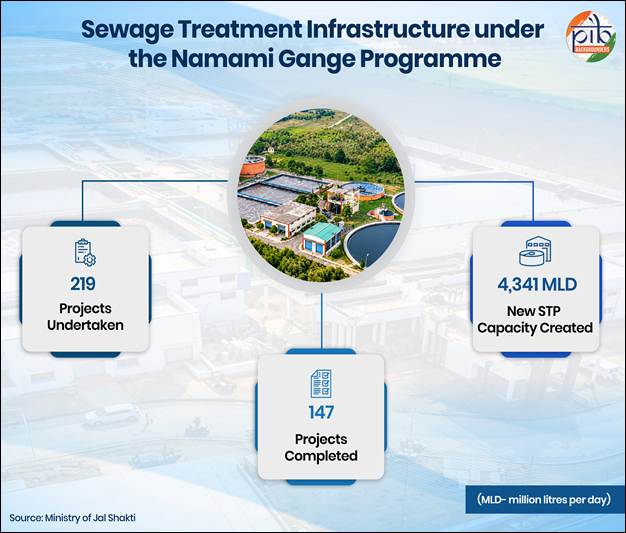
According to information released by the Press Information Bureau on October 21, 2026, the programme has undertaken 219 projects worth an estimated ₹35,664 crore, of which 147 have been completed. Across 10 Ganga basin states, interventions include the development of 6,603 million litres per day (MLD) of sewage treatment plant capacity, with 4,341 MLD created.
The programme follows a technology-neutral approach, selecting treatment processes according to local conditions, sewage characteristics, available land, discharge standards and opportunities for treated-water reuse.
Diverse Technologies Address Different Wastewater Challenges
The Namami Gange Programme uses several treatment processes, including the Conventional Activated Sludge Process, Upflow Anaerobic Sludge Blanket, Sequential Batch Reactor, Moving Bed Biofilm Reactor, Fluidized Aerated Bed and Food Chain Reactor. Other approaches include electrocoagulation, constructed wetlands and packaged treatment systems such as Johkasou.
Activated sludge uses microorganisms to break down organic matter into carbon dioxide, water and other inorganic compounds. Sequential Batch Reactor technology uses a cyclic activated-sludge process to achieve high treatment efficiency through a single-step biological process.
The programme has also introduced technologies designed to reduce land requirements, energy consumption and operational complexity.
Food Chain Reactor: This technology improves upon conventional activated-sludge and Sequential Batch Reactor processes by incorporating fixed artificial media and plant roots. It offers a smaller footprint, lower power consumption and nutrient removal. Five FCR-based sewage treatment plants are operational: two at Bhatpara in West Bengal and three at Prayagraj in Uttar Pradesh. Another plant is under construction at Bhagalpur in Bihar, with an approximate area of 175 square metres per MLD.
Electrocoagulation: This non-biological process uses electric current and a coagulant metal anode to destabilise suspended and emulsified pollutants. It can be suitable for cold temperatures, hilly terrain and locations with limited access. Uttarakhand has 17 recorded installations, including a 0.05 MLD plant at Police Chowki, a 1.19 MLD plant at Vivekanand Colony and a 1.25 MLD plant at Pokhari Bend.
On-site treatment: An Advanced Oxidation Process-based pilot at Varanasi’s Assi Drain was designed to treat excess wastewater near its source, avoiding the need for long interception and diversion sewer lines. The approach aims to improve water quality, increase dissolved oxygen and eliminate odour. Its financing model links payments to the volume of treated water and the achievement of performance indicators, without an upfront capital payment.
Multi-storey treatment plants: At Muni Ki Reti’s Chandreshwar Nagar, the programme has developed the country’s first four-storey municipal sewage treatment plant under the initiative. The 7.5 MLD facility occupies approximately 900 square metres, addressing land constraints and the challenges posed by local drainage conditions. Its land requirement is around 120 square metres per MLD with biological nutrient removal, compared with 400 square metres per MLD for the cited conventional alternative.
Nature-Based and Decentralised Treatment Solutions
The programme recognises that smaller settlements may not have the land, infrastructure or financial resources required for conventional sewer networks and large treatment plants. Decentralised and nature-based systems provide alternatives for such locations.
Constructed wetlands use plants, growing media, water, soil and microorganisms to remove pollutants under controlled conditions. In Bithoor, Uttar Pradesh, six wetlands were developed directly on drains to treat approximately 2 MLD of wastewater. The town, with a population of around 20,000, faced high conventional sewerage costs and a lack of suitable land for a treatment plant. Following third-party appraisal, constructed wetlands were selected as an emerging treatment technology. Biochemical Oxygen Demand levels fell from around 75 milligrams per litre at the inlet to below 10 milligrams per litre in the treated effluent.
Johkasou is another decentralised option. These prefabricated, plug-and-play units combine several treatment processes and can meet applicable regulatory and National Green Tribunal norms. They are useful where flows are low, construction is difficult or space is limited. Six installations have been recorded in Uttarakhand. Depending on the configuration, the systems may incorporate screening, primary and biological treatment, secondary settling, recirculation, disinfection and filtration.
NEREDA technology uses aerobic granular sludge, in which bacteria form compact granules with good settling properties. The technology offers a smaller footprint, lower construction costs and reduced operating expenditure. Reported power savings are approximately 50% compared with the Activated Sludge Process and 20% compared with the Sequential Batch Reactor. At the 60 MLD NEREDA-based plant at Pahadi Patna, the bioreactor occupies approximately 1,900 square metres, compared with 5,400 square metres for the cited SBR requirement.
Soil Biotechnology combines physical processes, such as sedimentation and infiltration, with biochemical processes to remove suspended solids and organic and inorganic substances. The system uses suitable minerals, native microorganisms and bio-indicator plants. A 1.2 MLD Soil Biotechnology-based sewage treatment plant was constructed at Devprayag, with effluent standards based on NGT parameters.
Faecal sludge and septage management extends treatment to areas without conventional sewer connections. At Chunar in Uttar Pradesh, a 10-kilolitre-per-day faecal sludge treatment plant pilot was sanctioned at a construction cost of ₹2.70 crore. An FSTP treats periodic septage from soak pits and septic tanks; it does not replace a conventional sewage treatment plant. Co-processing allows collected septage from unconnected areas to enter the wider treatment system alongside city sewage.
Energy Recovery and Greener Sewage Treatment Plants
Namami Gange also focuses on reducing the energy requirements and environmental impact of wastewater treatment. Anaerobic digestion breaks down organic matter in the absence of oxygen, producing biogas that can be used to generate electricity.
At Varanasi’s 140 MLD Dinapur STP, actual flow is approximately 110 MLD, with total monthly power consumption of 420,000 units. Biogas-based generation reaches around 220,000 to 300,000 units per month, representing approximately 52% to 72% of consumption. At the 80 MLD Naini STP in Prayagraj, biogas generation accounts for around 50% of daily power consumption. Projects at Jajmau in Kanpur and Bhagalpur also incorporate biogas generation, while a 220 MLD plant at Meerut has been identified for Bio-CNG generation.
Sludge management is another priority. The Volute Press, a sludge-dewatering device, was introduced at the 50 MLD Ramana STP to meet guaranteed energy-consumption and land requirements. A sludge-incineration pilot at Rishikesh is exploring thermal stabilisation and volume reduction. Dewatered sludge containing around 20% solids can be dried to approximately 90% solids using hot air before oxidation. The resulting dry ash is not bio-manure, although stabilised ash may be considered for making fire bricks or concrete.
Solar energy is also being incorporated into treatment infrastructure. At the 42 MLD Naini STP, a 1,000-kilowatt solar plant generates approximately 3,850 units daily against a requirement of 5,700 units. At the 80 MLD Naini STP, solar generation contributes around 1,400 units per day, while biogas supplies another 4,500 units against total consumption of about 8,900 units.
Additional installations and projects include the 16 MLD Jhunsi and 14 MLD Phaphamau STPs, along with projects at Bareilly, Bhagwanpur, Vrindavan, Hathras, Shamli and Saharanpur. A 220 MLD STP at Meerut has been proposed as a Green STP, with 100% solar power envisaged for the plant and associated facilities. A 10 MW off-site solar plant was being considered by the concessionaire, with electricity supply proposed under the Government of India’s Open Access Policy.
Rehabilitation and Long-Term Infrastructure Management
Expanding treatment capacity must be accompanied by the rehabilitation of existing sewage treatment plants and trunk sewers. Ageing equipment, failure to meet treatment standards and missing tertiary-treatment components can require upgrades.
Examples include rehabilitation work at the 80 MLD Naini STP in Prayagraj, incorporating electro-mechanical works, biogas power and online continuous effluent monitoring systems (OCEMS). The 130 MLD Jajmau STP in Kanpur received civil and electro-mechanical rehabilitation, biogas power, chlorination and OCEMS.
Trunk sewer rehabilitation is also critical for addressing siltation, damage and punctures in ageing networks. In Varanasi, a 7-kilometre brick trunk sewer, up to 2,400 millimetres in diameter, was taken up for rehabilitation using a Glass Reinforced Pipe liner. In Kanpur, 9.3 kilometres of old brick trunk sewer, up to 2,250 millimetres in diameter, was taken up using Machine Wound Spiral Lining.
The programme uses the Hybrid Annuity Model-based Public-Private Partnership and the One City/Cluster-One Operator model to integrate new and existing sewage infrastructure. These arrangements combine construction-linked payments with performance-linked payments over 15 years.
Under this model, 31 projects covering 1,955 MLD were taken up. Of these, 11 projects covering 454 MLD have been completed, while six projects covering 235 MLD are at an advanced stage of completion.
Read More :
 Arun Kumar N
 Srinivas Chakravarty