
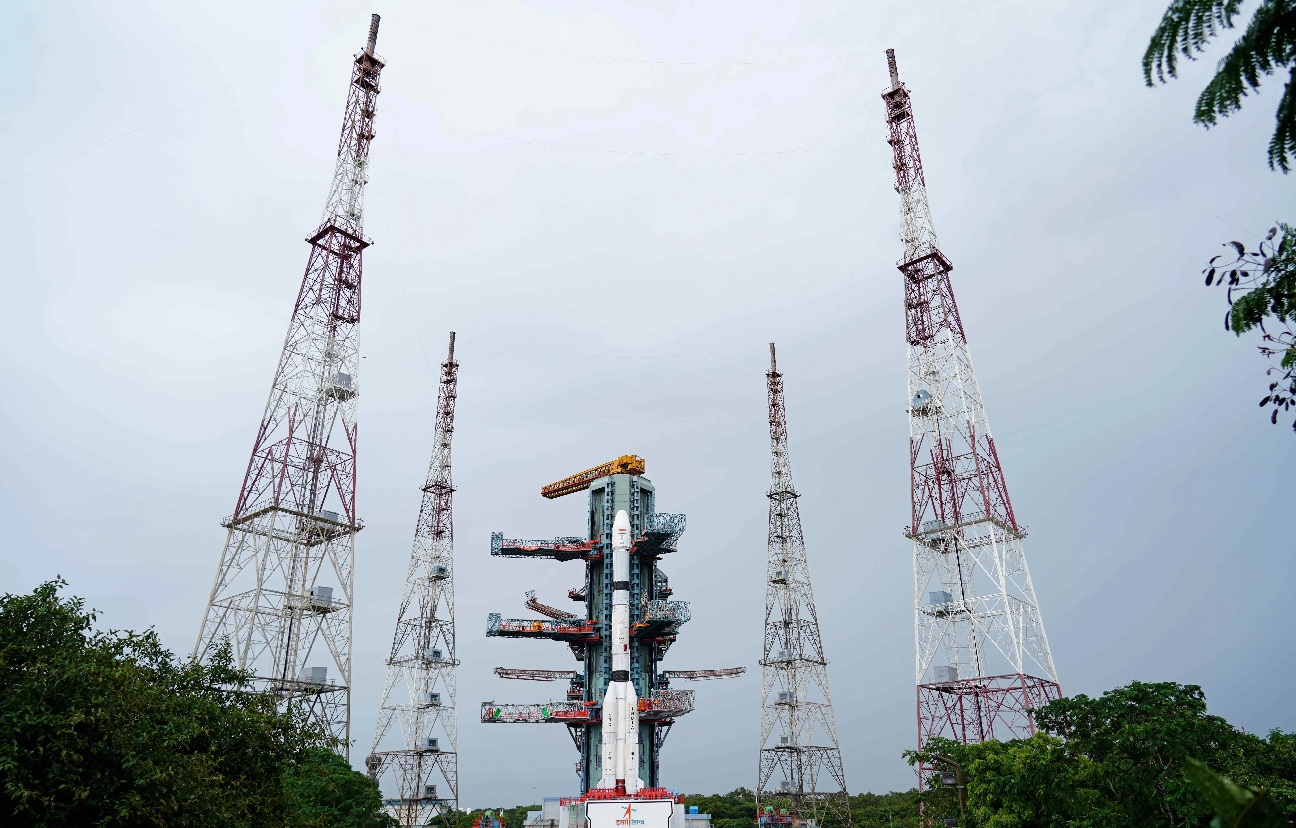
India has put a new navigation satellite into orbit, strengthening its homegrown alternative to GPS at a time when reliable positioning and timing data are essential for transport, communications and strategic operations. But the launch of NVS-03 is not the finish line: the satellite has reached an initial transfer orbit, NavIC’s constellation remains below its planned seven-satellite strength, and wider integration into mobile services will depend on completing the system.
The Geosynchronous Satellite Launch Vehicle GSLV-F18 lifted off from Sriharikota at 11:51 p.m. on October 30, carrying the 2,250-kilogram NVS-03. ISRO said the satellite was injected into its intended geosynchronous transfer orbit. The agency’s next task is to raise it into its designated orbital position and bring it into service.
The mission matters for more than the satellite itself. NVS-03 brings NavIC back to a four-satellite configuration described by ISRO Chairman V. Narayanan as the system’s minimum operational strength. That is a recovery in availability, not yet the full resilience or coverage envisioned for India’s regional navigation network.
The satellite is in orbit. NavIC’s recovery is still a work in progress.
The first major step after launch is already complete. ISRO reported that NVS-03’s first orbit-raising maneuver was executed on October 31 at 4:48 p.m. The spacecraft’s Liquid Apogee Motor burned for 2,174.8 seconds, lifting it from its initial orbit of 170.3 by 38,080 kilometers to an estimated orbit of 5,477.6 by 37,833.4 kilometers. ISRO said the satellite was functioning normally, with further maneuvers planned to place it at 111.75 degrees east.
That distinction is important: a successful launch means the rocket delivered its payload; it does not mean the satellite is already operating as part of the navigation service. NVS-03 must complete its orbital maneuvers and commissioning before its signals can be relied on for routine use.
The launch was the 20th flight of the Geosynchronous Satellite Launch Vehicle. ISRO’s GSLV-F18 placed the satellite into a geosynchronous transfer orbit roughly 18 minutes after liftoff. The mission also marked a 56-day interval between successive GSLV flights, the shortest turnaround achieved by the vehicle, according to ISRO Chairman V. Narayanan.
Why NavIC needed this satellite
NavIC, or Navigation with Indian Constellation, is India’s independent regional positioning, navigation and timing system. It is designed to provide coverage across India and approximately 1,500 kilometers beyond the country’s borders. Unlike the US Global Positioning System, which serves users worldwide, NavIC is built around India’s regional coverage needs.
The system’s weakness became clear after the failure of NVS-02, launched in January 2025. The satellite reached its initial orbit but could not complete its orbit-raising maneuvers. An investigation found that an electrical signal failed to reach a pyro valve in the oxidizer line, preventing the propulsion system from firing. The satellite was left unable to reach its intended position.
The change that could matter to phone users
NVS-03 carries navigation payloads in three frequency bands: L1, L5 and S. The addition of L1 is a key upgrade because it is widely used by global navigation systems and supported by many existing navigation receivers. NavIC’s earlier signals were L5 and S-band.
The practical implication is compatibility. By adding L1, ISRO is making NavIC easier to integrate into receivers and devices designed to use signals from multiple satellite-navigation systems. Compatible equipment could combine signals to improve positioning reliability and help address errors caused by the atmosphere. But the satellite’s new signal alone does not mean every smartphone will immediately use NavIC; device hardware, software and service integration still matter.
The satellite also carries an indigenously developed atomic clock alongside procured clocks. Navigation systems depend on precise timing: receivers calculate their position by measuring how long signals take to travel from satellites. A timing error can translate into a location error. Narayanan said two indigenous atomic clocks were already functioning in orbit, with NVS-03 carrying another.
Beyond maps: the strategic value of independent timing
Satellite navigation is not just about finding a route. Positioning, navigation and timing data support maritime operations, aviation, transport, precision agriculture, disaster management and telecommunications. NavIC also has a restricted, encrypted service for strategic users alongside its open civilian service.
That makes a reliable domestic system a matter of infrastructure and strategic autonomy. India can use other satellite-navigation systems, and many users already do. But a homegrown system gives the country an additional source of positioning and timing signals for applications where continuity and control matter. The launch strengthens that capability; the full benefit depends on the satellites, ground infrastructure and compatible receivers working together.
The mission also demonstrates ISRO’s ability to move from launch to orbit operations at a faster pace. NVS-03 is the third satellite in the second-generation series, following NVS-01 in 2023 and NVS-02 in 2025. The remaining satellites will be important to improving availability and building redundancy beyond the minimum operational threshold.
The immediate milestone is clear: NVS-03 is in orbit, its first orbit-raising maneuver is complete, and ISRO reports normal spacecraft health. The harder test comes next — commissioning the satellite, completing the constellation and making NavIC’s upgraded signals useful across civilian and strategic systems.