
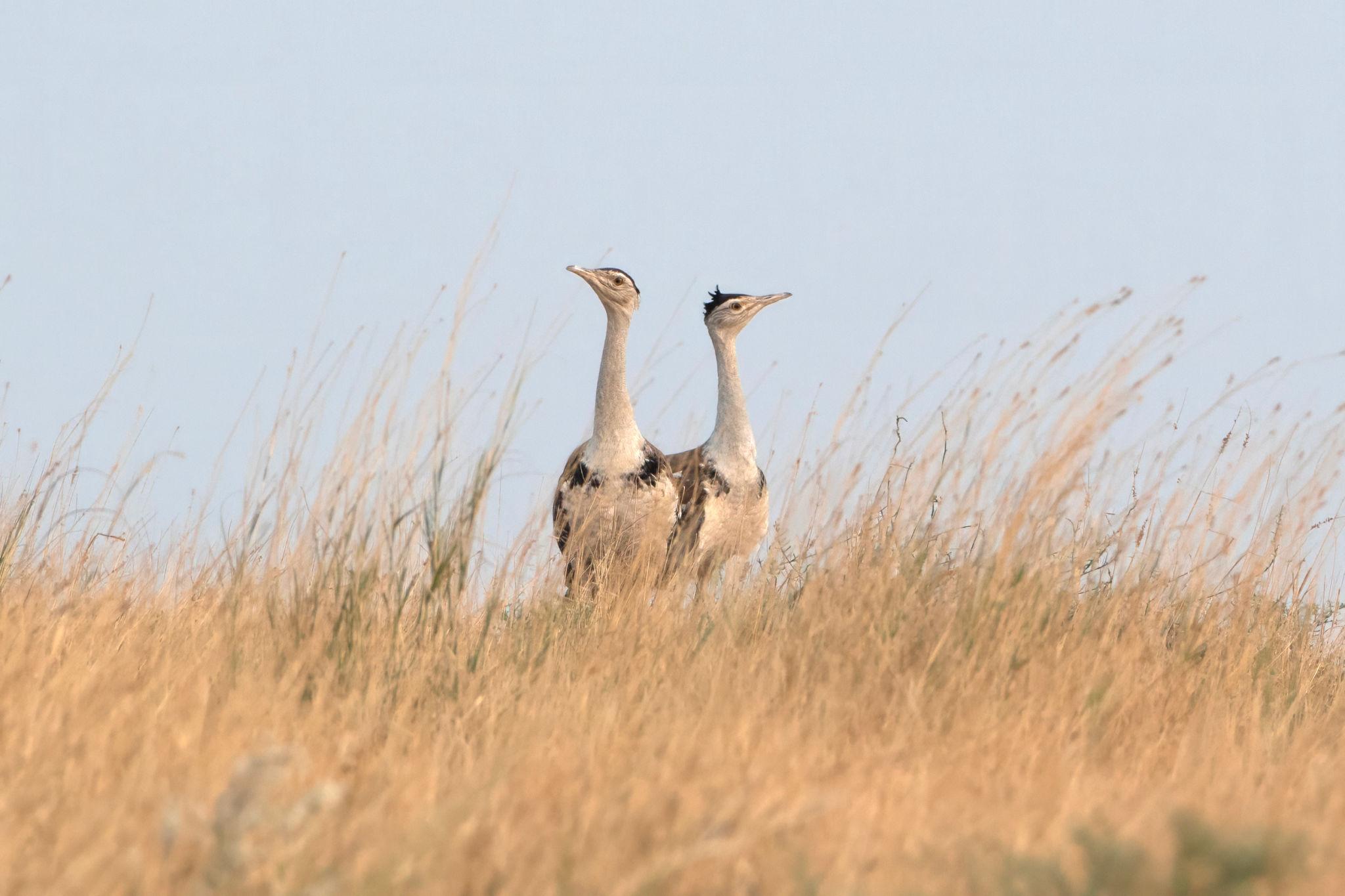
India has entered a critical new phase in its effort to save the Great Indian Bustard, with two captive-bred male birds released into the wild at the Desert National Park in Rajasthan’s Jaisalmer district after nearly a decade of conservation breeding.
The October 4 release marks the beginning of the rewilding phase of Project Great Indian Bustard, which has been running since 2013 to rebuild the population of one of India’s most endangered birds. Only about 110-150 Great Indian Bustards are estimated to remain in the wild, with Rajasthan holding the overwhelming majority of the surviving population.
The release was carried out by Union Environment Minister Bhupender Yadav at Sam in the Desert National Park. Rajasthan Forest and Environment Minister Sanjay Sharma and senior officials were also present.
“In a milestone move, released two male Great Indian Bustards in Sam, Desert National Park, Jaisalmer, today morning,” Yadav said in a post on X, describing the release as the result of nearly a decade of work by scientists, researchers and ground staff.
The birds were bred at conservation centres operated by the Wildlife Institute of India and the Rajasthan Forest Department at Sam and Ramdevra.
From captive breeding to survival in the wild
The significance of the release lies not simply in adding two birds to the wild population but in testing whether captive-bred Great Indian Bustards can survive, forage and eventually reproduce in their natural environment.
The breeding programme began with wild-laid eggs collected from Rajasthan and artificially incubated. The resulting chicks were hand-reared under controlled conditions before captive breeding was established.
The two released males are therefore the first major test of the programme’s transition from producing birds in captivity to establishing a self-sustaining wild population.
The numbers behind the programme show the scale of that effort. The two conservation-breeding facilities currently hold 97 Great Indian Bustards: 40 originated from wild-laid eggs and 57 were bred in captivity. Eleven birds have been earmarked for eventual release, including the two released on October 4. Captive breeding produced 24 live chicks in 2025 and another 29 in 2026.
The programme has also experimented with a “jumpstart” approach in which captive-laid eggs were placed in wild nests and accepted by naturally incubating females. That intervention produced six chicks in Rajasthan and two in Gujarat.
But conservation scientists caution that producing birds in captivity is only the first hurdle.
“It is the beginning of a long challenge,” Wildlife Institute of India scientist and project investigator Sutirtha Dutta told The Indian Express ahead of the release.
The birds face predators and other threats once they leave protected facilities. Project-linked experts have estimated annual survival for captive-bred bustards released into the wild at only about 10% to 30%, underlining the uncertainty surrounding the experiment.
Habitat loss and power lines remain major threats
The rewilding programme is unfolding against a much larger ecological problem: the Great Indian Bustard has lost most of its historical range.
The species once occupied large parts of India’s grasslands and arid landscapes, but its remaining population is now concentrated mainly in Rajasthan, particularly the Jaisalmer landscape, with a small number surviving elsewhere.
A 2026 population assessment found that the number of Great Indian Bustards in Rajasthan had remained broadly stable at 110-150, but the species survived in only about 16% of its potential Thar habitat. Shrinking grasslands, infrastructure expansion and collisions with power lines remain major threats.
Power infrastructure is particularly important because the birds are large, heavy and relatively poor at manoeuvring around overhead wires. The Supreme Court has directed that certain renewable-energy transmission lines in GIB habitats outside the Desert National Park be moved underground by December 2027.
The Rajasthan Forest Department has also established about 200 sq km of fenced grassland enclosures inside the Desert National Park. Long-term telemetry research by WII has identified these areas as important breeding habitat.
The government has invested heavily in preparing captive birds for this stage. A new rewilding aviary at Ramdevra was sanctioned at ₹9.25 crore and is designed to provide birds with a large, unobstructed flying environment where they can develop flight strength and natural behaviour before release.
The immediate objective is therefore not to claim a recovery but to generate evidence. The released birds will be monitored to determine how they move, feed, use habitat and respond to predators and other environmental pressures.
That makes the October release an experiment as much as a conservation milestone. If the birds adapt successfully, the data could determine how future batches are prepared and released across Rajasthan and potentially other states.
India has spent nearly a decade building a captive population. The harder phase has now begun: proving that those birds can live without human protection and eventually contribute to a viable wild population.