
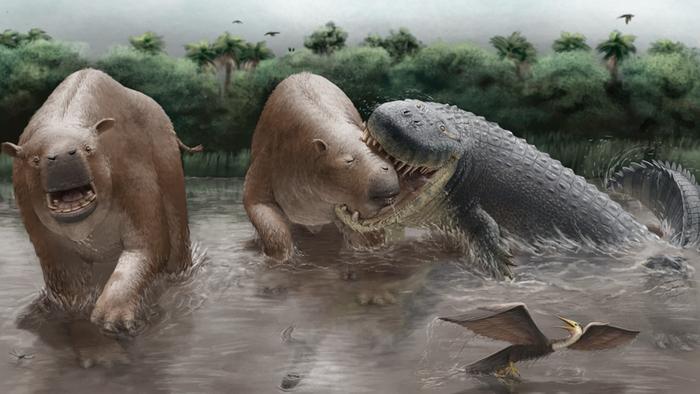
South America was home to a formidable collection of predators more than 10 million years ago, when a vast lake covered much of the continent and supported giant turtles, crocodylians and an extraordinary range of prey.
New research suggests that crocodylians, rather than mammals or other land-based predators, were the most important predators in these ancient ecosystems, particularly when it came to hunting large animals.
The findings are based on an analysis of fossil remains dating from about 10.5 million to 16 million years ago. Researchers examined bite and tooth marks preserved on herbivore fossils, providing direct evidence of interactions between predators and their prey.
A Seven-Metre Predator at the Top
The Miocene lake system supported an abundance of large herbivores, including giant ground sloths, glyptodonts — ancient relatives of modern armadillos — and several groups of large hoofed mammals.
Some of these animals, including astrapotheres and toxodontids, could weigh more than a tonne.
They shared the ecosystem with an equally imposing group of predators. Among the most formidable was Purussaurus neivensis, a giant crocodylian related to modern caimans. It could reach about seven metres in length and weigh as much as 1,800 kilograms.
Other predators included anacondas, saber-toothed mammals, flightless terror birds and sebecids, which were terrestrial relatives of modern crocodylians.
Despite this diversity, the study indicates that crocodylians were particularly important predators in the ancient ecosystem.
Fossil Bite Marks Tell the Story
Researchers from the University of Helsinki studied bite and tooth marks preserved on fossilized remains of herbivores. Such marks can reveal which predators attacked or scavenged animals, even when the predator itself is not preserved alongside its potential prey.
The frequency and characteristics of marks attributed to Purussaurus suggest that the giant crocodylian played a major role in the tropical food web.
Oscar Wilson, a postdoctoral researcher at the University of Helsinki, said the abundance of prey was so great that mammalian predators alone would not have been capable of consuming it all.
The evidence indicates that crocodylians filled an important ecological role, particularly by targeting large-bodied prey.
The findings also raise the possibility that Purussaurus influenced herbivore populations. As one of the largest predators in the ecosystem, the giant crocodylian may have exerted substantial pressure on large herbivores and helped shape the structure of the ancient food web.
The study provides a glimpse into an ecosystem where enormous predators and prey lived alongside one another — and where giant crocodylians may have occupied a position closer to the top of the food chain than previously recognized.
Also Read:
Crocodiles Set to Face Extinction, Says Australian Researcher
‘Nagatitan’: Southeast Asia’s biggest long-necked dinosaur discovered