
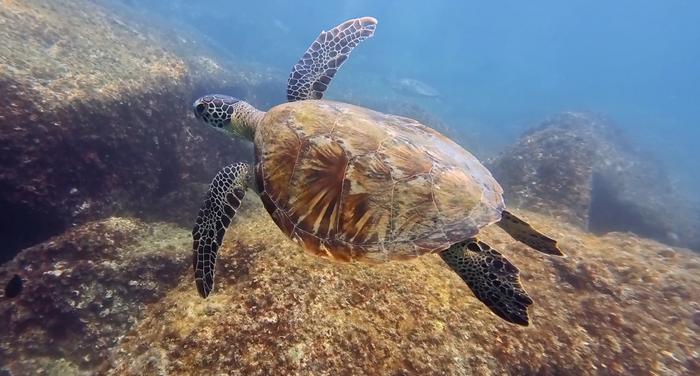
A protected coastal wetland in the United Arab Emirates (UAE) has emerged as an important habitat for young green sea turtles, with researchers finding that the animals spend most of their time within the protected area. The study highlights how a man-made lagoon near the Khor Kalba mangroves has developed into a valuable feeding and refuge site for the species.
Researchers tracked nine juvenile green turtles, each with a shell length of less than 60 centimetres, in the Al Qurm Wa Lehhfaiiah Protected Area on the UAE’s Gulf of Oman coast. The turtles were found to be highly resident in the wetland, spending more than 80% of their time within the protected area.
The findings were published in the journal Aquatic Conservation in a paper titled “Residency and Habitat Use of Juvenile Green Turtles in a Protected Coastal Wetland in the Gulf of Oman, United Arab Emirates.”
Man-Made Lagoon Attracts Large Numbers of Young Turtles
A key finding was the presence of juvenile green turtles in an artificial lagoon, locally known as a basin, located beyond the area’s natural mangroves.
The basin was excavated in 2003 as an extension of the Khor Kalba mangroves. It was initially developed as part of plans for a larger recreational and commercial waterfront project. Although the wider development plans and their objectives subsequently changed, the basin remained and gradually became a habitat for wildlife.
Researchers found that turtles had a strong preference for this modified habitat. Their odds of being found in the basin were five times higher than in surrounding habitats.
The basin floor is covered with algae, which researchers believe provides a food source for the turtles. They also suggest that the limited presence of predators, including sharks, may make the lagoon a relatively safe environment for young turtles.
Dr Owen Exeter of the University of Exeter said: “Our results show just how critical coastal wetlands can be to young green turtles”
He added: “The fact these turtles are using the artificial basin appears to be a happy accident, and an example of how wildlife can find a way in a world increasingly shaped by humans. However, without the natural mangroves connecting to this system, it’s unlikely that this would have occurred.
“The basin floor is covered in algae, likely providing them with food, and we believe few predators – such as sharks – make their way through the mangrove into this unique habitat.”
Mangrove Channels Remain Essential for Turtle Movement
Although the artificial basin provides a refuge and feeding habitat, the study emphasises that natural mangrove channels remain crucial to the wider ecosystem.
These channels connect juvenile turtles to the sea and allow them to move with the tides. Researchers therefore stress that protecting the lagoon alone would not be sufficient. The natural mangroves and connecting waterways are equally important for maintaining the habitat’s ecological value.
The Al Qurm Wa Lehhfaiiah Protected Area has been recognised as a wetland of international importance under the Ramsar Convention and as a Key Biodiversity Area since 2013.
The Sharjah government currently protects most of the area from building development, fishing and boating, helping preserve the last mangrove ecosystem on the UAE’s east coast.
Dr Exeter said: “The government of Sharjah currently protects most of this area from building development, fishing and boating – preserving the last mangrove ecosystem on UAE’s east coast,”
He further noted: “Coastal wetlands are tropical nature hotspots, providing essential nursery and foraging habitats for species including sea turtles.
“Wetlands are among the most threatened ecosystems globally, so we urgently need to understand how key species use both modified and protected wetlands.”
Researchers Highlight Wider Conservation Challenges
Despite the positive findings, researchers caution that the juvenile turtles’ long-term survival depends on habitats beyond the protected wetland.
Their life cycle also requires suitable nesting beaches, many of which have been lost to coastal development, as well as safe ocean environments. Fishing activity, boat and ship traffic and pollution continue to pose threats to sea turtles.
One of the tracked turtles travelled more than 700 kilometres south to central Oman, demonstrating how far the animals can move once they leave their juvenile habitats. The finding highlights the need for conservation measures that extend beyond individual protected wetlands and account for the movements of mobile marine species.
Brendan Whittington-Jones of the Sharjah Environment and Protected Areas Authority (EPAA) said: “Overall, our findings show that coastal wetlands, including engineered ones, can provide valuable habitat for juvenile turtles, provided they are designed for ecological connectivity and subsequent human pressures and threats are minimised.”
Study Highlights Importance of Protecting Modified Wetlands
The research was led by Sharjah’s Environment and Protected Areas Authority in collaboration with the University of Exeter through the Sharjah Marine Science Research Centre at the University of Khorfakkan.
The findings suggest that human-modified coastal environments can support wildlife when they remain connected to natural ecosystems and are protected from damaging human activities. However, researchers underline that artificial habitats cannot replace the ecological functions of natural mangroves and connected coastal waterways.
Read More :