
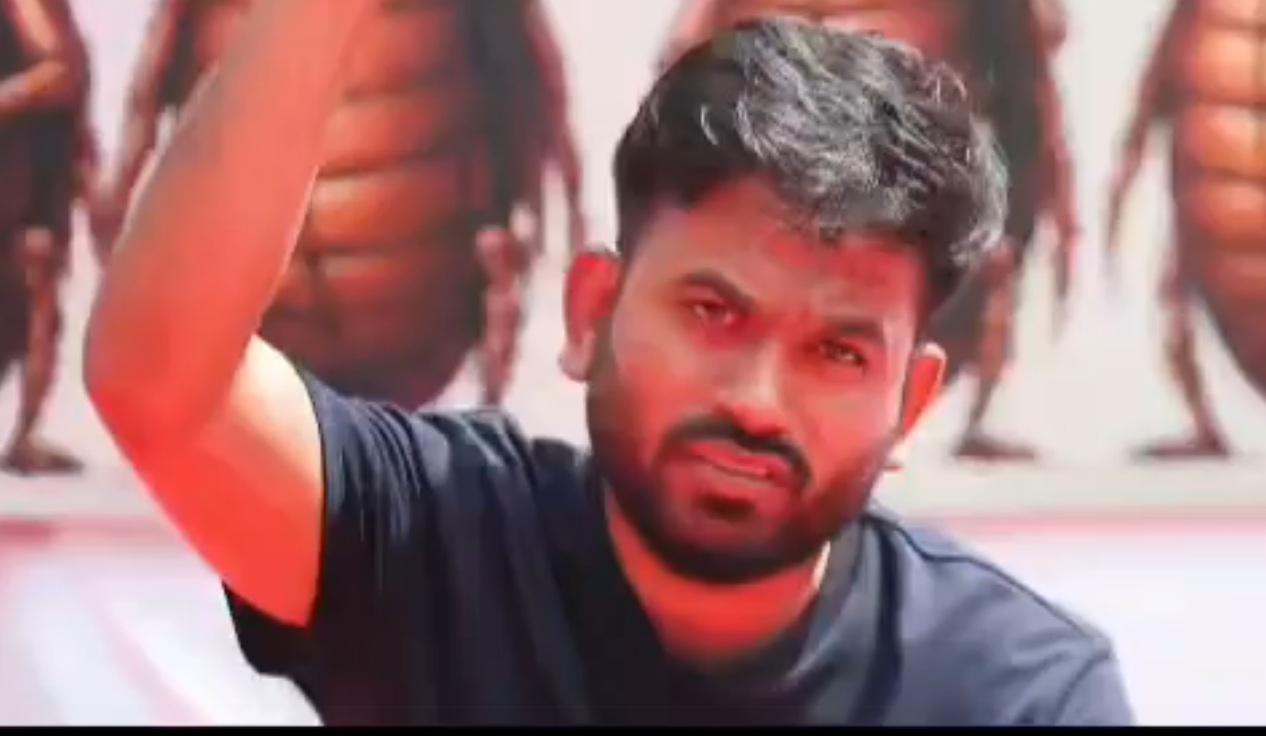
Delhi Police detained Cockroach Janta Party (CJP) founder Abhijeet Dipke on Friday ahead of a planned national-flag protest in the capital’s Connaught Place business district, escalating a confrontation over the Election Commission’s revision of electoral rolls and demands for Chief Election Commissioner Gyanesh Kumar’s resignation.
Live video posted on the movement’s Instagram account showed police officers stopping Dipke as he left a residence and taking him towards a police vehicle following a brief argument. An officer could be heard telling him, “We are detaining you right now.”
“I have not broken any law right now… how can you detain me,” Dipke asked as police took him away, according to the video. Police had warned him earlier against proceeding with the proposed demonstration but had not immediately commented on the detention, Reuters reported.
🚨 BREAKING NEWS🚨
Delhi Police have detained Abhijeet Dipke as he was heading alone to Central Park to hoist the Tricolour. https://t.co/vOmjevM4vi
— Neha Bora Team (@NehaAisa) October 16, 2026
The detention came as authorities stepped up security across central Delhi ahead of the CJP’s “Lehra Do Tiranga” protest, called in solidarity with two party leaders, Ashutosh Ranka and Saurav Das, who were sent to five-day judicial custody after a demonstration at Jantar Mantar.
The movement and its supporters had urged people to gather at Central Park in Connaught Place on Friday evening to wave and hoist the national flag. Police advised people against joining the gathering, while the New Delhi Municipal Council announced that Central Park would remain closed to the public on October 16 and 17, citing administrative reasons.
Police said they could facilitate a small group carrying the national flag and singing the national anthem at a suitable location, but the wider demonstration faced restrictions. The Delhi High Court had declined on Thursday to stop the proposed protest, recording police assurances that the gathering would be regulated.
SIR Row Drives Protests Against Election Chief
The latest confrontation is part of a wider campaign by the youth-led CJP, opposition groups and student organisations demanding Kumar’s resignation over the Special Intensive Revision (SIR) of electoral rolls.
Critics allege that the revision risks disenfranchising eligible voters and disproportionately affects vulnerable communities. The Election Commission has denied political bias, saying the exercise is intended to correct electoral rolls and that voters whose names were wrongly removed can re-enrol. The BJP has accused opposition parties of undermining democratic institutions by questioning the process.
More than 130 million voter names have reportedly been deleted during the revision, according to Reuters. The scale of the changes has intensified scrutiny of the process, although the total number of deletions does not by itself establish how many involved eligible voters wrongly excluded from the rolls.
The controversy has expanded from questions about electoral procedures into a broader dispute over political accountability, protest rights and the limits of police restrictions. The CJP has made the demand for Kumar’s resignation the centrepiece of its campaign, while opposition groups have joined demonstrations challenging the conduct of the revision.
The movement has also drawn attention through its use of the cockroach as a symbol of resilience, turning an online youth campaign into a street-level protest mobilisation.
Heavy Security and Traffic Restrictions in Connaught Place
Authorities deployed additional personnel and increased surveillance around Connaught Place, Central Park and nearby public areas. Police also warned that traffic movement across central Delhi could be disrupted as the proposed rally approached.
The security measures affected a major commercial and shopping district, prompting concerns among traders about business losses and access to the area. Traders have challenged the proposed demonstration, arguing that the gathering could cause serious disruption.
The developments place the authorities in a difficult position. Police must manage public safety and traffic in a crowded commercial district, while ensuring that restrictions on peaceful political assembly remain lawful and proportionate.
For the CJP, Dipke’s detention is likely to intensify its confrontation with the administration. The movement has portrayed its campaign as a defence of democratic rights and electoral accountability, while authorities have emphasised restrictions on gatherings and the need to maintain public order.
The immediate question is whether the protest can proceed under the restrictions imposed by the authorities. The larger dispute concerns the transparency of electoral-roll revisions and the extent to which demonstrations against the Election Commission can be conducted without repeated confrontations with police.
With the CJP demanding the election chief’s resignation and the BJP rejecting allegations of bias, the dispute has become a test of both institutional accountability and the handling of political dissent in the national capital.