
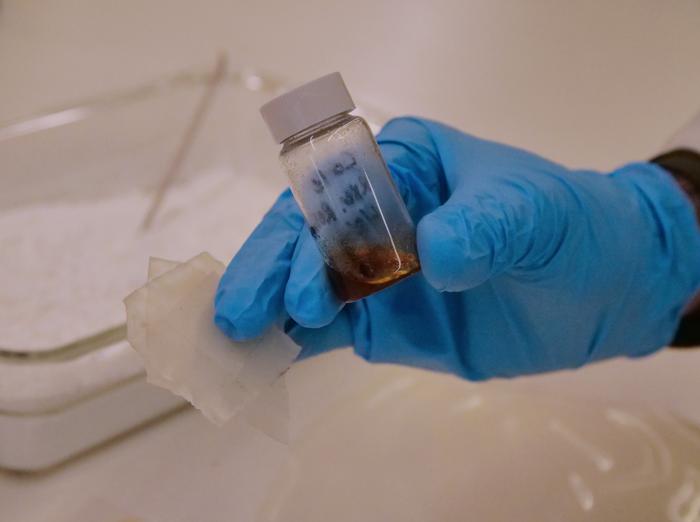
Researchers at the University of Queensland have developed a new hydrogel from a bio-derived plastic, creating a material that could support applications in tissue engineering, wound recovery, and drug delivery.
The gel-like material, called P3HB-HEAA, was developed by PhD researcher Cole Walchle through experiments involving an existing bioplastic. Its potential applications also include surgical products, hygiene materials, specialty coatings, and lubricants.
The research focuses on improving the properties of naturally derived plastics, many of which have promising sustainable origins but lack the strength and flexibility required for wider commercial use.
Transforming a Brittle Bioplastic Into a Strong Hydrogel
The research began with poly(3-hydroxybutyrate) (PHB), a bio-derived and biodegradable polymer known for its brittle nature. Although the material has potential as a sustainable alternative to conventional plastics, its physical limitations have restricted its commercial applications.
Walchle, a PhD student at the University of Queensland’s School of Chemical Engineering, used a grafting technique to modify the polymer’s structure.
The process involved applying gamma radiation to attach N-Hydroxyethyl acrylamide, a polymer commonly used in hydrogel preparation, to PHB. This produced P3HB-HEAA, a new material with a high capacity for water absorption.
“Crucially, the hydrogel is derived from a bio-derived and biodegradable polymer that – while promising itself – is too brittle to be commercially viable,” Walchle said.
“There’s huge potential for naturally-derived plastics to be useful at an industrial scale, but with many of them we just aren’t there yet.”
New Material Combines Strength With Water Absorption
The resulting hydrogel demonstrated a combination of properties that could make it suitable for several specialised applications. According to Walchle, the material is tougher than the original polymers while retaining strong water absorption capabilities.
“We’ve basically created something that is simultaneously tougher than the materials we had to begin with, yet also particularly good at absorbing water,” Walchle said.
The combination could be useful in medical technologies that require materials capable of absorbing and retaining water while maintaining structural strength.
The researcher said the material could also expand the range of applications for bioplastics.
“Our work demonstrates that there is scope to tweak them to create new, sustainable products that work for us now.”
Potential Applications in Surgery and Drug Delivery
P3HB-HEAA could have applications in tissue engineering and wound recovery, where hydrogel materials can play a role in medical and surgical settings.
Its water absorption properties may also make it useful for slow-release drug delivery systems. Other potential uses include hygiene products, specialty coatings, and lubricants.
The material’s sustainable origins could offer an additional advantage if its biodegradable properties are retained after modification.
“It’s a new material with the sustainable origins of a bioplastic, with a greatly expanded potential field of use,” Walchle said.
Further Research Needed to Confirm Biodegradability
Despite the material’s promising properties, further investigation is necessary to understand its behaviour and assess its suitability for commercial use.
One key question is whether P3HB-HEAA retains the biodegradability of the original PHB polymer after the grafting process.
“Further investigation is needed to fully understand the behaviour of this material, in particular its ability to biodegrade,” Walchle said.
“If the biodegradability is carried over from the original material, it would further confirm our method as a viable approach to generate new hydrogel-like superstructures.”
Read More :