
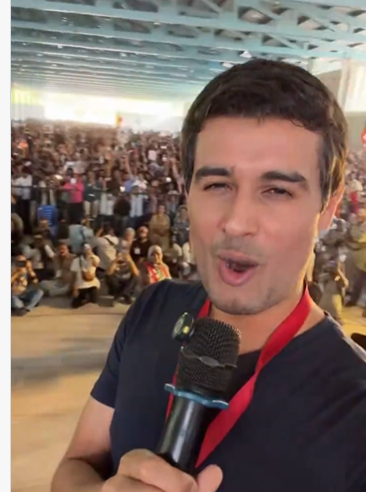
Actor-activist Prakash Raj and YouTuber Dhruv Rathee joined thousands of protesters at Bengaluru’s Freedom Park on Thursday in a widening campaign against the Election Commission’s Special Intensive Revision of electoral rolls, with demonstrators demanding that Chief Election Commissioner Gyanesh Kumar resign and the SIR exercise be scrapped.
The protest, organised by the Cockroach Janta Party (CJP), civil-society groups and the anti-SIR alliance, turned Freedom Park into a platform for people who claimed their names had been deleted, marked as shifted or otherwise affected during the revision. Protesters carried placards reading “Error 404 – Name Not Found”, “Vote theft” and “Don’t erase us, hear us”, while speakers accused the Election Commission of a lack of transparency.
The allegations have not been established as fact. The Election Commission has defended SIR as an exercise intended to identify and remove duplicate, dead, shifted and otherwise ineligible entries from electoral rolls. The BJP and the Election Commission have rejected opposition allegations that the revision is designed to manipulate elections or selectively disenfranchise voters.
The Bengaluru mobilisation comes as the SIR controversy moves beyond political parties and into street protests involving student groups, activists and public figures. It also follows opposition protests in New Delhi and other parts of the country demanding Kumar’s resignation.
Hello @narendramodi
India has a message for you. https://t.co/wqIGNlkWsh
— Dhruv Rathee (@dhruv_rathee) October 8, 2026
Karnataka rolls lose more than 1 crore names in draft revision
The scale of the electoral-roll exercise explains why SIR has become a major political flashpoint in Karnataka.
According to data from the Karnataka Chief Electoral Officer’s office reported by The New Indian Express, the state had 5,54,32,314 registered electors as of June 16, 2026. The draft electoral roll published after the SIR exercise contained 4,46,80,151 electors as of August 24 — a reduction of 1,07,96,339 names.
The Election Commission’s categorisation of those entries is central to the dispute.
Of the 1.08 crore names not carried into the draft roll, 65,45,679 were categorised as dead, 15,17,042 as permanently shifted, 7,09,870 as duplicates and 3,83,884 under “others”. The largest category, according to the data, comprised 1,07,96,339 voters listed as absent from the addresses recorded in the electoral database.
The figures have become a focal point for critics of SIR, who argue that genuine voters could be caught in the process, particularly people who have moved, lack documentation or live in vulnerable communities.
The Election Commission, however, has ordered a verification and enrolment exercise after the revision. Booth Level Officers have been instructed to identify voters missing from the current roll, visit their homes, establish their status and facilitate re-enrolment through Form 6 where appropriate. Political parties’ Booth Level Agents are also to receive lists for verification.
A special enrolment drive in Karnataka is scheduled to begin after October 27, following publication of the final electoral roll, according to the state election authorities. Officials have also been directed to organise special camps for people living in night shelters, labour colonies and other marginalised communities.
That process has done little to cool the political confrontation.
Rathee, Prakash Raj sharpen attack on Election Commission
Rathee, making his first public protest appearance in India, used the Bengaluru platform to appeal directly to voters who support the BJP, arguing that the controversy should not be viewed simply through party lines.
“I don’t want regime change, and I am not funded by Musk or Soros. I came with my own money,” Rathee said, referring to claims about his involvement in Indian political activism.
He said the issue concerned every voter, irrespective of political affiliation, and accused the Election Commission of what he described as “zero transparency and accountability”.
Rathee alleged that civil-society groups had documented cases in Karnataka where people were listed as dead despite being alive. He used such cases to question the procedures through which names are being removed from electoral rolls.
“These are not BJP voters or Congress voters,” he said, arguing that the right to vote should not depend on political allegiance.
He also demanded Kumar’s resignation.
Prakash Raj, addressing the gathering in Kannada, similarly argued that SIR was about more than individual names disappearing from voter lists.
“Who are they to take away our votes?” Raj said, framing the controversy as an issue of voting rights and citizens’ dignity.
CJP founder Abhijeet Dipke accused the Election Commission of carrying out voter deletions at the direction of the BJP-led government. Those allegations were part of the protesters’ political argument and have not been independently established. The BJP and Election Commission have rejected claims of manipulation.
The CJP has demanded that Kumar step down and that SIR be withdrawn.
The protest was structured as a “People’s Tribunal”, with organisers bringing people from several Karnataka districts to present accounts of problems they said they encountered during the electoral-roll revision. Speakers said participants came from areas including Vijayapura, Bhalki, Babaleshwar, Kodagu and Chitradurga.
The tribunal also featured former judge Gopal Gowda, journalist Vijayamma and retired bureaucrat Ibrahim, who heard testimonies presented by the organisers.
The event later expanded into demands for broader institutional accountability, with speakers invoking the Constitution, voting rights and the independence of electoral institutions.
Protest movement heads towards Delhi
The Bengaluru demonstration is part of a rapidly expanding national campaign.
The CJP and opposition groups have held protests in multiple locations, while Congress and other opposition parties have separately targeted the Election Commission over SIR. The demonstrations intensified after Rahul Gandhi was briefly detained during a protest in New Delhi on Wednesday, according to the Associated Press.
The CJP has announced another major demonstration at Delhi’s Jantar Mantar on October 10, with student organisations expected to participate.
For the Election Commission, the immediate challenge is to complete the revision while demonstrating that genuine voters have effective avenues to challenge deletions.
For the protesters, however, the issue has already moved beyond the mechanics of electoral-roll revision. Their central argument is that no eligible citizen should lose voting rights because of an opaque or difficult verification process.
The final electoral roll in Karnataka, expected after October 27, could therefore become the next major point of political scrutiny.
Until then, the competing narratives remain sharply divided: protesters describe SIR as a threat to voting rights and democratic participation, while election authorities maintain that the exercise is intended to clean up electoral rolls and provide mechanisms for genuine voters to be restored.