
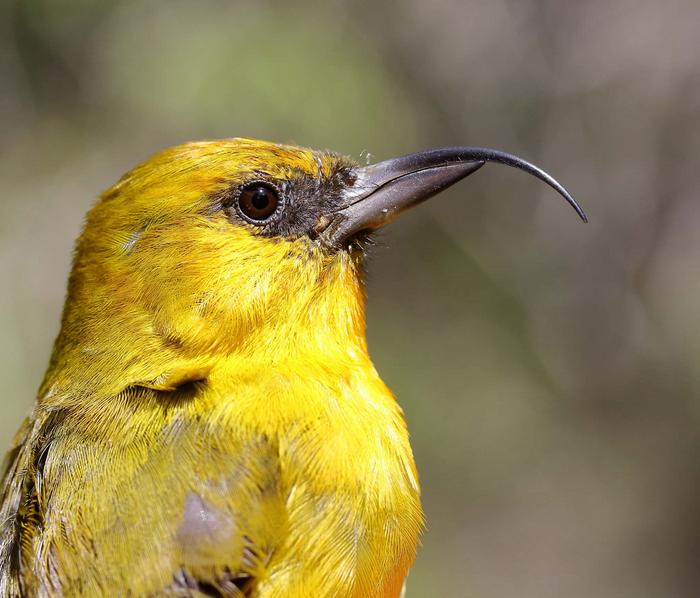
A critically endangered Hawaiian bird has evolved an unusual way of finding food, using its distinctive beak and specialised body structure to drill into tree branches and extract insects. A new study published in the journal Ornithology provides the most detailed anatomical examination yet of the ‘akiapōlāʻau, revealing how its feet, ankles, wings and beak work together during feeding.
Researchers from the Field Museum and the University of Chicago found that the bird’s unusual anatomy allows it to fill an ecological role similar to that of woodpeckers, which are absent from the Hawaiian islands. The findings also offer insights into the evolution of native Hawaiian species and highlight the conservation challenges facing the island’s unique wildlife.
The ‘Akiapōlāʻau Has a Distinctive Two-Part Beak
The ‘akiapōlāʻau, pronounced Ah-key-ah-pole-ah-ow, has an unusual beak in which the upper and lower sections perform different functions. Researchers describe it as a “Swiss army beak” because its two parts resemble tools designed for separate tasks.
The upper bill is long, narrow and flexible, allowing the bird to reach into small openings in branches and extract grubs and caterpillars. Its lower mandible is shorter and stronger, enabling it to gouge holes into wood. This combination allows the species to access food sources in a way comparable to woodpeckers.
“The Aki is unique from every other bird that has ever evolved, and not just in Hawaii—it has features unseen in any birds,” says Alexander Clark, a PhD candidate at the University of Chicago, affiliate of the Field Museum, and lead author of the study. “Its lower bill and its upper bill are distinctly very different from each other.”
Researchers believe intense competition for resources in Hawaii’s evolving ecosystems may have contributed to the development of these specialised features.
“When the island of Oahu emerged from under the water, there was a relatively large explosion of animal species. This was undoubtedly due to the different species competing for valuable resources, like caterpillars, to feed their young,” says Paul Banko, co-author of the study and former researcher at the USGS Pacific Island Ecosystems Research Center in Hawaii.
Its Feet and Ankles Help Generate Drilling Force
Although scientists understood how the ‘akiapōlāʻau used its beak to find insects, the anatomical mechanisms behind its feeding behaviour remained unclear. The new study examined these adaptations in greater detail, identifying several features that help the bird drill into wood without injuring itself.
Researchers found that the bony structure inside its upper bill, known as the rostrum, is considerably shorter than the external bill. The bird also has proportionally shorter wings than comparable mainland species and a shorter femur, a feature that resembles adaptations found in unrelated woodpeckers.
The most significant discovery involved its feet and ankles. The ‘akiapōlāʻau has a proportionally large tendon associated with a muscle that flexes the ankle. This structure allows it to generate a powerful downward movement when striking wood.
Unlike woodpeckers, which primarily rely on their neck muscles when drilling, the ‘akiapōlāʻau uses momentum generated by its entire body. The movement begins with its legs and ankles before travelling through the rest of its body.
“Basically, it’s like if you’re swinging an ax to split a log, you’re putting your whole body in there. You’re elevating yourself, you’re almost on your tippy toes and then coming down. So is the Aki. They rear up and use their whole body. but that whole body downward force starts with dorsiflexion of the ankles. It starts with the legs, the anchor system of what they’re actually hammering.”
The researchers studied the bird’s anatomy using historical museum specimens from the UC Berkeley Museum of Zoology, Washington University Burke Museum and the Field Museum. The work also highlights the value of museum collections in understanding the physical adaptations of rare and endangered species.
Critically Endangered Bird Faces Growing Extinction Risk
The study comes at a crucial time for the ‘akiapōlāʻau. Experts estimate that fewer than 2,000 individuals remain in the wild, with the entire population living on the northeastern slope of a single mountain on Hawaii’s Big Island.
Hawaii has exceptionally high levels of endemism, meaning many of its plants and animals exist nowhere else. Its geographical isolation has encouraged the evolution of distinctive species and adaptations, but it has also made native ecosystems particularly vulnerable.
The number of terrestrial native species across the Hawaiian archipelago has declined over several centuries, with extinction rates increasing in recent decades.
“It’s really cool to study this species while it’s still alive,” says Clark, who spent 15 months in Hawaii studying endemic bird species. He notes that observing living birds provides opportunities to understand how unusual anatomical features influence behaviour in ways that fossil specimens alone cannot reveal.
“Hawaii is very unique in that you are confronted with actual extinction, it’s something that I still struggle with,” says Clark. “This is an objective, unequivocal, complete loss of these birds’ songs and of their behaviors. This is the reality that we’re living in, this aspect of complete loss in Hawaii that I haven’t witnessed anywhere else.”
Read More :