
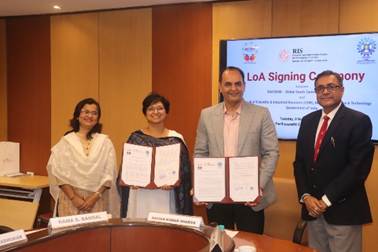
The Council of Scientific and Industrial Research (CSIR) and DAKSHIN-Global South Centre of Excellence at RIS have signed an agreement to strengthen research collaboration, technology partnerships and capacity building among countries of the Global South.
CSIR and DAKSHIN-Global South Centre of Excellence at the Research and Information System for Developing Countries (RIS) signed a Letter of Association (LoA) on November 3, 2026. The partnership aims to advance science, technology and innovation while supporting shared developmental priorities across countries of the Global South.
The association brings together CSIR’s scientific and technological expertise and DAKSHIN’s platform for knowledge sharing and international engagement. DAKSHIN seeks to encourage mutual learning among developing countries by promoting sustainable, affordable and locally relevant solutions.
Its approach includes sharing resources, transferring technologies, exchanging experiences and developing collaborative strategies to address common development challenges and accelerate progress towards the Sustainable Development Goals (SDGs).
CSIR contributes an extensive scientific and technological knowledge base, along with a portfolio of affordable, adaptable technologies that are ready for deployment. These solutions have potential applications across the developmental needs of partner countries, including wider dissemination, industry-led implementation and entrepreneurship.
Officials Highlight Opportunities for International Collaboration
Speaking at the signing ceremony, Dr. Rama Swami Bansal, Head of the International S&T Affairs Directorate at CSIR, emphasised the importance of international engagement among countries of the Global South. He also highlighted the scope for developing innovative collaborative models to address shared developmental priorities.
Professor Sachin Kumar Sharma, Director General of RIS, described the association with CSIR as an important step towards converting scientific expertise and technological innovations into collaborative solutions with practical impact across the Global South.
He identified healthcare, infrastructure, agriculture, the blue economy and the digital economy as key areas with potential for cooperation.
Four Key Objectives of the Partnership
The Letter of Association outlines four primary objectives to guide the collaboration:
- Joint policy studies: Conducting collaborative research to identify innovative and context-specific responses to developmental challenges.
- Institutional engagement: Bringing relevant institutions and agencies together to support the expansion of development interventions.
- Capacity building: Promoting human resource development, skills enhancement and capacity-building initiatives.
- Knowledge sharing: Documenting and exchanging development experiences, best practices and success stories to strengthen collective self-reliance among Global South countries.
The association is expected to create a platform for strengthening South-South cooperation, expanding international partnerships and facilitating the transfer, adaptation and deployment of suitable science and technology solutions.
Read More :