
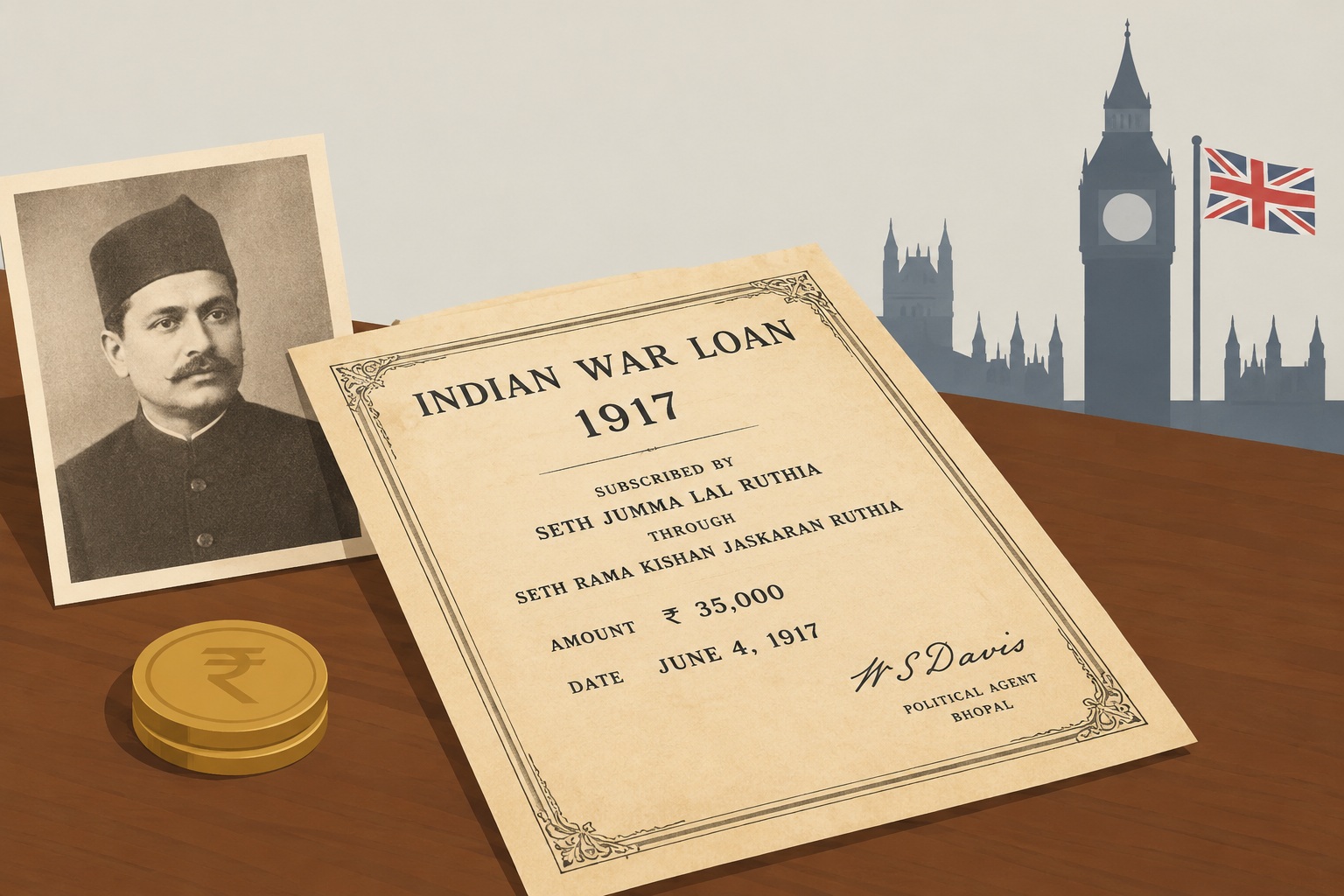
A piece of paper dated June 4, 1917, has become the centre of a family’s search for answers spanning more than a century. It records an investment of ₹35,000 by Seth Jumma Lal Ruthia, a merchant in the princely state of Bhopal, in an Indian War Loan issued during British rule.
The investment was made during the First World War, when the British administration raised money from the public to finance military expenditure. More than 109 years later, the Ruthia family says it has yet to receive a clear account of what happened to the money.
The family’s claim has now encountered a fresh hurdle. The United Kingdom’s Debt Management Office (DMO), responding to an inquiry from the family’s legal counsel, said it could find no evidence that the loan was or is an obligation of the British government.
The email, dated October 16, 2026, did not say whether the investment had been repaid. That omission has left the family pursuing the same fundamental question: if the money was settled, when and how did that happen?
For the descendants, the dispute is about more than the possible value of an old financial instrument. It is also about the meaning of a document that has survived generations, bearing the name of an ancestor who died long before India became independent.
A merchant’s wartime investment survives across generations
The certificate identifies Seth Jumma Lal Ruthia as the subscriber to the loan through the firm Seth Rama Kishan Jaskaran Ruthia. It bears the signature of W S Davis, who was then the political agent in Bhopal, and records the date of June 4, 1917.
According to the family, the investment carried an annual interest rate of 5.5%. The certificate has remained among the family’s papers for more than a century and now provides the documentary basis for its claim.
Jumma Lal Ruthia died in 1937, a decade before British rule in India ended in 1947. The investment therefore predates independence, the transfer of power and the many political and institutional changes that followed.
War loans were a familiar feature of British India’s wartime finances. The colonial administration invited members of the public, traders and institutions to subscribe money to government-issued debt instruments, with interest offered in return. The funds supported military expenditure, including supplies and troop payments.
For a merchant in Bhopal, subscribing to such an instrument meant placing money in a financial arrangement backed by the authority of the colonial administration. The surviving certificate records that transaction, but it does not, by itself, establish whether the investment remains unpaid today or which present-day institution would be legally responsible for it.
The family has sought repayment of the original ₹35,000 subscription and says it supplied authenticated documents, including the historical certificate, through its legal counsel.
The amount involved in 1917 was substantial enough to remain a matter of interest to the descendants more than a century later. The family estimates that compounding the sum at 5.5% annually over 109 years could produce several crores of rupees. A separate comparison based on the rise in gold prices could put the equivalent above ₹10 crore.
These are the family’s estimates, not an independently established amount owed by the British government. Any actual entitlement would depend on the terms of the instrument, its repayment history, the applicable legal framework and whether a surviving liability can be established.
Britain’s response leaves the family’s central question unanswered
The latest response came from the UK Debt Management Office after an inquiry by Shreyansh Raniwala, legal counsel for the family of Vivek Ruthiya, 63, of Sehore in Madhya Pradesh.
In its October 16 email, the office said it had investigated the matter but could find no evidence that the loan was or is an obligation of the UK government.
The response does not amount to a judicial ruling on the family’s claim. Nor does it establish that the investment was repaid. It indicates that the office has not found evidence supporting the existence of a British government liability in the records it examined.
That distinction is central to the dispute. A certificate can document an original subscription, but proving that a debt remains outstanding after 109 years requires more than establishing that the investment was once made.
Social activist Vinay Ruthiya has questioned why the British authorities have not provided an account of the loan’s repayment or settlement. He said the family had submitted the documents requested by the authorities, including the historical certificate.
“If the loan was repaid, there should be a record showing when and how it was settled. We submitted the documents they asked for, including the historical certificate,” he said. “We want a clear answer on what happened to the money,” he added.
The family is seeking clarification on whether the subscription appears in historical financial records and, if so, how the liability was accounted for. That would help distinguish between a claim that cannot be verified from available records and one that can be traced to a recorded repayment or settlement.
The passage of time complicates the search. The investment was made under a colonial administration that no longer exists in its original form, and the merchant who subscribed to it died in 1937. The family is now attempting to trace the financial history of a transaction through records that may have been created, transferred or maintained by institutions over several generations.
The immediate question is whether further historical records can establish the fate of the subscription. The broader issue is whether the available documentation can identify a legally responsible entity and demonstrate an outstanding obligation.
For now, neither the family’s claim nor the British office’s response provides a complete account of what happened to the money.
The certificate dated June 4, 1917, remains evidence of the investment the family says its ancestor made. But after more than a century, the most important part of the story remains unresolved: whether the loan was ever repaid, and where the record of that repayment, if it exists, can be found.
FAQs
1. Who invested ₹35,000 in the 1917 Indian War Loan?
Seth Jumma Lal Ruthia, a merchant associated with the firm Seth Rama Kishan Jaskaran Ruthia in the princely state of Bhopal, is named on the certificate dated June 4, 1917.
2. What has the UK Debt Management Office said?
The office said on October 16, 2026, that it could find no evidence that the loan was or is an obligation of the British government. It did not state whether the money had been repaid.
3. How much could the original investment be worth today?
The family estimates that compounding ₹35,000 at 5.5% annually for 109 years could produce several crores of rupees. A gold-price comparison could exceed ₹10 crore. These are estimates, not an established debt.
4. Does the old certificate prove that Britain still owes the money?
No. The certificate provides documentary evidence of the original subscription, but it does not independently establish that the loan remains unpaid or that the present-day UK government is legally liable.
5. What is the family asking British authorities to clarify?
The family wants to know whether the subscription appears in historical financial records and, if the loan was repaid, when and how the settlement occurred.
6. Why is the case difficult to resolve after 109 years?
The investment dates to British colonial rule, and the original subscriber died in 1937. Establishing a current liability requires tracing historical financial records, repayment or settlement information, and the legal status of the instrument.
 Sridhar P