
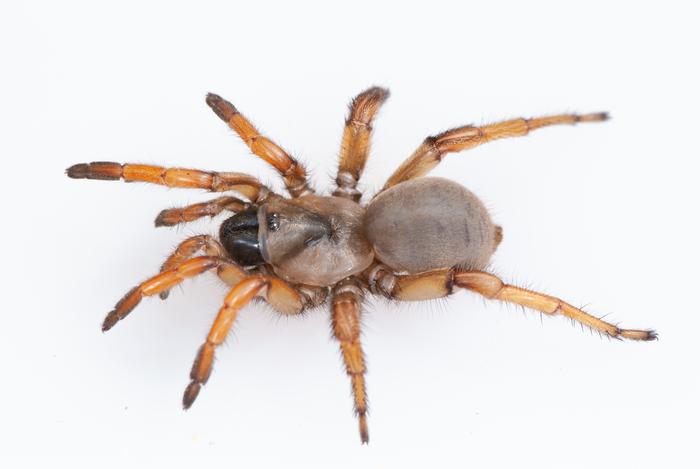
Trapdoor spiders often reach their largest size around Halloween after spending the summer feeding. However, researchers at the University of California, Davis, have discovered another remarkable characteristic of one species: its unusually large genome.
Named Aptostichus stephencolberti after comedian Stephen Colbert, the spider is approximately the size of a quarter. Its genome measures 4.6 gigabases, equivalent to 4.6 billion DNA base pairs. Although it is not the largest spider genome known, it represents an important addition to scientific understanding of spider genetics.
“At 4.6 gigabases, or 4.6 billion DNA base pairs, it’s not the largest genome among the spiders, but it’s significant,” said Jason Bond, a professor in UC Davis’s Department of Entomology and Nematology and the study’s corresponding author.
How the Trapdoor Spider Lives
The species inhabits burrows along Northern California’s coastal dunes, where beachgoers may unknowingly encounter it. Female spiders spend their entire lives underground in silk-lined burrows protected by hinged doors that blend into their surroundings.
They wait for vibrations to signal the approach of potential prey before emerging rapidly to capture it. Despite their intimidating appearance, their venom is not dangerous to humans. Bond noted that only around 30 to 50 of the more than 50,000 known spider species have venom established as toxic to people.
What Makes Its Genome Different?
The spider’s genome contains 52 chromosomes, compared with 23 in humans. However, its larger genome does not simply reflect a greater number of genes. Approximately 77% consists of repetitive DNA sequences that have been copied multiple times throughout its genetic material.
Researchers also identified a feature shared by spiders generally: the absence of telomere repeats, which normally help protect the ends of chromosomes. This loss could help explain why chromosomes have evolved more rapidly in spiders than in vertebrates.
“It lends itself to broadening our understanding of spider genome composition and consequently how genomes have evolved across the animal Tree of Life,” Bond said.
The spider’s name originated in 2008, when Colbert discovered that Bond had named a trapdoor spider after rock musician Neil Young. Wanting similar recognition, Colbert used a segment titled “Who’s Not Honoring Me Now?” on his former Comedy Central programme, The Colbert Report, to demand a spider of his own.
Bond subsequently named Aptostichus stephencolberti in his honour. The final “t” in Colbert’s name is silent when pronouncing the spider’s scientific name.
Coastal Habitat Faces Environmental Threats
The genome sequencing forms part of the California Conservation Genomics Project, a state-funded initiative designed to develop genetic datasets that support conservation efforts.
Because trapdoor spiders rarely travel far and their coastal habitats are fragmented, genomic information can help scientists identify distinct populations that may need protection.
“We Californians love our beaches and trapdoor spiders share them with us,” Bond said. “We’re hoping to understand how things like climate change, fire and urbanization might be impacting the genetic diversity of species.”
The species lives exclusively in coastal dunes across Central California, from the San Francisco Bay to Monterey. Rising sea levels threaten this restricted habitat, while invasive species pose another significant risk.
“They’re going to be incredibly sensitive to sea-level rise, but they’re also very sensitive to invasive species,” Bond said.
Beyond conservation, spider genomes may help researchers identify compounds in venom with potential medical and agricultural applications. Some venom-derived substances could be developed into painkillers, while others may offer new ways to control pests.
“We don’t really know what’s out there in terms of untapped natural product diversity for venoms,” Bond said.
Read More :