
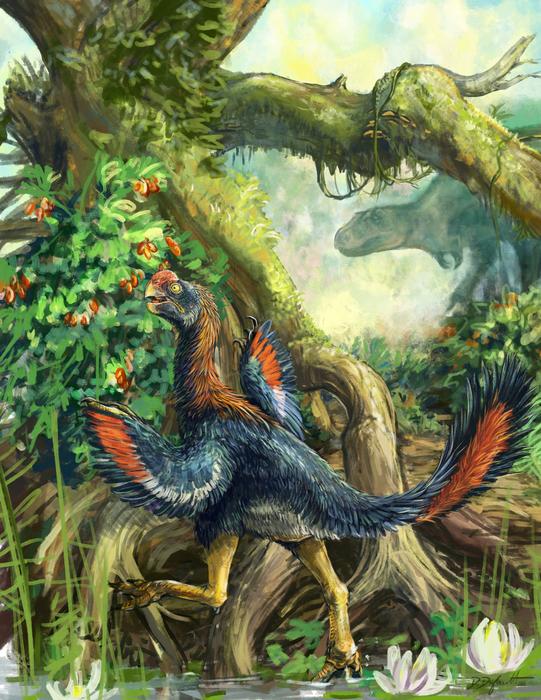
A newly identified dinosaur species may change scientists’ understanding of how dinosaurs interacted with flowering plants. Researchers from Stony Brook University, the Royal Ontario Museum (ROM), and the North Dakota Geological Survey have discovered Infernogallus jamesi, a small oviraptorosaur with specialised chewing muscles that indicate it may have eaten fruit.
Led by Dr. Gregory Funston, assistant professor in the Department of Anatomical Sciences at Stony Brook University, the research analysed the dinosaur’s chewing muscles and skull structure. The findings, published in Nature Communications, reveal an unusual arrangement resembling the anatomy of modern fruit-eating parrots.
The discovery challenges the traditional picture of Cretaceous dinosaurs as predominantly meat-eaters or plant-eaters with less specialised feeding habits.
“We knew dinosaurs evolved to fill so many different roles in ecosystems in the Cretaceous, but we never expected to discover fruit-eating dinosaurs,” says Dr. Gregory Funston. “For more than 100 years, we didn’t know what the skulls of these animals looked like. Now, we know they were even weirder than we could have predicted.”
A Small Dinosaur With Unusual Feeding Adaptations
The name Infernogallus, meaning “hell chicken,” refers to the Hell Creek Formation in the United States, where its fossils were discovered. The formation stretches across Montana, North Dakota, South Dakota, and Wyoming, and was home to dinosaurs such as Tyrannosaurus rex and Triceratops.
The fossil material includes a nearly complete, articulated skull and a partial skeleton, currently displayed at the Royal Ontario Museum.
Infernogallus belonged to the caenagnathids, a group of toothless, feathered dinosaurs that evolved from meat-eating ancestors. Approximately the size of a turkey, it weighed around 12 kilograms (25 pounds), making it one of the smallest members of its group even as a fully grown adult.
Its specialised chewing mechanics suggest that it could mash soft foods, particularly stone fruits, to separate the fleshy parts from the central seed.
“It’s pretty rare for animals to become specialized for a diet of fruit, so when it happens, it comes with some remarkable adaptations,” says Dr. Thomas Dudgeon, current Rebanks Postdoctoral Research Fellow at ROM and one of the co-authors of the research paper. “The anatomy of Infernogallus is bizarre among dinosaurs, and we quickly realized that we were dealing with something special.”
CT Scans Reveal How Infernogallus Chewed Fruit
To understand the dinosaur’s feeding abilities, researchers used CT scans to reconstruct its skull and examine its palatal bones, which form the roof of the mouth.
They found that these bones curved downwards into the mouth, changing the orientation of certain chewing muscles. Instead of facing vertically, these muscles were positioned from front to back, potentially allowing the beak to slide backwards and forwards during chewing.
This mechanism differs from the comparatively rigid, vertical biting action associated with T. rex and other dinosaurs. A similar forward-facing muscle arrangement occurs in mammals, including humans, which perform complex chewing movements, and in certain fruit-eating birds, such as the Vulturine Parrot (Psittrichas).
The researchers suggest that these adaptations helped Infernogallus process soft foods in its mouth rather than relying primarily on digestion to break them down.
Discovery Could Reveal Dinosaurs’ Role in Plant Evolution
The findings may also offer new insights into the relationship between dinosaurs and flowering plants. During the Cretaceous period, flowering plants increasingly replaced cone-bearing plants as the dominant vegetation on land. Fossil evidence from this period includes preserved fruits, reflecting the expansion of these plants.
Because Infernogallus appears to have consumed fruit, the discovery raises the possibility that some dinosaurs helped disperse plant seeds, an ecological role performed by birds, reptiles, and small mammals today.
The researchers also observed parallels between the evolutionary diversification of caenagnathids and the increasing size and availability of fruits. This suggests that changes in flowering plants may have influenced the development of specialised feeding adaptations in these dinosaurs.
“Complete remains of small dinosaurs like Infernogallus are very rare in the fossil record. The strange skull of Infernogallus is an exciting find because it reveals surprising insights into dinosaur evolution and feeding specialization,” says Dr. David Evans, Chief Curator, Natural History & Temerty Chair in Vertebrate Palaeontology at ROM and senior author of the paper. “This discovery shows that we still have a lot to learn about the world of T. rex, and about dinosaurs more generally.”
The discovery highlights how much remains unknown about dinosaur diversity and behaviour near the end of the Cretaceous. It may also contribute to ongoing scientific debates about whether dinosaur populations were already declining before the mass extinction that brought the era to an end.
Read More :