
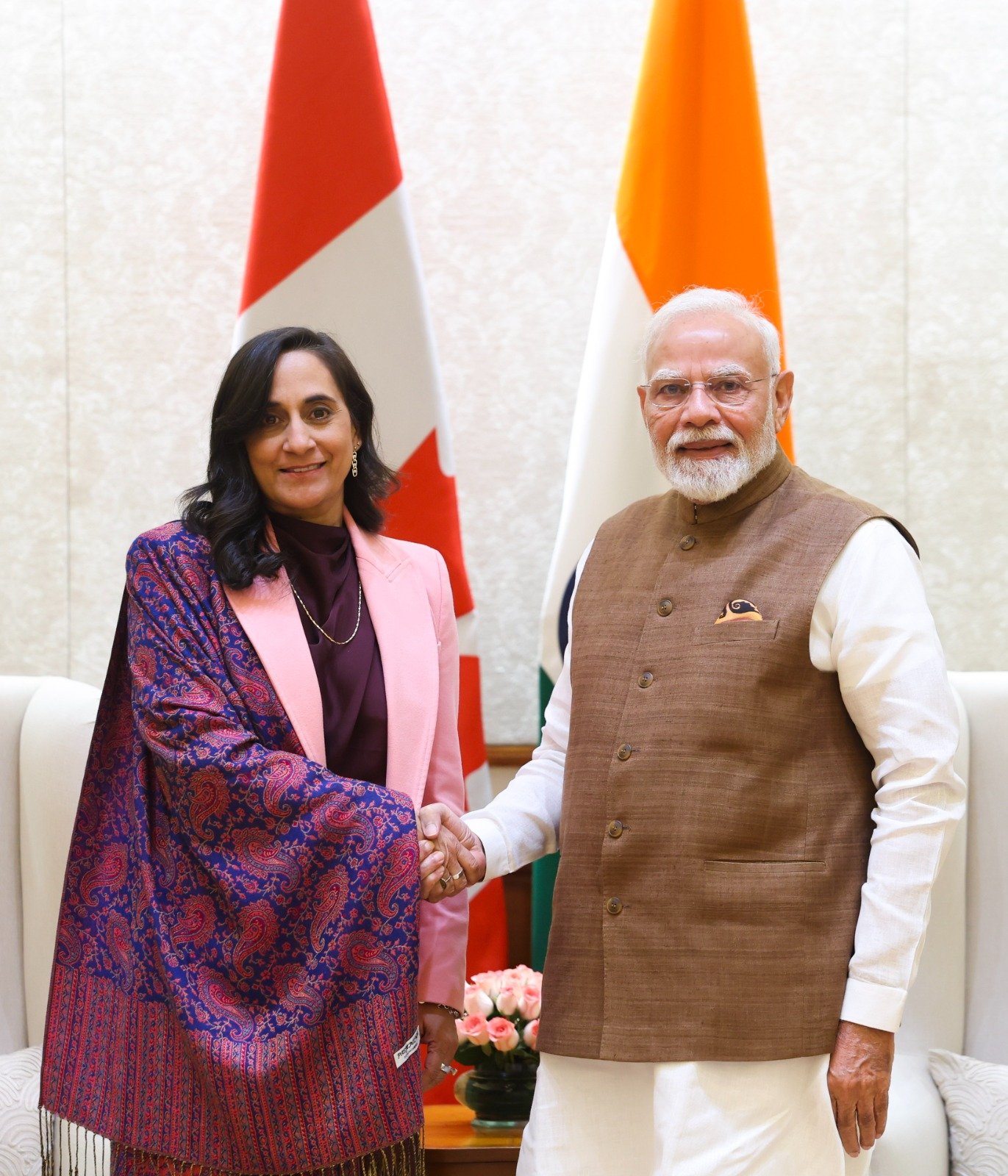
Prime Minister Narendra Modi met Canadian Foreign Minister Anita Anand in New Delhi on Wednesday as India and Canada stepped up efforts to rebuild bilateral ties, with an early trade agreement, security cooperation and energy partnerships emerging as key priorities.
The meeting comes a day after Modi held a telephone conversation with Canadian Prime Minister Mark Carney, signalling renewed high-level engagement between the two countries following a period of strained relations. Both governments are now pushing to translate diplomatic outreach into tangible economic and strategic outcomes.
Modi said the discussions covered trade, technology, security, energy, education and people-to-people exchanges, reiterating India’s commitment to a “constructive and forward-looking strategic partnership” with Canada.
“Pleased to meet Canadian Foreign Minister Anita Anand. We had a productive discussion on further strengthening India-Canada ties in trade, technology, security, energy, education and people-to-people exchanges,” Modi said in a post on X.
The Prime Minister’s Office said the two sides discussed expanding cooperation across trade, science and technology, defence, security, energy, education and multilateral engagement. Modi also stressed the need to sustain the momentum in bilateral relations and secure an early conclusion to negotiations on a Comprehensive Economic Partnership Agreement (CEPA).
India-Canada Trade Deal Targeted for Year-End
The proposed CEPA has emerged as a central pillar of the renewed diplomatic engagement, with both governments seeking to expand commercial ties amid shifting global trade conditions.
Canadian Prime Minister Mark Carney’s office said following his October 13 conversation with Modi that the leaders had reaffirmed their commitment to concluding negotiations at the earliest opportunity. The agreement is intended to support efforts to double bilateral trade by 2030.
Canada’s trade diversification strategy has added urgency to the negotiations. Ottawa is seeking to reduce its reliance on the United States amid President Donald Trump’s protectionist trade policies and expand commercial relationships with India, Europe and other markets.
Canadian Foreign Minister Anand has said the India agreement forms part of this broader strategy, with Canada aiming to conclude the pact by the end of 2026.
A Canadian trade delegation led by International Trade Minister Maninder Sidhu is also visiting India, highlighting the commercial focus of the renewed engagement. The two governments are looking to turn diplomatic progress into expanded trade, investment and business opportunities.
The potential economic stakes are substantial. According to Reuters, India-Canada bilateral trade in goods and services stood at $30.4 billion in 2025, while both countries are targeting $70 billion annually by 2030. The proposed agreement could help expand market access, although its final impact will depend on the terms negotiated and the sectors covered.
Energy cooperation is another area of growing importance. A uranium supply agreement worth C$2.6 billion, or about $1.8 billion, between Canadian company Cameco and India was signed earlier this year, providing a concrete example of cooperation between the two countries.
The discussions also cover technology, education and people-to-people exchanges, areas that could create opportunities for businesses, students and professionals on both sides.
Security Cooperation Remains Crucial to Diplomatic Reset
Despite the renewed emphasis on trade, security remains a sensitive component of India-Canada relations following the diplomatic dispute over the 2023 killing of Sikh separatist Hardeep Singh Nijjar in Canada.
The fallout from the killing placed significant strain on bilateral ties, making progress on law enforcement cooperation and national security a critical test of the diplomatic reset.
Anand met External Affairs Minister S Jaishankar on Wednesday, with both sides discussing the renewed strategic partnership, trade, investment, education, energy, defence and people-to-people exchanges.
Canada’s foreign ministry said the ministers reviewed progress under the joint roadmap launched during Anand’s first visit to India a year earlier. They also welcomed a recent bilateral security dialogue at the national security adviser level, during which officials reviewed security and law enforcement cooperation and committed to sustained engagement.
The Canadian government said the two countries also discussed regional and international developments, including the conflict in the Middle East and the war in Ukraine.
Anand has emphasised that closer engagement with India could contribute to shared economic interests and a more prosperous Indo-Pacific. For New Delhi, progress on security cooperation will be important to ensuring that the diplomatic reset extends beyond trade and commercial priorities.
The two governments have not indicated that all outstanding differences have been resolved. The renewed engagement instead points to an effort to manage sensitive issues while expanding areas of common interest.
Modi’s Expected Canada Visit Could Give Talks Fresh Momentum
The diplomatic outreach is expected to continue in the coming weeks, with Modi scheduled to visit Canada in December, according to Carney’s office.
The planned visit could provide an opportunity for the two prime ministers to review progress on the trade agreement and assess whether recent ministerial engagements have produced concrete results.
For Canada, a stronger economic relationship with India would support its efforts to diversify exports and reduce dependence on the US market. For India, closer engagement with Canada could widen opportunities in energy, technology, education, investment and trade.
The proposed CEPA will be a key measure of progress. An agreement could improve access to each other’s markets, but difficult negotiations over tariffs, market access and sector-specific interests may still determine the final outcome.
For Indian businesses, the immediate question is whether the renewed diplomatic engagement translates into predictable commercial rules and greater opportunities to export goods and services to Canada. For the Indian diaspora, developments in education, mobility and people-to-people exchanges will also be closely watched.
Modi conveyed his greetings to Carney during the meeting with Anand and said he looked forward to continuing their engagements.
The latest meetings mark a renewed push by both governments to broaden their relationship after years of tension. Whether that momentum produces a lasting reset will depend on progress in trade negotiations, sustained security cooperation and the ability of both sides to address unresolved concerns while advancing shared interests.
————————————————————————————————————————-
 Sridhar P