
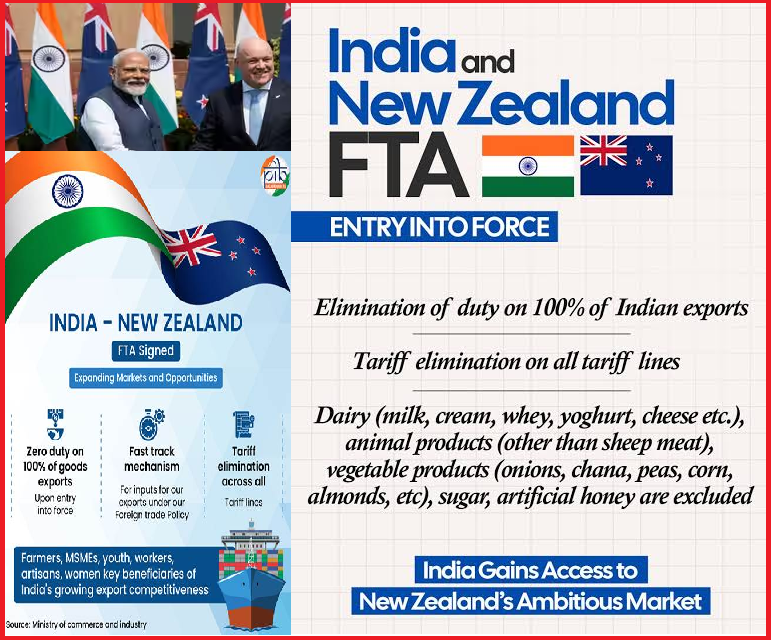
India’s free trade agreement with New Zealand, which came into force on October 20, 2026, introduces new protections for Indian students seeking overseas education, including a commitment against numerical limits on student admissions, a minimum of 20 hours of work a week during study and expanded post-study employment opportunities.
The agreement establishes a dedicated student mobility and post-study work framework between the two countries. While it does not guarantee admission to a university or automatic approval of a visa, it commits both governments to providing pathways for eligible students who meet institutional and immigration requirements.
New Zealand’s Immigration Minister’s department confirmed on October 20 that the agreement had taken effect, bringing its visa commitments into force. The provisions are particularly relevant to Indian students considering New Zealand for higher education, as they address both the ability to work while studying and the opportunity to gain professional experience after graduation.
No Numerical Caps on Indian Students, Minimum 20-Hour Work Commitment
Under the agreement, neither country can impose numerical limits on students from the other country seeking admission to recognised educational institutions, provided they satisfy the applicable eligibility conditions. Students are also entitled to multiple-entry visas valid for the duration of their studies, subject to immigration requirements.
The FTA commits both countries to allowing eligible students to work for at least 20 hours a week while studying, in line with their respective national policies on student visa work rights.
New Zealand currently permits eligible international students, including Indians, to work up to 25 hours a week during study. Immigration New Zealand has clarified that the FTA’s 20-hour provision is a minimum commitment intended to protect Indian students if the country’s policy settings change in the future. It does not reduce the existing 25-hour allowance.
The distinction matters because the agreement establishes a guaranteed minimum rather than a fixed ceiling on student employment. Students must continue to comply with the conditions attached to their visas.
The framework also does not remove academic admission requirements, tuition fees, financial requirements or other immigration checks. Applicants must secure admission to a recognised institution and meet the relevant eligibility criteria.
The Indian government described the student provisions as a first in New Zealand’s trade agreements. In its April 27 announcement following the signing of the pact, the Press Information Bureau said the agreement would create a dedicated pathway for student mobility and post-study work visas.
Commerce and Industry Minister Piyush Goyal said the agreement placed student mobility, skills, investment and services at the centre of a broader economic partnership.
Post-Study Work Rights Extend Up to Four Years
The FTA sets out post-study employment opportunities for Indian students completing recognised qualifications in New Zealand. Under the agreement, eligible graduates can obtain temporary work opportunities for up to two years after completing a bachelor’s degree, up to three years after a master’s degree and up to four years after a doctoral degree.
An additional provision extends the potential post-study stay for Indian students who graduate with first-class honours in STEM subjects, including information and communications technology, from two years to three years.
These provisions are intended to help graduates gain international work experience and apply their qualifications in professional settings. They may be particularly relevant to students pursuing careers in science, technology, engineering, mathematics and research.
However, the maximum periods are not automatic entitlements for every graduate. Applicants must complete the qualifying programme and satisfy the applicable immigration conditions.
Immigration New Zealand confirmed on October 20 that expanded post-study work rights for Indian graduates with New Zealand PhDs would take effect from November 16, 2026. Eligible Indian doctoral graduates will then be able to obtain post-study work visas of up to four years, compared with the previous maximum of three years.
The later implementation date is important for students planning their graduation and employment timelines. The FTA’s entry into force on October 20 does not mean that every associated immigration change becomes available on the same day.
The agreement also provides for a working-holiday scheme for Indian citizens aged 18 to 30. The programme will be introduced within two years of the FTA taking effect, with up to 1,000 multiple-entry visas available annually for stays of up to 12 months. This is a separate youth-mobility route and should not be confused with student or post-study work visas.
For Indian students, the agreement offers greater certainty over work rights and post-study opportunities, but the practical benefits will depend on eligibility, the qualifications pursued and the ability to secure suitable employment. The pact creates a more structured pathway from education to work experience without guaranteeing jobs, permanent residence or automatic visa approval.
FAQs
1. What benefits does the India-New Zealand FTA offer Indian students?
The agreement provides for student mobility without numerical caps, a minimum commitment of 20 hours of work per week during study and post-study employment pathways for eligible graduates.
2. Can Indian students work while studying in New Zealand?
Yes. Eligible Indian students can work subject to their visa conditions. New Zealand currently allows eligible international students to work up to 25 hours a week during study. The FTA establishes a minimum commitment of 20 hours a week.
3. How long can Indian students stay in New Zealand after graduation?
Eligible Indian graduates can access post-study work opportunities of up to two years after a bachelor’s degree, three years after a master’s degree and four years after a doctoral degree, subject to the applicable qualification and immigration requirements.
4. Will Indian PhD graduates get four-year post-study work visas?
Eligible Indian doctoral graduates will be able to access post-study work visas of up to four years from November 16, 2026, according to Immigration New Zealand. The benefit is subject to the applicable eligibility conditions.
5. Does the FTA guarantee admission to New Zealand universities?
No. The agreement’s student mobility provisions do not guarantee admission. Students must meet university entry requirements, secure admission to an eligible institution and satisfy the relevant visa conditions.
6. How many Indian students can obtain working-holiday visas under the agreement?
The agreement provides for up to 1,000 working-holiday visas annually for eligible Indian citizens aged 18 to 30. The scheme is scheduled to be introduced within two years of the FTA taking effect, with stays of up to 12 months.
7. Does the India-New Zealand FTA guarantee jobs or permanent residency?
No. The agreement creates pathways for student mobility and post-study employment but does not guarantee a job, permanent residency or automatic visa approval.
8. When did the India-New Zealand FTA come into force?
The agreement came into force on October 20, 2026. Some associated immigration changes have separate implementation dates, including the expanded post-study work provision for eligible Indian doctoral graduates from November 16, 2026.
 Shelton Rozario