
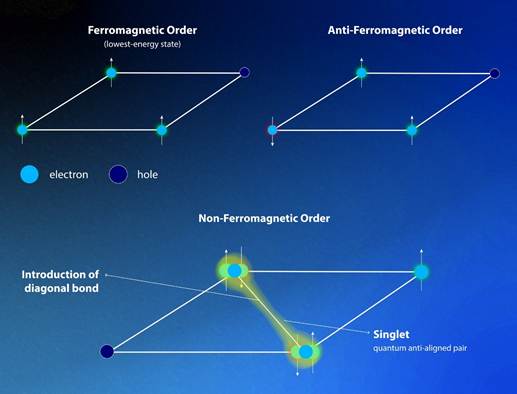
Scientists at the Raman Research Institute (RRI) have discovered a way to manipulate an exotic form of quantum magnetism by altering the connectivity of a network. The theoretical finding could have applications in quantum devices, including systems designed to store quantum information.
The research explores how the arrangement and connections between interacting quantum particles influence their collective behaviour, offering a new approach to engineering magnetic order through changes in network geometry.
Understanding Quantum Magnetism Through Network Connectivity
Many systems consist of interacting objects whose collective behaviour depends on how they are connected. Examples include flight-route networks, where hubs connect multiple cities, and social networks, where highly connected individuals can influence the spread of information or diseases.
However, these familiar examples are classical systems. Researchers at RRI, an autonomous institute under the Department of Science and Technology (DST), investigated how connectivity influences the collective behaviour of quantum objects.
Revathy B. S., the lead author of the study and a postdoctoral fellow at RRI, and Shovan Dutta, co-author and assistant professor in RRI’s Theoretical Physics group, examined a square lattice containing one vacant site, or hole, with all other sites occupied by electrons.
Electrons possess an intrinsic property called spin, which can point either upwards or downwards. The movement of the hole from one site to another can influence how the electron spins arrange themselves, producing a phenomenon known as kinetic magnetism.
Unlike conventional magnetism, which arises from direct interactions between spins, kinetic magnetism emerges from the quantum motion of particles and has no classical counterpart.
Changing Magnetic Order Through a Diagonal Bond
When all spins point in the same direction, the system exhibits ferromagnetic order. When neighbouring spins point in opposite directions, the arrangement is known as antiferromagnetic order.
Previous research had established that a square lattice containing one hole has a ferromagnetic ground state, meaning its lowest-energy configuration has all spins aligned.
The new study demonstrates that this magnetic ordering can be altered by changing the network’s connectivity. Introducing a diagonal bond into the square lattice causes the two electrons involved to align antiparallel, forming a quantum-mechanical pair known as a singlet. The remaining sites retain their ferromagnetic ordering, while the hole continues to move across the network.
“What’s amazing is that I can almost deterministically predict that wherever I [introduce a diagonal bond], I will get [singlets],” said Revathy.
By modifying connectivity locally, the researchers were able to engineer the global magnetic order of the system. Their findings demonstrate that collective quantum order can be shaped through geometry alone.

Advanced Computational Methods Help Solve a Complex Problem
The computational complexity of analysing such systems had prevented physicists from exploring the problem in detail for decades. A lattice containing just 20 sites can produce approximately two million possible configurations.
Revathy and Dutta combined advanced numerical and analytical methods to identify the microscopic patterns and understand the physical mechanisms behind them.
“This is far from obvious, because if you had a classical system, similar changes in geometry do not really affect the magnetic order,” said Dutta.
The research, published in Physical Review B, comes at a time when experimental advances are increasingly making it possible to investigate complex quantum phenomena and potentially observe theoretical predictions in real-world systems.
Potential Applications in Quantum Information Storage
Although the study is theoretical, it offers new avenues for controlling quantum states of interacting particles, with possible applications in quantum devices.
Conventional hard drives use magnetic patterns to store information in the form of classical bits. The singlet states generated in these quantum networks, however, are entangled quantum states and could potentially be used to store quantum information.
The ability to engineer magnetic ordering through changes in network connectivity could therefore contribute to future approaches to quantum information storage and the development of quantum technologies.
Read More :