
Typhoon Champi is moving towards Japan’s southwestern islands on Friday after battering Taiwan with powerful winds and torrential rain, disrupting hundreds of flights and prompting evacuations. Japan’s weather agency warned of gusts reaching 198 kph, waves as high as 12 metres and the risk of prolonged downpours around Okinawa.
Taiwan reported one death and more than 170 injuries as Champi passed near its northeastern coast, according to the Associated Press. Authorities cancelled all 262 domestic flights and 669 international flights, closed schools and offices, and evacuated more than 2,600 people from vulnerable mountainous areas.
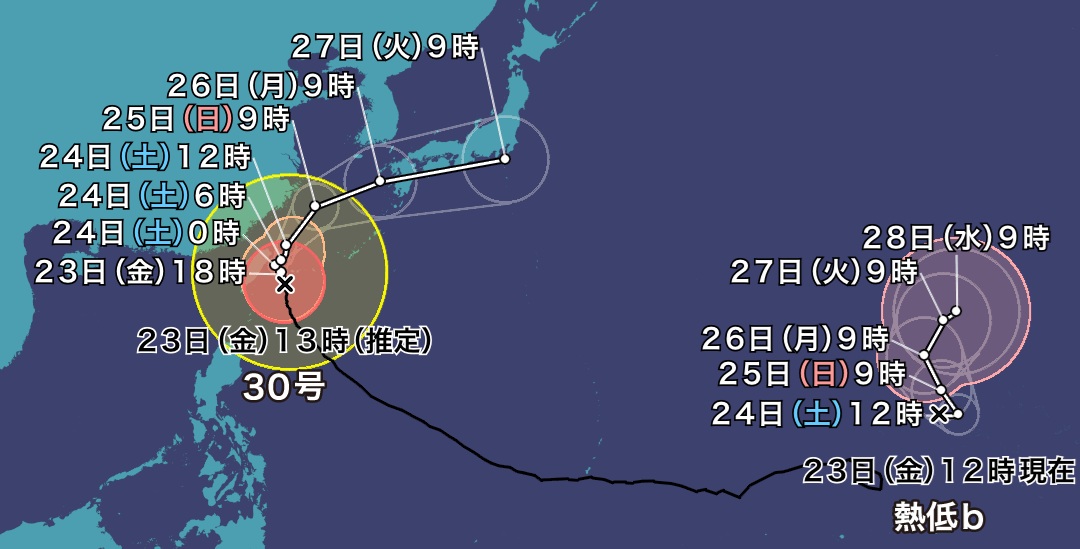
The Japan Meteorological Agency (JMA) said Champi, the 30th typhoon of the year, was moving north-west off the southern islands. It forecast that the storm would pass near the Sakishima island chain, southwest of Okinawa, through Saturday before turning towards the East China Sea and later approaching Kyushu.
Japan braces for violent winds, flooding and 12-metre waves
The JMA forecast maximum wind gusts of 198 kph in Okinawa on Friday and 180 kph on Saturday. Waves could reach 12 metres on both days, while rainfall could total 250 mm in the 24 hours through Saturday, followed by up to 120 mm over the next 24 hours. The agency warned that rainfall could be higher if a persistent rainband forms.
The principal threats include landslides, flooding in low-lying areas, rivers rising or overflowing, and coastal flooding caused by storm surges coinciding with high tides. Forecasts indicated that Champi would pass closest to the Sakishima Islands by October 24 before moving into the East China Sea and turning towards Kyushu around October 26. It is forecast to weaken gradually, potentially becoming an extratropical low south of Honshu by October 27.
The storm’s projected path remains subject to change. Its weakening would not necessarily eliminate the risks from heavy rain, high waves and strong winds across affected areas.
Flights cancelled and power outages reported
The typhoon has already affected southwestern Japan. One person was injured, flights were grounded and nearly 2,000 homes on Ishigaki Island lost electricity, the Associated Press reported. Dozens of flights serving islands including Miyako, Ishigaki and Okinawa were cancelled.
Japan Airlines had warned of possible operational disruptions at Naha, Miyako, Ishigaki and Yonaguni airports. Travellers were advised to check flight status as the storm approached the islands.
The disruption follows a major shutdown in Taiwan, where transport services, schools and offices were affected as Champi passed nearby. The scale of the storm’s circulation meant that dangerous weather extended well beyond its centre.
Taiwan forecasters warn the storm could prolong dangerous conditions
Taiwan’s Central Weather Administration warned that Champi’s large wind field could keep strong winds affecting the island for an extended period.
Forecaster Liu Pei-teng told Reuters: “If the storm slows down, the strong winds will affect Taiwan for longer.” Liu also said a direct landfall could not be ruled out if the storm “stalls, loops, or wobbles from side to side” as it approaches Taiwan.
In the northeastern Taiwanese county of Yilan, authorities prepared for flooding and possible evacuations. Lee Ming-chen, head of the port town of Suao, told Reuters: “When necessary, the military will come in to help people, including using amphibious vehicles for evacuations or disaster relief.”
Taiwan reported one death after a person was swept away by waves on Thursday, with more than 170 others injured, according to the AP report published Friday. More than 2,600 people had been evacuated from vulnerable mountainous areas.
The storm had earlier reached peak sustained winds of 298 kph before weakening as it approached Taiwan. Its centre was forecast to remain offshore as it passed the island’s northeastern tip and moved towards Japan.
For Japan, the immediate focus is the passage near Okinawa’s remote islands, where violent gusts, high seas and concentrated rainfall pose the greatest risks. Authorities and travellers will be watching for changes in Champi’s track as it moves north and potentially brings further disruption to western Japan.