
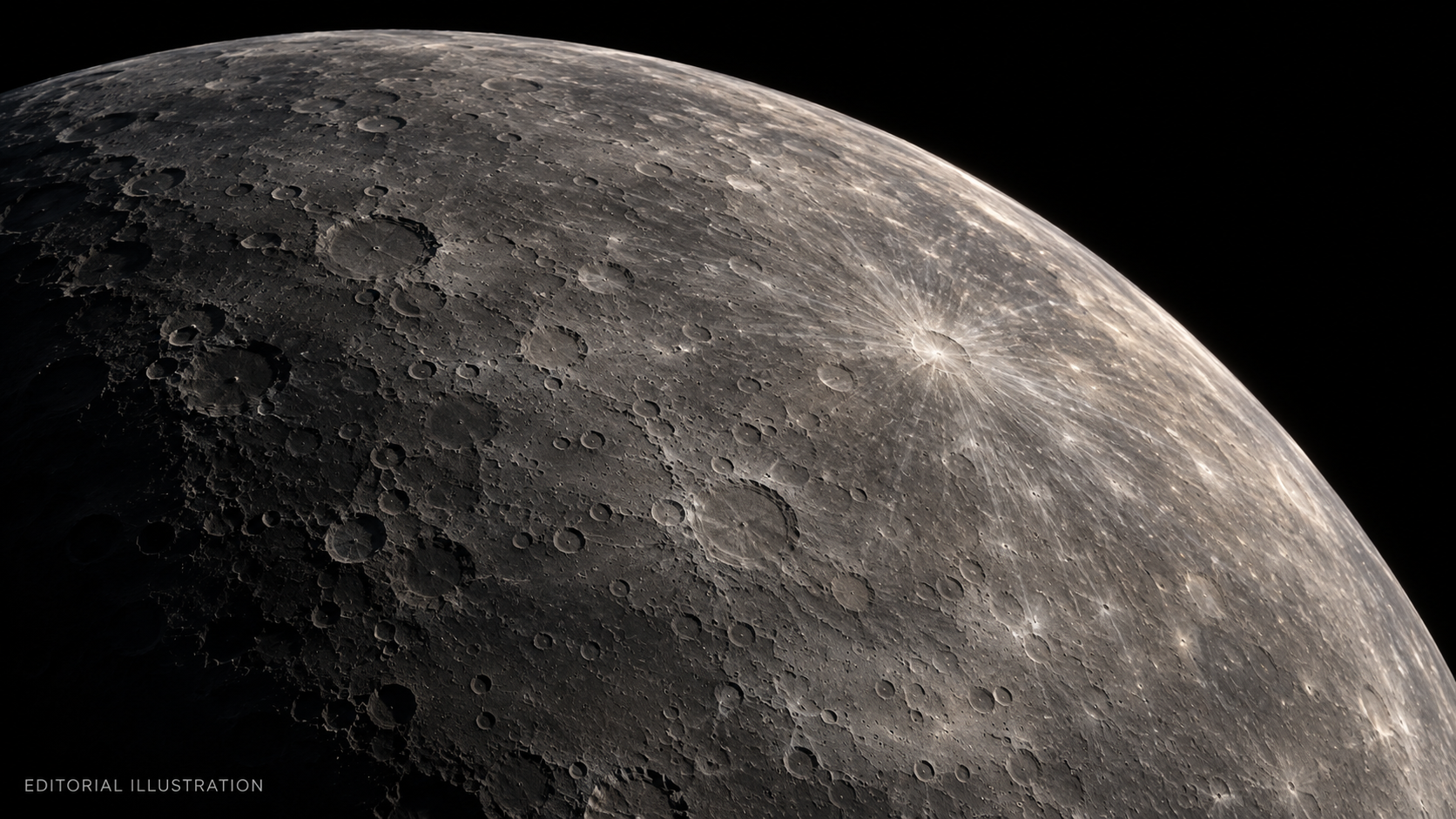
The European Space Agency says its BepiColombo spacecraft is safely orbiting Mercury after a software glitch cut short the engine firing that brought it into orbit. The European and Japanese mission remains on track to separate its two science orbiters on 9 December in Germany, or 10 December in Japan, ESA said in its 23 November update.
The spacecraft entered orbit on 21 November after eight years in transit. When contact resumed after a scheduled radio blackout, controllers in Darmstadt, Germany, found it had entered safe mode. ESA said the spacecraft had nevertheless slowed enough to stay in orbit around Mercury, the smallest planet in the Solar System and the closest to the Sun.
Mission controllers investigated the shortened burn with spacecraft manufacturer Airbus and the Japan Aerospace Exploration Agency, known as JAXA. ESA traced the interruption to software. Its update confirmed a stable orbit and kept the separation date in place. The separation itself is still ahead, as is the work of placing both orbiters in the paths they need for their measurements.
What happened during arrival
To enter Mercury orbit, BepiColombo had to shed enough speed for the planet’s gravity to capture it. Getting close to the planet is only part of the task. A spacecraft that arrives too fast can pass by, so the engine firing was timed to change its speed during the approach. Although the burn ended before controllers intended, the mission cleared that first hurdle.
The engine firing came after a separate milestone on 3 September, when BepiColombo discarded the transfer module that had helped carry it through the inner Solar System. The instruments that will study Mercury arrived together. They now have to part company so that each can operate in its own orbit. In a different setting, IITimes has covered how India’s NVS-03 navigation satellite used further manoeuvres after its initial orbital insertion.
- 3 September · Transfer module separates.
- 21 November · Spacecraft enters Mercury orbit.
- 9–10 December · Separation of the two science orbiters is planned.
Two spacecraft will study one planet
ESA’s Mercury Planetary Orbiter will study the planet itself, including its surface and interior. JAXA’s Mercury Magnetospheric Orbiter, called Mio, will investigate the magnetic environment around the planet and how it responds to the solar wind, the stream of charged particles from the Sun. Mercury’s proximity to the Sun makes those interactions especially interesting to researchers.
ESA describes BepiColombo as the first mission designed to operate two spacecraft around Mercury at the same time. With instruments in different orbits, researchers can compare conditions at two locations and use those readings to work out whether a change was local or affected a larger region. Measurements of the surrounding magnetic environment can also help researchers interpret observations of the planet itself.
The two agencies still have to show that each orbiter can separate and operate independently. The next visible milestone will be confirmation that both spacecraft have pulled apart and can communicate with Earth. ESA’s assessment means the shorter burn has left that milestone within reach. It does not yet establish how the commissioning of either spacecraft will proceed once the pair has separated.
 Shelton Rozario
 Sridhar P