
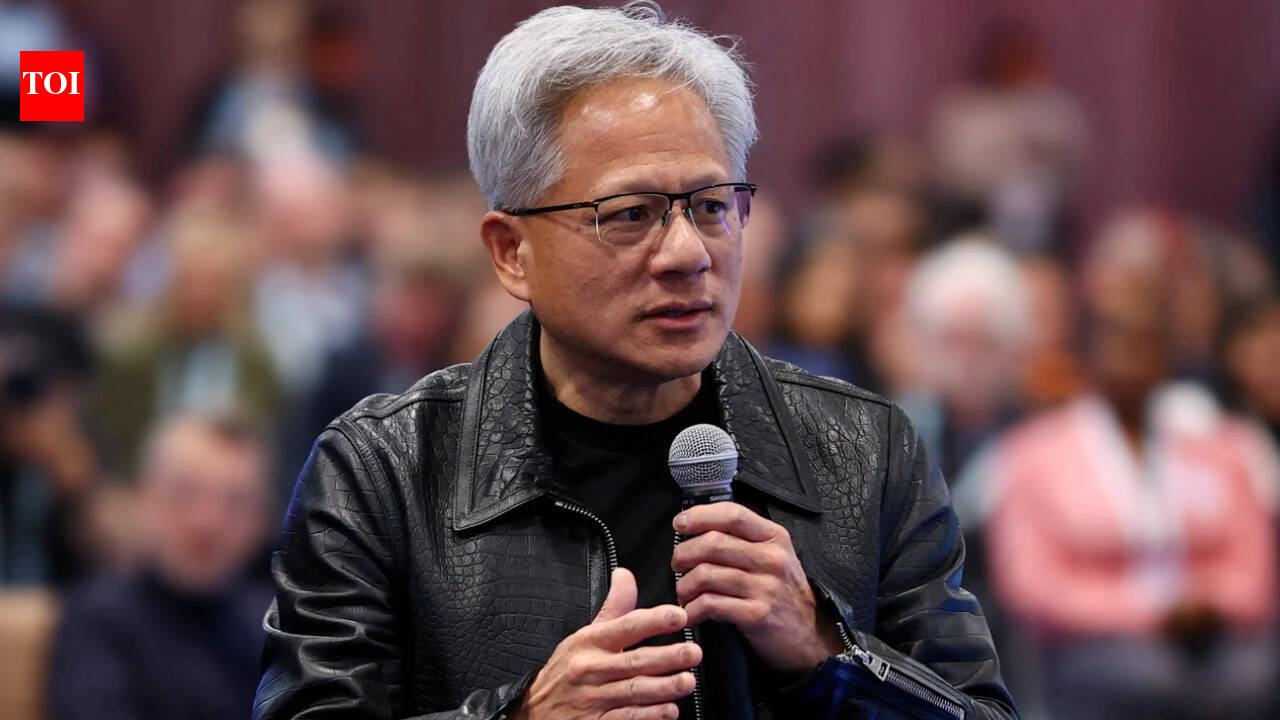
The spotlight has turned to three Indian-origin technology leaders as speculation intensifies over who could take charge of Nvidia, the semiconductor giant that has become a driving force behind the global artificial intelligence revolution.
Sanjay Mehrotra of Micron Technology, Nikesh Arora of Palo Alto Networks and Thomas Kurian of Google Cloud have reportedly emerged as possible contenders for Nvidia’s top job amid claims of a sudden leadership shake-up involving longtime CEO and co-founder Jensen Huang.
The reported developments have sparked discussions across the technology industry about Nvidia’s future leadership and whether the company should turn to an established semiconductor veteran, an experienced global technology executive or someone from within its own ranks.
According to the circulating reports, Nvidia has appointed chief financial officer Colette Kress as interim CEO, while longtime director Harvey Jones has been named chairman of the board. However, these leadership changes and the circumstances surrounding Huang’s reported departure remain unverified.
Why the Three Indian-Origin Executives Are Drawing Attention
The three executives represent different areas of the technology industry, bringing experience in semiconductor manufacturing, cybersecurity, cloud computing and artificial intelligence.
Their potential candidacies also highlight the growing influence of Indian-origin leaders in some of the world’s largest technology companies.
Sanjay Mehrotra: The Semiconductor Industry Veteran
Among the names being discussed, Micron Technology CEO Sanjay Mehrotra brings particularly relevant semiconductor industry experience.
Mehrotra has spent decades in the memory and storage technology business, overseeing operations in an industry closely connected to Nvidia’s AI hardware ecosystem.
Under his leadership, Micron has benefited from growing demand for high-performance memory chips used in AI servers and data centres.
His experience in chip manufacturing, semiconductor supply chains and advanced memory technologies could make him a compelling candidate for a company whose future depends heavily on AI infrastructure.
Nikesh Arora: The Global Technology Strategist
Nikesh Arora, CEO of Palo Alto Networks, brings a different leadership profile.
Since taking charge of the cybersecurity company in 2018, Arora has overseen its expansion into cloud security, enterprise cybersecurity and AI-powered protection systems.
Before Palo Alto Networks, he held senior leadership positions at Google and served as president and chief operating officer of SoftBank Group.
His background in global business operations, corporate strategy and technology investments could offer Nvidia a broader enterprise-focused perspective as the company expands beyond its traditional hardware business.
Thomas Kurian: The Cloud and AI Infrastructure Leader
Google Cloud CEO Thomas Kurian is another prominent Indian-origin executive whose name has reportedly surfaced in succession discussions.
Kurian has played a central role in expanding Google Cloud’s enterprise business and strengthening its position in artificial intelligence and cloud infrastructure.
His experience managing large-scale computing platforms, enterprise relationships and AI services could be particularly relevant to Nvidia’s next phase of growth.
As technology companies invest heavily in AI infrastructure, leadership experience across cloud computing and advanced AI systems has become increasingly valuable.
Nvidia’s Biggest Challenge: Finding a Leader Who Can Match Huang’s Legacy
Replacing Jensen Huang would be no ordinary corporate succession.
Since co-founding Nvidia in 1993, Huang has been instrumental in transforming the company from a graphics chip manufacturer into a leading supplier of processors powering artificial intelligence systems worldwide.
Nvidia’s graphics processing units and CUDA software ecosystem have become foundational technologies for AI development, data centres and high-performance computing.
That transformation has made Huang closely associated with Nvidia’s technological strategy, corporate culture and long-term vision.
Any eventual successor would face the challenge of maintaining Nvidia’s competitive advantage while navigating rising competition, geopolitical tensions, semiconductor supply constraints and rapidly changing AI technology.
According to reports attributed to Bloomberg, Nvidia has engaged an external executive search firm to identify potential leadership candidates, although this claim has not been independently confirmed.
Internal Candidates Could Have an Advantage
While external executives have attracted attention, Nvidia’s existing leadership team could also play a significant role in any succession process.
Chief financial officer Colette Kress is among the executives mentioned in the reports. Her extensive knowledge of Nvidia’s financial operations, business strategy and investor relationships could make her a potential internal contender.
Another name is Ian Buck, Nvidia’s vice-president and a key figure in the development of CUDA, the software platform that helped turn Nvidia GPUs into essential tools for artificial intelligence computing.
Other external executives reportedly mentioned include Arm CEO Rene Haas and Apple’s hardware chief Johny Srouji.
However, there has been no independently verified confirmation that these individuals have been formally approached or shortlisted for the position.
What Sparked the Reports About Jensen Huang?
The succession speculation stems from reports alleging that Jensen Huang stepped down following scrutiny over his personal relationships.
The circulating account includes allegations of extramarital affairs and claims involving a businesswoman suspected of connections to Chinese intelligence.
It further alleges that Huang apologised to his family and employees, while Nvidia maintained that there was no evidence of compromised company information or national security.
These are serious and potentially damaging allegations. Their authenticity, along with the reported resignation itself, has not been independently established and should not be treated as confirmed developments without authoritative evidence.
What a Leadership Change Could Mean for Nvidia
The larger question extends beyond who might occupy Nvidia’s corner office.
As artificial intelligence reshapes the global technology industry, Nvidia’s next generation of leadership will play a crucial role in determining how the company responds to competition and sustains its technological advantage.
A semiconductor specialist such as Mehrotra could bring deep hardware expertise, while Arora could offer experience in enterprise technology strategy. Kurian, meanwhile, could provide insight into the cloud infrastructure and AI services markets that drive much of Nvidia’s demand.
An internal appointment could offer greater continuity with Nvidia’s established engineering culture and long-term strategy.
For now, the reported succession discussions remain speculative. Nevertheless, the attention surrounding these three Indian-origin executives reflects their prominence in the global technology industry.
 Arun Kumar N